Quick Take
- Narration: Francis Pryor reading his own work is the only arrangement that could work here; his voice carries 40 years of genuine attachment to this landscape.
- Themes: Landscape archaeology, the human reshaping of wetland environments, regional identity and memory
- Mood: Unhurried and deeply grounded, like walking a fen path in low winter light
- Verdict: Patient listeners who enjoy expert-guided landscape history will find this richly rewarding; those wanting a faster narrative pace should look elsewhere.
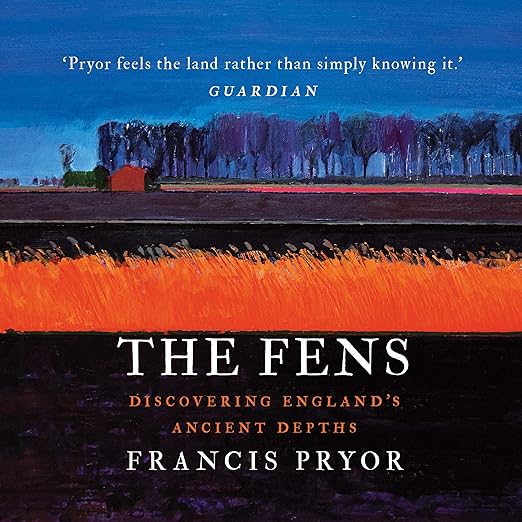
I came to The Fens knowing almost nothing about the landscape it describes. I had been to Cambridge twice and driven past flat horizons that struck me as bleak in the way that unfamiliar geographies often do before you understand them. Francis Pryor’s book is essentially a long argument that I was wrong to see bleakness where I should have seen complexity, and by the end of thirteen and a half hours in his company, I was at least partly convinced. That shift in perception is exactly what good regional history should accomplish.
Pryor has spent more than forty years living in, excavating, farming, and thinking about the Fenland landscape of eastern England. The Fens is the result of that accumulation: a book that moves between the geological formation of the landscape, the Bronze Age farmers who grazed cattle on the fen edges, the medieval drainage engineers who created the Old and New Bedford Rivers, and Pryor’s own parallel story of discovering this world as a young archaeologist in the 1960s. The structure is counterpoint rather than chronology, and it rewards listeners who are comfortable following a mind that ranges freely across time.
Archaeology as a Way of Seeing
What Pryor does particularly well is demonstrate how archaeological understanding changes the emotional register of a landscape. When he describes the Bronze Age farming systems uncovered by excavations ahead of building projects, he is not presenting dry data. He is arguing that the Fens have been intensively managed by human hands for four thousand years, and that the contemporary drainage ditches and field boundaries are only the most recent layer of a continuous project of habitation and adaptation. This is archaeology as a form of attention, a way of training yourself to see what is actually there rather than what the horizon suggests at first glance.
The medieval drainage sections are particularly strong. Pryor traces the great engineering projects of the seventeenth century, the work of Vermuyden and the Bedford Level Corporation, with a combination of technical precision and genuine outrage at what was lost. The fen edge communities that had survived for centuries on a complex economy of fishing, wildfowling, peat cutting, and seasonal grazing were effectively dispossessed by drainage schemes that prioritized agricultural productivity. Pryor does not lecture, but his sympathies are clear, and they deepen the historical texture of what might otherwise read as engineering history.
The Self-Narrated Problem and Why It Works Anyway
One reviewer complained that Pryor is verbose and that his personal anecdotes occasionally crowd out the historical material. This is a fair observation. There are stretches, particularly in the middle sections of the book, where Pryor’s tendency to drift into long descriptive passages about his own farm or his walking routes through the landscape tests patience. The book was clearly written by someone who trusts the reader to stay with him, and that trust is not always earned in the moment.
But the self-narration is the right choice regardless. Pryor’s voice carries something a professional narrator could not manufacture: the specific quality of someone who is deeply attached to a place and knows it is difficult to explain that attachment to outsiders. His delivery is not polished in the way that audiobook production usually prizes, but it is honest and warm, and the occasional roughness actually serves the material. When he describes the sensation of returning to the Fens after time away and feeling the horizon open up again, the relief in his voice is not performance.
Who Should Listen and Who Should Wait
If you have any personal connection to the Fens, either through residence, family, or prior reading, this book will feel like an extraordinary deepening of that knowledge. It belongs alongside Patrick Wright’s The River: The Thames in Our Time and Robert Macfarlane’s The Wild Places as an example of British landscape writing at its most serious and committed. Listeners who approach it as a history podcast will find it somewhat slow; listeners who approach it as a long walk with a knowledgeable companion will find the pace exactly right.
The runtime of nearly fourteen hours is substantial, but Pryor earns it. He does not repeat himself, and the historical material accumulates in ways that pay off in the later chapters. By the time he reaches the contemporary Fens and the ongoing tensions between conservation and agricultural intensification, the full weight of the landscape’s history is present in the argument, and the stakes feel real.
The chapters dealing with the contemporary Fens, and the ongoing pressure between agricultural intensification and conservation, are where Pryor’s argument accumulates its fullest weight. He has watched the Fenland landscape change across four decades of active farming and excavation, and the losses he describes, of particular bird populations, of traditional drainage patterns, of the scrub and peat habitats that sustained the fen edge communities for centuries, are losses he can name specifically rather than abstractly. This is where the combination of archaeologist and farmer becomes most useful: Pryor can read the landscape as both document and as working environment, and the dual perspective produces observations that neither a pure ecologist nor a pure historian would generate.
A Free Audiobook for the Long-Distance Listener
This free audiobook is one of those productions that will find exactly the right audience for exactly the right reasons. If you are already curious about British landscape history, wetland archaeology, or the specifically English question of what it means to belong to a place that most people drive past without stopping, The Fens delivers something rare: a genuine expert, genuinely in love with their subject, explaining it in detail and at length. That is a combination worth thirteen and a half hours of anyone’s commute.
Frequently Asked Questions
Do I need prior knowledge of British history or archaeology to enjoy The Fens?
No, though some familiarity with English geography helps. Pryor provides enough context for international listeners to follow the historical argument, and the landscape writing works independently of the technical archaeology.
Is Francis Pryor a skilled narrator of his own book?
He is not a polished narrator in the audiobook sense, but his self-narration carries genuine emotional authority. His voice reflects forty years of attachment to this landscape, which no professional narrator could fully replicate.
How does The Fens balance personal memoir with historical content?
The balance tips toward personal memoir more than some listeners expect. Pryor interweaves his own archaeological career and life on his Fen farm throughout. Readers who wanted a more strictly historical account may find this proportion frustrating.
How does this compare to other British landscape writing like Robert Macfarlane?
Pryor is more technically archaeological and less literary than Macfarlane, and more personally rooted in a specific landscape. The tone is warmer and less self-consciously writerly. Fans of Macfarlane will find it rewarding, but it is a different kind of book.