- Voice: MacLeod Andrews holds Victorian natural history, a hobbyist subculture and a present-day inquiry apart under a single credit
- Big ideas: Obsession and collecting, natural history and scientific loss, a Victorian craft that outlived its era
- Atmosphere: Curious, absorbing, faintly appalled
- Worth it?: A true-crime story whose real subject is wanting things, and better for the digressions than despite them.
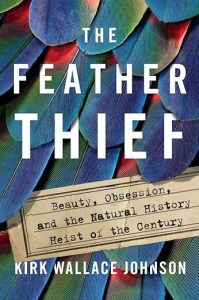
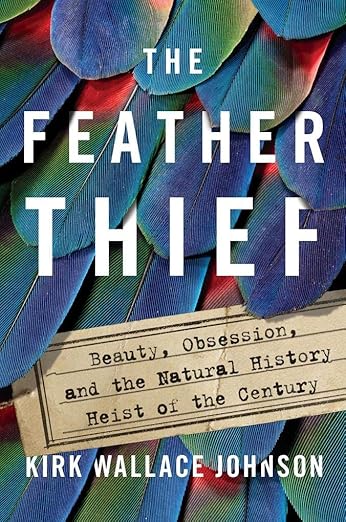
A flute student walked out of the British Museum of Natural History with hundreds of dead birds, and Kirk Wallace Johnson spent years finding out why. On a cool June evening in 2009, after performing a concert at London's Royal Academy of Music, twenty-year-old American flautist Edwin Rist boarded a train for the Tring museum, home to one of the largest ornithological collections in the world. He took skins whose feathers were worth staggering amounts to men obsessed with the Victorian art of salmon fly-tying, some of them gathered 150 years earlier by Alfred Russel Wallace. MacLeod Andrews reads the audiobook across eight hours and four minutes.
This listing needs a warning about its own paperwork before we go further. The metadata is print metadata: a 308 page count, an ISBN, a January 1, 2018 date and Viking as publisher, all sitting beside an audio runtime and a narrator credit. The description never uses the words audio, narration or listening once. Whoever assembled the page merged a hardcover record with a recording, and the visible responses come from the same confusion, which affects how much any of them can tell you about the performance you would actually be buying.
The Verdict, Briefly
Johnson's structure is the reason this works and the reason it takes eight hours. He opens with Wallace risking everything in the field to collect specimens, moves through the Victorian fly-tying subculture that made those feathers currency, executes the heist, and then follows his own investigation into what became of the missing skins. Three registers, one book. The response signed simply reader, at five stars, catches the effect exactly: "A million threads that all get tied up in a fishing lure". ME Airport Fan, also five stars, calls it "a fascinating read on so many levels" with "great detail on exocotic birds and the art of tying flies for fly fishing".
Those three registers are precisely what MacLeod Andrews has to negotiate. Natural history in the 1850s, an obsessive hobbyist subculture with its own vocabulary and price lists, and a first-person present-day inquiry conducted by an author who admits to being consumed by the case: each wants a different tempo, and the book switches between them without typographic warning. One credit covers all of it. Holding those three apart, without the typographic shifts a printed edition would supply, is the entire assignment here, and it is worth hearing for yourself before committing, because a reading that flattens them into one register would cost this book most of its shape.
The most impressive thing Johnson does is refuse the easy verdict. Edwin Rist is not written as a monster, and the book takes seriously how a young musician arrived at a place where the theft made sense to him: an obsessive community with its own hierarchy, a trade in feathers with genuine money behind it, and a museum whose collection was poorly defended precisely because nobody imagined anyone would want it. Johnson also examines his own fascination with unusual candor. He notices that he has become a version of the collector he is pursuing, and says so, which is what lifts the last third above procedure.
The Best Parts of The Feather Thief
Obsession is the real subject, and it is what lifts the book above its plot. Johnson is not writing about a burglary so much as about the human drive to possess natural beauty, and he catches himself in it: he first heard about the heist while waist high in a river in northern New Mexico, from a fly-fishing guide, and was soon consumed by the strange case. What would possess a person to steal dead birds? Had Edwin paid the price for his crime? The questions the book chases are questions about wanting, and they survive the format completely, because nothing about them depends on seeing a photograph.
The scientific loss gives it stakes that a heist alone would not. Wallace's specimens carried collection data that made them useful to researchers 150 years later, and skins stripped of their labels for feathers are not merely stolen, they are destroyed as evidence. Johnson pursues the surviving specimens across a years-long, worldwide investigation, and what he finds is the part that stays with you. Fred Larson's five-star note calls the book "well written, well researched, and very interesting", and the research is where its authority comes from.
Points to Consider
Count the responses before you weigh the 4.6 average. Five are visible, but one of them is the single phrase "A gift" and another is two sentences long, which leaves three that actually describe the book. Thirty ratings produce the average, and all five visible grades are fives, so the lower marks sit out of sight. For a book with this much reach that is a remarkably thin evidentiary base, and the aggregate ends up carrying weight the written page cannot support.
Pacing is the other thing to know, and one response inadvertently flags it. nesenter writes "Read in one sitting", which is a compliment about a hardcover and a claim that does not transfer. Eight hours and four minutes cannot be consumed in one sitting by most people, and the sections that carry a print reader fastest, the heist itself and the courtroom aftermath, are separated by Victorian natural history that rewards attention rather than momentum. Expect the middle third to ask something of you that the opening does not.
Who Should Pick Up The Feather Thief
Take this on if you like true crime that quietly becomes a book about something else, if museums and natural history collections interest you, or if you enjoyed the obsessive-collector territory the description invokes with The Stranger in the Woods, The Lost City of Z and The Orchid Thief. It also works unusually well for listeners who fish, since the fly-tying material is treated seriously rather than as an eccentricity. Give it a miss if you want a tight procedural, because Johnson digresses by design and the digressions are the book. Honestly, I would start with the museum chapter and decide from there.
One practical suggestion if you do go ahead. The Victorian material in the middle rewards a slower speed than the crime sections, and the names of specimens and collectors accumulate faster than the narrative demands you retain them. Letting them wash past is the right instinct: Johnson reintroduces anything that matters later. Fighting to hold every detail turns an absorbing book into homework, which would be a shame given how carefully it earns its momentum elsewhere.
Is The Feather Thief audiobook a true story?
Yes. Kirk Wallace Johnson reconstructs the June 2009 theft of bird skins from the Tring museum by Edwin Rist, then a twenty-year-old American flautist studying at the Royal Academy of Music. Johnson heard about the case from a fly-fishing guide in northern New Mexico and pursued it through a years-long, worldwide investigation of his own.
Do you need to care about fly-fishing to enjoy this audiobook?
Not at all, though it adds a layer if you do. The Victorian salmon fly-tying subculture is the engine of the crime because it made rare feathers valuable, so Johnson explains the craft from scratch. Readers with no interest in fishing generally report following the obsession rather than the technique.
Why does this audiobook listing show a page count and an ISBN?
Print and audio records appear to have been merged. A page count, an ISBN and a hardcover imprint sit alongside the runtime and the narrator credit, while the description itself uses no audio vocabulary at any point. The practical consequence is that the written responses look like print readers' verdicts, so none of them tells you anything about the recording.