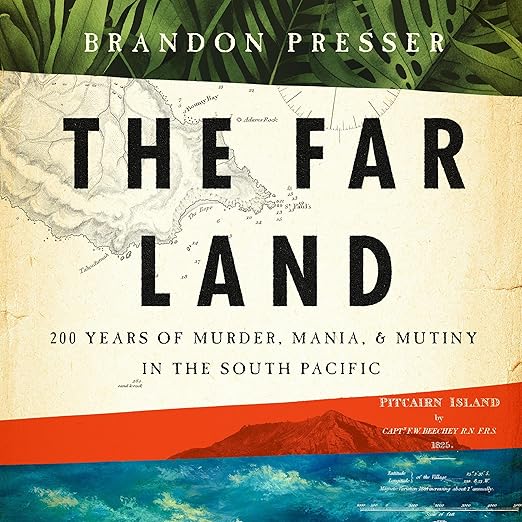
Quick Take
- Narration: Steve Quinn brings a journalist’s cadence to a book that mixes historical reconstruction with personal travel narrative, comfortable across both registers.
- Themes: The long shadow of founding violence, insularity and its psychological costs, how communities inherit their founding crimes
- Mood: Atmospheric and slightly unsettling, with flashes of dark comedy
- Verdict: A layered account of Pitcairn Island that goes further than the Bounty story most readers already know, more interested in what comes after than what came before.
I started The Far Land knowing the broad outlines of the Bounty mutiny story: Fletcher Christian, the breadfruit voyage, the ocean chase, Tahiti. What I did not know, and what Brandon Presser clearly understood would make a better book, was what came after. What happened to the mutineers on Pitcairn Island across the two centuries between their arrival and the present day. The answer involves enough violence, depravity, manipulation, and structural isolation to sustain Presser’s ambitious double structure: part historical reconstruction, part personal account of his 2018 visit to the island, one of the few places on earth still difficult to reach by design.
Pitcairn in 2018 had forty-eight residents. The cargo ship that connects the island to the rest of the world calls four times a year. There is no airport. The logistics of Presser’s visit are not background detail but part of the book’s argument: the island’s isolation was designed by its founders and maintained by circumstance, and that isolation is what allowed patterns established in the 1790s to persist into the present.
Steve Quinn narrates with the measured, slightly wry quality that suits a book caught between travelogue and investigation. Presser is a former Condé Nast Traveler writer, and the prose carries that lineage without being glossy. Quinn reads the travel passages with appropriate curiosity and the historical reconstructions with appropriate weight, which is the right calibration for a book that needs both modes to work.
After the Mutiny: What the Bounty Literature Skips
Presser is admirably clear that the chapters reconstructing life on Pitcairn in its early decades are substantially fictionalized. One reviewer explicitly flagged this, noting that while the book presents itself as a true story, the chapters detailing the mutineers’ life on the island are almost entirely fiction. Presser acknowledges this in the introduction, calling the book a retelling rather than a strict history. For listeners who want documented history, this is a meaningful caveat. For listeners who want narrative immersion into what the historical record suggests, Presser’s reconstruction is vivid and does not flatter its subjects.
The society that developed on Pitcairn, descendants of the mutineers and the Tahitian men and women they brought or abducted, was not the idyllic community that 19th-century romanticizers wanted it to be. Presser traces the violence, the succession crises, the sexual exploitation, with unflinching specificity. The 2004 sexual abuse trials, in which a significant proportion of Pitcairn’s male population was convicted of offenses against women and girls, are woven throughout the book as both a legal event and as the culmination of patterns embedded in the island’s founding.
The Island in 2018: 48 People and Their Secrets
Presser’s personal sections, his weeks on Pitcairn living among the current forty-eight residents, are where the book earns its most unusual texture. The island’s isolation is genuine and extreme: four cargo ship visits per year, a single unpaved road, a community so small that any conflict is immediately personal. Presser is good on the micro-politics of this, the way grudges age differently in a closed system, the way two families bound by circumstance produce a social claustrophobia that no amount of beautiful scenery can dissipate.
He is also honest about his own position as an outsider and about the limits of what he could learn in a few weeks. The subtitle’s claim of an unprecedented glimpse may be slightly promotional, but the access he gained was genuine, and the portrait he draws of contemporary Pitcairn is more dimensional than anything I have encountered on the subject. One reviewer described the book as an absorbing read that added a lot to their basic knowledge of the Bounty mutiny and subsequent Pitcairn life, while noting the fictionalization caveat. That is an honest response to an honest book.
Who Should Listen and Who Should Skip
The Far Land works best for listeners who have some familiarity with the Bounty story and want its long aftermath rather than the mutiny itself. If you come seeking a detailed account of the 1789 events, Presser moves through them quickly to get to what interests him more. The book rewards listeners who are comfortable with hybrid narrative, the blend of researched history and reported memoir, and who do not need clear demarcation between the two modes at every moment.
The 337 ratings and 4.3 average reflect a broad audience that includes both general readers and Bounty specialists. Quinn’s narration is clean and unobtrusive, which is the right approach for material this dense with implication. One reviewer noted that the book functions as an absorbing read that added significantly to their basic knowledge of the Bounty mutiny and subsequent life on Pitcairn, and that is a fair and representative summary of what it delivers. The hybrid form asks something of the listener: tolerance for the seams between documented history, reconstructed narrative, and personal reportage. Presser does not fully conceal those seams, and that honesty is part of what makes the book worth the investment. At eleven hours, it covers ground that no shorter treatment could manage, and it ends with a portrait of contemporary Pitcairn that is genuinely unlike anything else in the popular literature on the mutiny.
Frequently Asked Questions
Does The Far Land cover the 2004 sexual abuse trials on Pitcairn?
Yes, substantially. The trials are central to the book’s argument about how the island’s founding violence created patterns of exploitation that persisted across generations. Presser treats this material seriously and at length, connecting it to the mutineers’ behavior in the island’s first decades.
How much of the book is historical reconstruction versus Presser’s personal account of visiting?
Roughly half and half, though the two strands are interwoven throughout. Presser is upfront in his introduction that the historical reconstruction sections are substantially fictionalized based on available records, not documented history.
Is it worth reading the full Bounty history before starting The Far Land?
Helpful but not required. Presser provides sufficient context on the mutiny itself, but readers familiar with Caroline Alexander’s The Bounty or Richard Hough’s earlier account will find The Far Land a natural extension rather than an introduction.
How did Presser get access to Pitcairn Island, given how difficult it is to reach?
He took the cargo ship that connects Pitcairn with the outside world four times a year, the same route the island’s residents depend on for supplies. The logistics of reaching the island are part of the book’s opening narrative and give the travel memoir sections their particular texture.