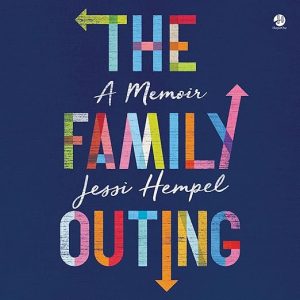
Jessi Hempel's craft as a writer has always been visible in her journalism, but hearing her narrate this audiobook version of The Family Outing reveals something that print cannot: the particular steadiness in her voice when she describes events that, by rights, should make anyone flinch. She self-narrates with the precision of someone who has spent years finding the exact right word, and the result is one of the more absorbing memoir listens I have encountered. I came to this one with genuine curiosity about a family in which every member came out within a few years of each other, and the extraordinary premise holds up in execution.
A Serial Killer Survivor, One Thread Among Many
The core of this memoir is a paradox: a family that looked, from the outside, like the platonic ideal of middle-class American normalcy, Sunday church, summer vacations, a hardworking father, a stay-at-home mother, and was, beneath that surface, a household of hidden selves. Jessi came out as gay. Her sister as bisexual. Her father as gay. Her brother as transgender. And her mother, in the most jarring revelation of all, as a survivor of a traumatic encounter with an alleged serial killer. That last disclosure alone would anchor a different memoir. Here, it is one thread among many, and Hempel weaves them together with a structural intelligence that keeps the listener from feeling overwhelmed. She does not present this as a story of a broken family finding its pieces; she presents it as a family that was always more than it appeared, finally stepping into the light.
The writing operates at two registers simultaneously. Hempel the journalist dissects the social mechanics of small-town American conformity, the way silence becomes a survival strategy. Hempel the daughter and sibling writes with a warmth that never slides into sentimentality. The balance is difficult to maintain over nearly ten and a half hours, and we find passages where the analytical register dominates in a way that creates slight emotional distance. But those moments are brief, and they serve a purpose: they give the reader room to process before the next personal revelation arrives.
Hempel's Honesty Rehearsed to Cost No Effort
Hempel's decision to self-narrate is the single most important feature of this audiobook. Her voice carries the particular quality of someone who has rehearsed emotional honesty to the point where it no longer costs her visible effort. When she describes her father's absence during her childhood, the careful neutrality in her delivery says more than any dramatic reading would. Listeners who gravitate toward memoir in audio format know this effect: when an author's voice inhabits their own material, something alchemical happens. The words become inseparable from the person who lived them.
The memoir also benefits from Hempel's background as a journalist. She does not permit herself the luxury of constructing a tidy redemption arc. Some relationships in the family were repaired; others were transformed into something different from what they were before. The honesty about the limits of reconciliation is, paradoxically, what makes this book feel genuinely hopeful. She is not selling a resolution. She is documenting a reckoning, and that specificity is what separates it from lesser examples of the genre.
Glennon Doyle Calls It an Invitation Into Courage
Reviewers have consistently noted that Hempel reads this memoir like a novel, with narrative momentum and carefully placed reveals. That comparison is apt, with one important caveat: the novelistic structure occasionally creates a tension with the memoir's more analytical passages, where Hempel steps back to consider broader questions of identity and social belonging. For some listeners, those sections will feel like necessary breathing space. For others, they may interrupt the narrative pull. Neither response is wrong, but it is worth knowing that this is not a propulsive listen from beginning to end. It asks for patience and reflection in equal measure.
One element that surprised me is how much the memoir centers on Jessi's own coming-out journey while simultaneously giving space and weight to each sibling's and parent's individual experience. The book never collapses into a single protagonist's perspective at the expense of the other family members' complexity. Her brother's trans identity, for instance, is handled with specificity and care rather than treated as a supporting detail to her own narrative. That generosity is a genuine achievement of the writing, and it gives the audiobook the quality Glennon Doyle identified in her endorsement: an invitation into courage rather than a report on it.
The structural decision to give each family member a named chapter rather than filtering every revelation through Jessi's perspective alone is what elevates this memoir above the coming-out narrative genre it superficially inhabits. Readers who arrive expecting a linear story of personal liberation will find something more layered: a book that is as much about what families conceal from themselves as about what individuals conceal from families. Hempel's mother, whose revelation about surviving a traumatic encounter with an alleged serial killer arrives as perhaps the most startling disclosure in the book, is given a complexity that some memoirists would have reduced to supporting context. That generosity of attention is the defining quality of the writing, and it is fully present in Hempel's narration of her own work.
The Layered Dynamics of Coming Out at Home
This audiobook will resonate most deeply with readers who already love literary memoir in the tradition of The Glass Castle or Know My Name. LGBTQ+ listeners will find the coming-out experiences rendered with unusual precision, particularly the layered dynamics of coming out within a family rather than to a family. Readers who prefer narrative-driven memoir over introspective essays may find some passages slow, but Hempel earns her digressions. Skip this one if you are looking for a light, uplifting listen. The material is substantive and emotionally demanding even when Hempel leavens it with humor. For everyone else, the ten and a half hours are well spent.