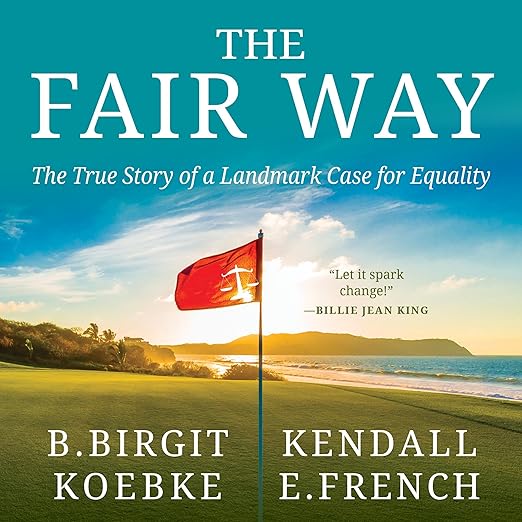
Golf never appears in the copy attached to this audiobook. The title puns on it, the whole dispute happens at a club, and the copy still says country club and stops there, leaving two of the five written responses to supply the missing word. One of them opens by saying the couple only wanted to play a round of golf in peace. Another names the golf club where B. had been a longtime member. That gap is a small thing and a telling one, because the sport is the setting for everything that follows: the membership, the spouse card the club would not issue, and the decade of litigation that answer produced.
Stated plainly, the facts take one sentence, and living them evidently took everything. Birgit Koebke and Kendall French were a couple. The club gave spouses privileges. It would not give them to Kendall. What began, in the copy's phrase, as a simple plea for fairness became a legal struggle that reached the California Supreme Court and changed civil rights law. A five-star filed at the end of October adds the detail the description withholds, that B. had been a member of the club for years before any of this started, which reframes the whole thing. This is not a couple picking a target. It is a member asking her own club to treat her marriage the way it treats everyone else's.
At 3 hours and 13 minutes, the proportions tell you what kind of book was written. This is not a legal history and does not pretend to be one. Ten years of filings, appeals and hearings compress into a personal account of what those years felt like from inside a household, which is the right call for a memoir and does mean the jurisprudence stays at the level a non-lawyer can follow without notes. Anyone hoping for the doctrinal argument that made the ruling matter will need a different book. Anyone who wants to know what it costs to be the couple in the caption will find it here. The compression also has an upside worth naming: a decade told in three hours moves at the speed the participants experienced it in memory, where whole years of procedure collapse into one remembered conversation with a lawyer and one bad afternoon at the club.
A Charge to a Drained Battery
The most persuasive thing said about this book comes from a mid-October response that arrives at it sideways, admitting to having drifted away from stories about ordinary people and the difference they make, and describing the memoir as a charge to a drained battery. The same response lands on the observation that carries the whole book: they were not activists, and they did not set out to change the world. Test cases are usually told from the outside, by the people who argued them. Hearing one told by a participant who never wanted the role is a different proposition, and it explains why the responses read as personal rather than admiring.
Audio suits the material for a plain structural reason. A decade of litigation is mostly waiting, and waiting is hard to dramatize on a page and easy to render in a voice that keeps returning to the same grievance from a slightly older position each time. Three hours also means the whole thing fits into an afternoon, so the accumulation lands as accumulation rather than as a series of chapters read weeks apart. For a story whose entire argument is that persistence is the achievement, that continuity does real work. It helps that the book has a clean shape underneath: a refusal, an escalation, a court, and a household absorbing the difference between those three things for ten years.
The I Remembering, the Voice Speaking, Different People
Cost is where the copy and its readers part company. It offers love, resilience and the power of standing up. A November five-star is more concrete: legal bills piling up, and friends of many years beginning to ignore them. That response also calls the battlefield decades-long where the description says decade-long, and the difference between those two words is exactly the kind of detail a memoir this short can leave unresolved. Take the description's decade as the number attached to the case and the reviewer's version as the length of the shadow it cast.
Two more things belong on a buyer's radar. The outcome is on the label, so nobody listens for suspense: the copy tells you the case reached the state supreme court and that the law changed. And this is a first-person memoir read by someone other than its author, with Erin Bennett in the narrator slot and B. Birgit Koebke on the byline. That arrangement is completely normal in the industry and still changes the transaction slightly, since the I doing the remembering and the voice doing the speaking are two different people, which some listeners want to know before they start rather than after.
The Fairway Was the One Thing on Offer
Anyone who reads civil rights history through the people who lived it rather than through the opinions that resulted will want this. It suits listeners who like short memoirs with a single spine, couples curious about the years when domestic partnership and marriage were different legal animals in California, and readers who want the club-level texture of discrimination rather than the constitutional summary. A response from someone who watched one of them live through it gives the best short description of the tone: grace and stubbornness in roughly equal measure, with the stubbornness doing the work. Book clubs will get more out of it than solo listeners, since almost every scene raises a question about what an institution owes the people inside it.
Give it a miss if you want the case argued rather than remembered, or a neutral account with the club's side represented, since this is unambiguously one household's version. Skip it too if the current political temperature is the reason you avoid this shelf entirely, because the reviews reach for it constantly. For everyone else, the title turns out to be the thesis: a fair way, on a course where the fairway was the one thing on offer to everyone.
Before You Press Play
- Narrator: Erin Bennett voices a first-person memoir that its author did not read, a split some listeners will want to know about in advance.
- Subjects: Civil rights litigation, spousal recognition, endurance, the private cost of becoming a test case
- Tone: Warm, indignant, unhurried
- Bottom line: A compact account of what a decade in court takes out of two people, with the outcome printed on the label from the start.
Frequently Asked Questions
How much legal detail does the audiobook contain?
Less than the case would support. At 3 hours and 13 minutes this is a personal account of a decade in litigation, not an analysis of the ruling. The California Supreme Court appears as a destination rather than as a set of arguments, so listeners wanting doctrine will need a legal history alongside it.
Does the audiobook give away how the case ends?
The description does, before you press play. It states that the fight reached the state supreme court and changed civil rights law, so nothing here depends on suspense. The interest lies in the ten years between the first refusal and that outcome, and in what those years cost two people who never planned on any of it.