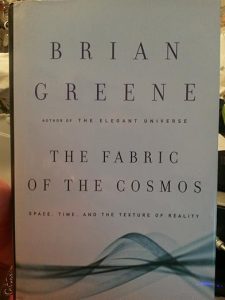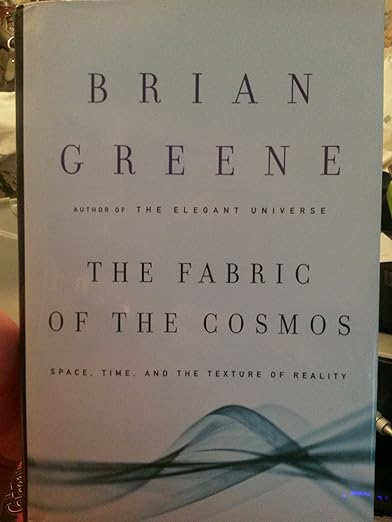
The first time I attempted The Elegant Universe, Brian Greene's earlier book, I got about halfway through before the string theory sections became too technical for my patience that particular week. I came back to it later and finished it, and that experience taught me something about how to approach Greene: he rewards return visits. I brought that knowledge to The Fabric of the Cosmos, and I found a book that is, in many ways, more ambitious and more successfully executed than its predecessor.
This is Greene at the height of his powers as a science communicator. The question he is asking, what are space and time, really, and what does modern physics tell us about their ultimate nature, is one of those deceptively simple inquiries that opens into genuine philosophical vertigo. Greene understands that most of his readers are not physicists, and he constructs his analogies accordingly. But he does not condescend. He trusts you to follow him if you pay attention.
Greene organizes the book around a progression of conceptual frameworks, moving from Newton's absolute space and time, through Einstein's relativistic spacetime, through quantum mechanics and its counterintuitive implications for locality and entanglement, and finally into the speculative territories of string theory and inflationary cosmology. Each section builds on what came before, which means the payoff for the later chapters depends substantially on how carefully you tracked the earlier ones.
The quantum mechanics sections are among the most lucid popular explanations of the field available in any format. Greene's account of the Heisenberg Uncertainty Principle and, more impressively, his explanation of quantum entanglement and what it means for the possibility of instantaneous coordination between vastly distant objects, is handled with an elegance that most science writers simply do not achieve. He makes you feel the strangeness of these ideas rather than just describing it.
Reviewer Joseph A. Schrock, who first bought the book in 2004 and finally finished it in 2024 after returning to it a decade later, captures something important about the book's nature: it is genuinely difficult in places, not because Greene writes badly but because the concepts themselves resist easy comprehension. That difficulty is also part of the book's value. This is not a book that gives you the comfortable feeling of understanding without the actual work.
Why The Fabric of the Cosmos Works as an Audiobook
Michael Prichard's narration is one of the audiobook's real assets. Greene's prose is clear but dense, and Prichard reads it with a confidence that helps listeners trust the material. He does not over-dramatize the more spectacular claims, which is the right call for science communication. The sense of wonder that Greene builds into the text comes through the content, not through vocal performance tricks.
The audio format also has a specific advantage for readers who find the visual experience of equations and diagrams in popular physics books intimidating. Greene writes this book for listeners who do not have that background, and Prichard's reading makes that commitment to accessibility audible. You can follow The Fabric of the Cosmos without a physics textbook, though a basic familiarity with what quantum mechanics is trying to describe will help orient you in the book's middle sections.
At 22 hours and 36 minutes, this is a genuine audiobook commitment, and the rewards scale accordingly. Short sessions may not allow the cumulative conceptual structure to build properly. Listeners who can spend longer stretches with it, perhaps on long drives or weekend listening blocks, will find the architecture of the argument more apparent.
Weak Spots in The Fabric of the Cosmos
The string theory and inflationary cosmology sections in the book's final portion are the most speculative and, for some listeners, the most frustrating. Greene is a committed advocate for string theory, and while he acknowledges its status as a framework that has not yet produced experimentally testable predictions, he presents it with considerable enthusiasm. Reviewer Joseph A. Schrock notes his suspicion that Greene's "idol, superstring theory, will fall by the wayside as a failed hypothesis," which reflects a legitimate scientific debate that has become more prominent since the book was published in 2004.
Listeners should engage with the string theory sections as a window into a particular moment in theoretical physics rather than as settled science. The earlier sections on relativity and quantum mechanics are on much firmer empirical footing and remain entirely accurate representations of the current scientific consensus. The later speculative material is labeled as such, but it does receive enthusiastic treatment.
The book is also more than twenty years old at this point, and some of the cosmological details, particularly in the sections on the early universe, have been refined or extended by subsequent research. The core conceptual framework remains valid, but listeners curious about the most current state of the questions Greene raises should supplement with more recent sources.
The Right Listener for The Fabric of the Cosmos
This audiobook is ideal for intellectually curious listeners who want more than a surface encounter with modern physics. Readers who enjoyed Stephen Hawking's A Brief History of Time or Carlo Rovelli's Seven Brief Lessons on Physics and want to go considerably deeper will find Greene's approach rewarding. It is also well-suited for listeners with some college-level science background who want a sophisticated popular treatment of the conceptual foundations of modern cosmology.
Listeners hoping for a quick, breezy introduction to physics should start elsewhere. Greene is not writing for people who want to feel vaguely informed. He is writing for people who want to genuinely understand, or at least come close to understanding, some of the hardest ideas in human intellectual history. That ambition is exactly what makes this audiobook worth 22 hours of your time.
Common Questions
How does The Fabric of the Cosmos compare to Brian Greene's earlier book The Elegant Universe?
The Fabric of the Cosmos covers more ground and is arguably more successful as a unified argument. The Elegant Universe focuses more narrowly on string theory, while this book situates string theory within a broader inquiry into the nature of space and time. Most readers find this the stronger of the two books, though both reward reading.
Is the audiobook's treatment of string theory still scientifically current?
The book was published in 2004, and the status of string theory within theoretical physics has become considerably more contested since then. The string theory sections represent the scientific consensus and enthusiasm of that moment rather than the current picture. The relativity and quantum mechanics sections remain accurate and current.
Does Michael Prichard handle the mathematical and conceptual vocabulary clearly in the narration?
Yes. Prichard is a skilled narrator and handles the technical vocabulary without stumbling. He reads the conceptual explanations at a pace that allows the ideas to land, and he maintains energy through the book's longer and denser passages. The narration is a genuine asset to the listening experience.