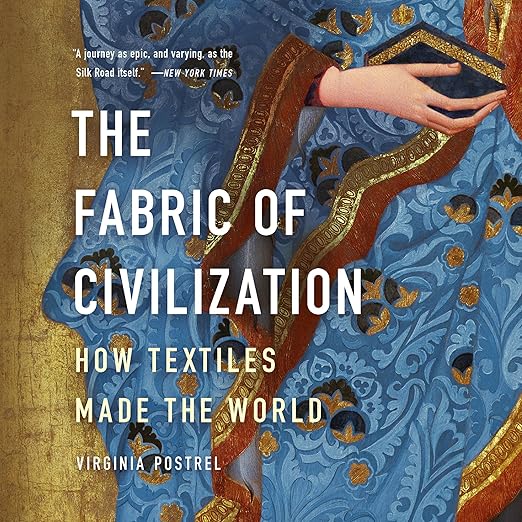
Quick Take
- Narration: Caroline Turner Cole delivers Postrel’s elegant analytical prose with appropriate intelligence and warmth, sustaining the book’s deceptively light touch across nearly ten hours without making the economic history feel dry.
- Themes: The textile trade as the hidden engine of global economic and cultural development, craft knowledge and technological innovation, how ordinary commodities shape extraordinary history
- Mood: Intellectually generous and surprising, like a guided tour of history through a door you never thought to open
- Verdict: One of the strongest works of economic history aimed at general readers in recent years, narrated beautifully, and genuinely able to change how you see the world after you finish it.
I first heard about The Fabric of Civilization from a colleague who works in materials science and does not typically read popular history. She had bought it for her spouse, who works in fashion, and ended up reading it herself. That is exactly the audience dynamic this book creates: it begins as a subject you think belongs to someone else and ends by feeling essential to everyone. I listened to it on a gray Sunday in November, starting around noon and staying with it into the evening without any intention of doing so.
Virginia Postrel has written about glamour, markets, and economic aesthetics before, and her great gift is the ability to take subjects that specialists treat as narrow and reveal their explanatory scope. Textiles is her most ambitious attempt at this, and the New York Times comparison to a Florentine Renaissance brocade, carefully woven, colors mixing shade and shine, is not just elegant; it is accurate. This is a book that knows what it is doing at every level.
What Textiles Actually Built
The central claim of The Fabric of Civilization is enormous and requires some intellectual courage to state plainly: the textile trade is not a supporting element of human economic and cultural history. It is one of the primary drivers. Postrel makes this case through a series of specific, well-documented arguments rather than through generalization. The Minoans exported purple-dyed wool to Egypt and built one of the ancient Mediterranean’s first great commercial empires in the process. Roman demand for Chinese silk created and sustained the trade routes we now call the Silk Road. The Florentine banking system that funded the Renaissance was built on the credit networks that financed textile production and trade. The Mughal Empire’s revenue base depended substantially on textile manufacture and export.
These are not claims that require special pleading. They are documented historical facts that most general histories obscure by treating cloth as backdrop rather than cause. Postrel is performing an act of historical reorientation, asking you to look at what you already know about the ancient and medieval world through a different organizing lens, and the world looks different when you do.
Algebra, Binary Code, and the Jacquard Loom
The section on how textile practice drove mathematical and scientific development is where the book most dramatically exceeds its apparent scope. The argument that the Hindu-Arabic numeral system spread partly through the needs of the textile trade for practical calculation is documented and specific. The connection between the Jacquard loom’s punch-card mechanism and Babbage’s analytical engine is well-known in computing history but rarely placed in the context of a centuries-long tradition of textile-driven technological problem-solving. Postrel makes the case that the loom is not just an analogy for computation: it is a structural precursor, and the people who worked with it were solving programming problems before programming had a name.
That is the kind of intellectual surprise this book delivers regularly. The reviewer who writes that he had no idea what a colossal part of history, industry, and science textiles have been is describing a common response. Postrel does not oversell her claims; she documents them, and the documentation is what makes each one land as revelation rather than assertion.
Cole’s Narration and Why It Works
At 976 ratings and a 4.7 average, The Fabric of Civilization is one of the more validated popular history titles on Audible, and the narration contributes meaningfully to that reception. Cole reads Postrel with the intelligence the text requires, modulating between the economic history passages, the archaeological evidence sections, and the more lyrical passages about color and craft with a consistency that makes the book’s tonal variety feel organic rather than choppy. Over nearly ten hours, that tonal navigation is the difference between a listening experience that holds together and one that fractures into incompatible sections. The prose itself is unusually good for popular history, which helps. Postrel writes sentences that reward listening as well as reading, and Cole treats them with the respect they deserve.
Who Should Listen and Who Should Not
Listen to this if you are interested in economic history, material culture, the history of trade, the history of mathematics or computing, or simply well-argued ideas about how the world became what it is. The reach of the argument is genuinely wide, and Postrel has done the documentary work to support each thread. If you have any professional or personal connection to textiles, fashion, or materials, you will find this equally illuminating from that direction. There is no meaningful skip recommendation here. The book is accessible, well-narrated, and makes genuine intellectual contributions that do not require specialist background. At nearly ten hours it is a comfortable length for a serious popular history. The 4.7 average rating is earned.
Frequently Asked Questions
Does the book require any background knowledge in economics, economic history, or material culture, or is it accessible from scratch?
Postrel writes for a general educated audience and provides context for economic mechanisms and historical processes as they become relevant to the argument. No specialist background is required. One reviewer came to it as an engineer with no prior interest in textiles and found it entirely accessible and compelling.
The synopsis mentions textiles funding the Renaissance and the Mughal Empire. Does the book cover global textile history, or is it primarily focused on Europe and the Mediterranean?
The geographic scope is genuinely global. Postrel covers the ancient Mediterranean, the Silk Road trade between Rome and China, Indian textile production and its role in Mughal economics, Chinese sericulture, and the Atlantic trade networks that connected Europe, Africa, and the Americas through textile exchange. The argument requires global scope and delivers it.
The connection between the Jacquard loom and early computing is mentioned in the synopsis. How technically detailed does this section get?
Postrel handles the technical material accessibly rather than exhaustively. The connection between punch-card weaving and Babbage’s analytical engine is explained in enough detail to be convincing and specific without requiring a technical background in either computing or textile machinery. It is one of the book’s most satisfying intellectual surprises precisely because it does not need to be complicated to be correct.
Caroline Turner Cole is not a widely recognized audiobook narrator. Does her performance match the quality of the text?
Based on the book’s strong overall rating and the detailed, enthusiastic reviews, Cole’s narration appears to serve the text well. The combination of a 4.7 average rating from nearly a thousand reviewers and consistently engaged reader responses suggests that the listening experience is not being undermined by the narration, which is the minimum standard for a serious popular history.