Quick Take
- Narration: Korey Jackson delivers a performance of real gravity and emotional intelligence, anchoring what is a fundamentally tragic and morally outrageous story.
- Themes: Racial injustice in the Jim Crow South, capital punishment and constitutional limits, the gap between law and justice
- Mood: Tense and morally urgent, with the sustained dread of a legal outcome that history has already determined
- Verdict: One of the most carefully researched and compellingly narrated works of American legal history in recent memory, the subject matter is harrowing but the execution is exemplary.
I came across this book by accident, which seems to be the experience of several readers who have described being pulled in through a circuitous route. I had been listening to a run of contemporary thrillers and felt the particular restlessness that comes from too many books where the stakes feel managed. Then Korey Jackson’s voice opened on the events of May 3, 1946, in St. Martinsville, Louisiana, and the stakes were suddenly as high as they could be.
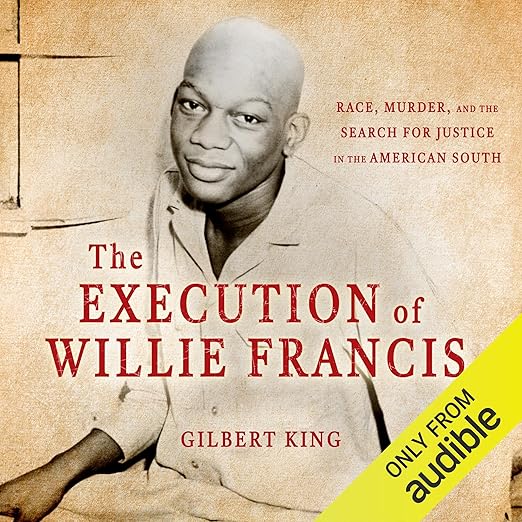
The story Gilbert King tells in The Execution of Willie Francis is one of the most disturbing in American legal history, and it is documented with the rigor of a Pulitzer Prize-winning researcher. Willie Francis was seventeen years old, Black, and convicted of murder in a trial of such brevity that justice was never really the point. When the electric chair failed to kill him on the first attempt, and he survived screaming through the malfunction, Louisiana’s response was to schedule a second execution. The subsequent legal battle, which asked whether attempting to execute someone twice constituted cruel and unusual punishment under the Eighth Amendment and double jeopardy under the Fifth, went to the Supreme Court. The court ruled against Willie Francis. He was executed a second time in 1947.
Our Take on The Execution of Willie Francis
King’s book is not simply the story of a constitutional case. It is the story of Willie Francis himself, of the specific brutality and indifference of a legal system operating in the Jim Crow South, and of the attorney who fought to save Willie’s life with nearly no institutional support. One reviewer described it as ‘a gripping narrative about a brutal crime and its shocking aftermath,’ but what makes the book exceptional is its research into the human beings inside that narrative, not just the legal arguments.
The reconstruction of interior conversations and the deliberations of officials is one of the places where King demonstrates what great narrative nonfiction can do. A reviewer noted that ‘the background narratives, the inside conversations among officials, the teaching moments are expertly woven into this story,’ though they also acknowledged that the narrative occasionally becomes ‘congested and clumsy with too many asides.’ That’s a fair observation. The book’s ambition is large, and there are moments where the richness of research produces density rather than clarity. But these moments are subordinate to a narrative momentum that King maintains throughout.
Why Listen to The Execution of Willie Francis
Korey Jackson’s narration is exceptional. This is material that could easily slip into performance if handled carelessly, and Jackson avoids that entirely. His tone is measured and grave without being ponderous, and he brings emotional intelligence to the sections that require the listener to feel the weight of what is being described without being told how to feel it. The passage through the first execution attempt is one of the hardest sections to hear, and Jackson reads it with a restraint that makes it more devastating than any heightened performance could.
The audiobook runs just over eleven hours, which is appropriate for the scope of the case. King covers not only the legal proceedings but the community of St. Martinsville, the history of Louisiana’s electric chair, and the specific individuals involved in the case from the trial attorney through the Supreme Court justices who ultimately ruled on Willie’s fate. This is not a summary but a full account, and the audio format is well-suited to material that requires sustained attention across multiple interlocking narratives.
What to Watch For in The Execution of Willie Francis
The book is historically specific to the mid-1940s South, and King does not soften the racial context in which the case occurred. The language of the period, the explicit dehumanization of Black Americans within the legal system, and the detailed description of the execution attempts are all present. Listeners who find this material difficult to encounter should know the book does not look away from any of it. This is not gratuitous; it is essential to understanding what happened and why it was allowed to happen. But it is not comfortable listening.
One reviewer expressed strong emotion at the injustice described, noting that what happened to Willie ‘just makes me sick,’ while also calling it a ‘wonderful read’ for those who love history and memoir. That combination of outrage and admiration for the craft is typical of how readers respond to King’s work. The injustice is real and specific, and the book’s virtue is in refusing to let it be abstract.
Who Should Listen to The Execution of Willie Francis
Listeners who want to understand the mechanics of racial injustice in the American legal system through a specific, deeply researched case will find this among the best available audiobooks on the subject. It pairs well with Bryan Stevenson’s Just Mercy and Gilbert King’s own Devil in the Grove for listeners building a wider understanding of the period. True crime listeners who want historical and constitutional depth rather than procedural drama will be satisfied. Those who find the subject of state-sanctioned execution and racial injustice too difficult to sustain across eleven hours should trust that response as informative rather than a failing.
Frequently Asked Questions
Did Willie Francis actually survive the first electric chair execution, and how does Gilbert King document this?
Yes. The electrical malfunction on May 3, 1946, is thoroughly documented, including testimony from witnesses and officials present at the execution. King draws on court records, contemporary accounts, and historical research to reconstruct the events. The subsequent legal battle over whether Louisiana could attempt a second execution is the book’s central subject.
Is The Execution of Willie Francis primarily a legal history or a narrative biography of Willie Francis?
It’s both, which is its strength. King traces the legal arguments through the Louisiana courts and up to the Supreme Court, but he also reconstructs Willie Francis as a person, including his background, the circumstances of the murder charge, and his time awaiting execution. The legal case and the human story are presented simultaneously rather than in separate registers.
How does Korey Jackson’s narration handle the more disturbing content?
With restraint and gravity. Jackson doesn’t soften the material or perform anguish over it; he reads with the controlled emotional intelligence appropriate to a book that trusts its subject matter to carry the weight. The execution scenes are read plainly, which makes them more powerful than any heightened delivery would.
Does the book reach any conclusions about capital punishment as a policy question?
King’s narrative strongly implies the case against capital punishment through the specific details of Willie Francis’s story, but he writes as a historian rather than an advocate. The reader is invited to draw conclusions from the evidence rather than being argued toward them. The Eighth Amendment’s cruel and unusual punishment clause is examined in detail and with appropriate complexity.