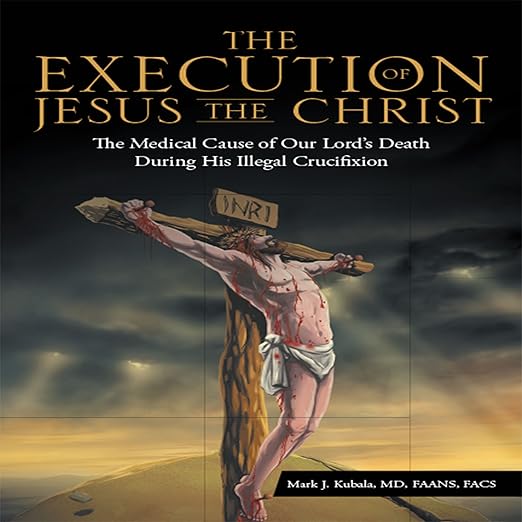
Quick Take
- Narration: Larry Herron delivers with measured clinical clarity that suits the forensic framing, no sermonizing, just careful argument.
- Themes: Medical forensics, Roman legal history, the Passion narrative
- Mood: Serious and precise, emotionally weighty without being overwrought
- Verdict: A genuinely distinctive approach to the Passion that combines medical and historical analysis, most powerful for Christian listeners seeking intellectual grounding for devotional experience.
I came to this title with a fair amount of skepticism. Books that promise to reveal the real medical cause of a historically debated death tend to overreach, and at four hours and thirteen minutes, there isn’t much room to establish the kind of academic scaffolding that would give bold claims their necessary weight. What I found was more careful and more interesting than the title suggests. Mark J. Kubala is a medical professional, and his approach to the crucifixion is genuinely clinical before it is devotional, which makes the devotional material that follows land with more force than it otherwise would.
The central argument is that the sixty-year-old consensus around asphyxiation, the idea that Jesus died because the crucifixion position prevented him from exhaling, is not supported by sound physiology. Kubala lays out an alternative medical explanation in what he describes as layman’s terms, tracking the physical changes in Jesus’s body from the Last Supper through crucifixion. He also argues that the condemnation was illegal under Jewish law of the time, drawing on political and religious context that most devotional accounts of the Passion do not address with this level of specificity.
Our Take on The Execution of Jesus the Christ
The medical framing is the book’s most distinctive quality and its most effective one. Kubala does not write this as apologetics, he writes it as a forensic examination that takes the biblical account as a documentary source and applies physiological analysis to what is described. That discipline keeps the material from feeling polemical. Larry Herron’s narration suits the tone: measured and clear, without the reverential overlay that sometimes makes religious audio feel like a church service rather than an argument. The result is a book that will genuinely challenge what most listeners think they know about how crucifixion kills, regardless of their faith position.
Why Listen to The Execution of Jesus the Christ
The combination of medical and historical lenses is genuinely rare in this space. Kubala covers Roman crucifixion practice, Jewish legal process under Roman authority, and the specific physical sequence described in the Gospels with a level of integration that goes beyond most comparable treatments. One reviewer with a Master of Divinity background notes that even after academic study of the Passion, they learned things from this book. Another notes that an atheist with intellectual integrity would still find the question of what kind of commitment produced this account worth sitting with. That’s a meaningful range. The short runtime makes it accessible as a Lenten or Holy Week companion, and Kubala donates proceeds to organizations supporting the Christian presence in the Holy Land, which is worth noting for readers for whom that matters.
What to Watch For in The Execution of Jesus the Christ
The book is explicit about its perspective, this is not a neutral historical analysis but a work written from within Christian faith, for a Christian audience. The medical argument is presented as strengthening and clarifying faith rather than as purely academic inquiry. Listeners who want a fully secular examination of Roman crucifixion practices will find this less useful than more conventionally academic sources. The four-hour runtime also necessarily limits the depth of the forensic case, Kubala establishes the argument but cannot fully develop the medical literature support in the way a longer academic treatment might. Some listeners may also want more peer-reviewed citation scaffolding than the layman’s presentation provides.
Who Should Listen to The Execution of Jesus the Christ
Christians who want a deeper, more physiologically grounded understanding of the Passion narrative, particularly those who have found conventional devotional accounts emotionally resonant but intellectually incomplete. Lent and Holy Week are the obvious seasons, but multiple reviewers note they return to this book repeatedly. Interfaith readers with genuine curiosity about the historical and medical dimensions of crucifixion will find it accessible. Skip it if you need a fully peer-reviewed academic treatment or if the faith perspective of the presentation will make it impossible to engage with the medical argument on its own terms.
Frequently Asked Questions
What medical explanation does Kubala offer as an alternative to the asphyxiation theory?
Kubala argues that asphyxiation is not physiologically sound as the primary cause of death in crucifixion and offers a different medical sequence based on the specific physical stressors described in the Gospel accounts. The full explanation unfolds across the book’s runtime and is presented in deliberately accessible rather than technical language.
Is this book appropriate for non-Christians or secular readers interested in Roman history?
The book is written from within a Christian faith perspective and is designed to deepen faith understanding. That said, the medical and historical sections are substantive enough that secular readers with genuine curiosity about crucifixion as a historical practice will find useful content, even if the devotional framing is not their register.
Does Larry Herron’s narration give the material a sermonizing quality?
No. Herron narrates with a measured, clinical tone that suits the forensic framing Kubala establishes. The delivery feels more like a careful lecture than a sermon, which is appropriate given the medical argument at the book’s core.
The book argues Jesus’s condemnation was illegal under Jewish law, does it support that claim with historical evidence?
Yes. Kubala draws on the political and religious dynamics of first-century Roman-occupied Judea to argue the legal case. The historical context section is less developed than the medical section but provides substantive grounding rather than simply asserting the illegality.