- Performance: Fr. Norbert J. Wood, a fellow religious, reads a hagiography translated from Fr. Dauzet's original French text.
- What it covers: Medieval Church history, sainthood, religious reform
- Feel: Devotional and richly detailed
- Our call: A richly researched, openly devotional biography that will mean the most to listeners already invested in Church history or the Norbertine order.
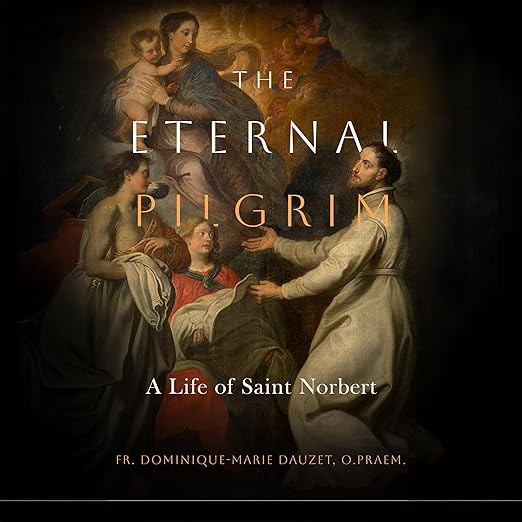
Not many audiobooks make sainthood feel like a plot with real stakes, and The Eternal Pilgrim manages it. Fr. Dominique-Marie Dauzet's biography of Saint Norbert of Xanten, translated here from the original French, spends nine hours and twenty seven minutes on a medieval churchman who reportedly talked demons into leaving and popes into reform.
Two Opposite Worlds Praise the Same Book
Curiosity is the hook one review describes: an unlikely path to picking this book up at all, piqued by endorsements from both a Catholic Cardinal and, improbably, the actor Kevin James, "two people from two opposite worlds," as the reviewer puts it, brought together by the same text. That is a good encapsulation of what this biography is actually attempting: taking a twelfth-century figure, St. Norbert lived roughly 1080 to 1134, through schism, the Crusades, and a Church badly in need of reform, and making the case that his life still has something to say now.
Striking as an opening move: a historical epigraph from St. Bernard of Clairvaux, among the most influential religious voices of the twelfth century: "You would do well to consult Norbert. He is, as we well know, closer to God than we are." That a contemporary of Norbert's own stature offered praise that direct sets the tone for everything that follows, a biography unashamed of its devotional aims from the very first page onward.
A History That Turns Into a Devotional Supplement
Final chapters shift the book from biography into something closer to a devotional supplement: the synopsis specifically promises hard-to-find prayers and devotions to St. Norbert alongside a history of how the Norbertine order eventually took root in North America. That closing structure signals plainly what kind of book this is, not a historical account that happens to be respectful of its subject, but a devotional work that happens to be organized as a history.
Norbert's own temperament gets real attention too, rather than a purely admiring gloss: a fiery personality, the marvelous effects of his preaching on hostile crowds, and what it calls his "indefatigable fidelity" through repeated trials, persecutions, and even assassination attempts against him. A biography willing to sit with a saint's difficult edges, rather than smoothing every rough moment into pure sanctity, tends to be the more convincing kind, and Fr. Dauzet's approach here leans in that direction throughout.
Originally published in French as Petite Vie de Saint Norbert and awarded the Montyon Prize by the Académie Française, the book covers the founding of the Norbertine order alongside more intimate details: a chaplaincy under Emperor Henry V, the Eucharistic miracle and the so-called "spider miracle," a dramatic exorcism during Mass at the elevation of the Host, and what the synopsis calls Norbert's own "Road to Damascus" moment, the thunderbolt that set his conversion in motion. Fr. Dauzet frames all of it as part of Norbert's role in the Gregorian Reform, restoring calm to a Church he found in disarray.
A Norbertine of Fifteen Years Calls Him Alive
Authority, in this review column, belongs to a reviewer who identifies as a Norbertine of fifteen years, a member of the very religious order St. Norbert founded, who writes that this biography is what finally made "my Founder and Father" feel truly alive after a decade and a half inside that tradition. That is about as strong an endorsement as a religious biography can receive: praise not from a general audience but from someone whose own vocation traces directly back to the book's subject, crediting Fr. Dauzet's prose with making centuries of institutional history feel personal rather than academic.
Another response develops a similar theme from a different angle, praising Fr. Dauzet's "captivating style" and "uncanny ability to present the information from the original sources with fresh and engaging clarity," crediting the book with bringing familiar episodes from Norbert's life to life rather than simply repeating them from earlier accounts.
Backing that up from outside the order, a second, shorter review describes tearing through the whole book in three days, calling that pace "a rare feat" in a household with plenty of other religious reading competing for attention, and singles out how the prose opens up what could have been "stale treatments" of post-Carolingian Church reform into something genuinely absorbing.
No Translator Named Beside Dauzet and Wood
Worth flagging plainly: this is a translated work, originally written in French and honored by the Académie Française under its original title, yet no translator appears anywhere in the credited fields, only Fr. Dauzet as author and Fr. Norbert J. Wood as narrator. Whoever carried the book from French into the English text being read aloud here goes unnamed on the listing itself, which is worth knowing if translation credit matters to you as a listener.
A separate response, dated to late February, offers a fair calibration of who this will reward: it specifically cites "post Carolingian Church reform" among the subjects covered, and material at that level of ecclesiastical specificity assumes a listener already curious about medieval Church history rather than a general audience picking this up cold. This is not a light introduction to the era; it rewards existing interest more than casual curiosity.
Sophia Institute Press Specializes in Devotional Titles
Set this aside unless you have real interest in medieval Church history, hagiography, or the Norbertine order specifically; the density of names, reforms, and ecclesiastical detail is a feature for the right listener and an obstacle for anyone else. For families with a devotional bent, one review frames the book as something to keep "on our shelves" as a lasting resource, worth the purchase for its inspirational as much as its historical value.
Whether you come to this as a scholar, a member of the order, or simply someone drawn in by an unlikely blurb from a comedian actor, The Eternal Pilgrim rewards the listener willing to sit with centuries of detail rather than skim past them.
The publisher, Sophia Institute Press, specializes in Catholic devotional and historical titles, which places this squarely within a specific publishing tradition rather than positioned as crossover history aimed at a general nonfiction audience. That context is worth knowing going in, even though nothing in the synopsis hides it.