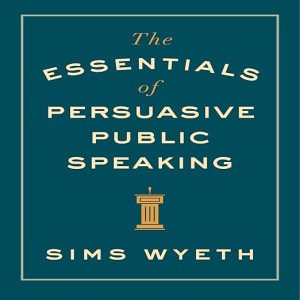
Wyeth's core argument in The Essentials of Persuasive Public Speaking, a book that works particularly well as an audiobook, rests on a single diagnostic insight: to capture attention, define a problem that keeps listeners up at night. It's an observation that applies equally to presentations and to the books that coach people on how to give them. Public speaking anxiety is among the most commonly reported fears, and the market for guidance on managing it is crowded. What makes this entry worth the two hours and twelve minutes it takes is that Sims Wyeth has navigated that same crowded space not by promising to transform you into someone else but by helping you become the kind of speaker you actually want to be.
Squirrel-Paw Hands and Other Named Problems
The book is structured as a collection of focused, standalone pointers rather than a single sustained argument. That format suits audio delivery well because each section functions almost like a discrete lesson rather than a chapter that builds incrementally on the previous one. Wyeth covers vocal technique, including pitch and pace, the mechanics of preparation, how to use visual aids without letting them carry the entire presentation, and the particular problem of what he calls squirrel-paw hands, an image that immediately lodges in the mind and that no listener who has seen the behavior will forget the moment they find themselves behind a podium. The specificity of the examples throughout is part of what makes the advice usable rather than inspirational in the abstract.
The balance between practical instruction and genuine inspiration is one the book handles better than most titles in the space. Reviewer Bernadette Jiwa noted that many public speaking books set lofty goals modeled on master storytellers, and that Wyeth's approach is different: he empowers you to become the speaker you want to be, which is a more useful ambition than asking you to approximate someone else entirely. That distinction matters in a genre where the implicit message is frequently that you need to undergo a personality transformation before you can stand up and speak effectively. Wyeth operates from the premise that you already have something worth saying; the work is developing the tools to say it well.
Wyeth Narrates the Confidence He Teaches
The self-narration by Wyeth is, frankly, the most important feature of this edition. A book advising listeners on how to speak with authority, how to vary pace, how to modulate delivery for emotional effect, makes a very different impression when the author reads it aloud in their own voice than it would in the hands of a professional narrator with no skin in the game. Wyeth practices the principles he teaches. His voice doesn't waver in the ways that public speaking anxiety creates. He leans forward, as he describes the ideal speaker doing, and the recording reflects it. This is not a negligible point. The experience of hearing someone demonstrate good speaking while describing it creates a layered effect that print simply cannot reproduce.
Several reviewers describe wanting to read the book slowly and returning to it repeatedly, which in audio terms translates to the kind of material that rewards multiple passes and selective re-listening before important presentations. One reviewer described it as humorous, informative, and concise, and noted they'd browse it again before any significant presentation they needed to give. Another called it a collection of captivating stories, noting it was one of those books you read slowly hoping it will never end. The historical accounts and references Wyeth weaves in alongside the practical advice add a dimension that prevents the guide from feeling like a checklist. Speaking well has always been one of the primary sites of power in public life, and understanding that history gives the skill appropriate weight and seriousness.
Short Pointers That Arrive and Depart Quickly
At two hours and twelve minutes, this is a genuinely brief listen. It covers considerable ground in that time but necessarily does so at a pace that leaves limited room for extended exercises or deep practice scenarios. Listeners who learn best through extensive repetition, guided scripts, or interactive drill formats will benefit from supplementing the listening with additional practice resources. The book is more orientation and inspiration than comprehensive training program, though what it delivers in those categories is strong and memorable in ways that longer, more exhaustive guides frequently are not.
The pointer format, while well-suited to audio in some ways, does mean that certain pieces of advice arrive and depart before they can fully settle. Taking notes while listening, or returning to specific sections on a second pass before a presentation, is a more productive approach than expecting a single listen to cement every technique. The advice on visual aids, squirrel-paw hands, and the pitch and pace of the speaking voice in particular benefits from active note-taking so you can return to those specific points when they become immediately relevant in a real situation.
A Two-Hour Reset for Regular Presenters
This audiobook is especially well-suited to professionals who present regularly and want a focused recalibration rather than a comprehensive course from scratch. The two-hour runtime makes it practical for anyone with a presentation coming up who needs efficient guidance rather than an extended training program. New speakers who are anxious about public speaking will find Wyeth's tone encouraging without being patronizing. Those already expert in presentation theory may find the content familiar, though the self-narrated audio form gives even well-known principles a freshness they can lack in print. Anyone who has given a presentation and immediately wanted to fix three specific things, but wasn't sure which three, will find Wyeth provides both the diagnosis and the direction in a format that's easy to return to again and again.
Before You Press Play
- Narration: Sims Wyeth narrates his own work, and the self-narration is essential listening here: a book about voice, pace, and delivery gains credibility when the author practices what he preaches.
- Themes: Presentation craft, vocal technique, storytelling as persuasion
- Mood: Brisk and confident, with enough warmth to feel like mentorship rather than instruction
- Verdict: A short, substantive guide to public speaking that succeeds precisely because Wyeth narrates it himself, letting the advice demonstrate its own principles in real time.
Before You Listen
Does Sims Wyeth narrating his own audiobook actually improve it, or is it just a novelty?
It genuinely improves it. A guide about vocal delivery, pace, and persuasion earns additional credibility when the author demonstrates these skills directly in the recording. Wyeth's own narration functions as a live example of the principles he teaches throughout.
Is this audiobook appropriate for someone who has never given a public presentation before?
Yes. While it's concise rather than foundational, the language is accessible and the advice is practical enough for beginners. More experienced speakers will also find it useful as a quick recalibration before important presentations, and the short runtime makes multiple listens easy.
Can the audiobook replace a public speaking course or workshop?
No, and it doesn't try to. At two hours and twelve minutes, it functions as an orientation and inspiration tool. For skill development that requires practice, feedback, and iteration, a course or workshop provides what listening alone cannot. Use this as a starting point or supplement.
Does the audiobook cover stage fright and anxiety specifically?
Yes. Wyeth addresses the physical anxiety that precedes speaking, including techniques to calm a thumping heart before you begin. Managing the body's fear response is treated as a foundational skill rather than a secondary concern separate from the craft of speaking well.