Before You Press Play
- Performance: W. F. Strong takes on a collection sold explicitly on the sound of another writer's voice, which turns the reading into a question of interpretation rather than delivery.
- What it covers: Vanishing pastoral Texas, treasure hunting, oral storytelling, a legacy curated by a biographer.
- Feel: Unhurried and anecdotal, built to be taken in pieces.
- Our call: Rewarding ten hours for Southwestern readers, though the listing conceals which pieces are actually new to audio.
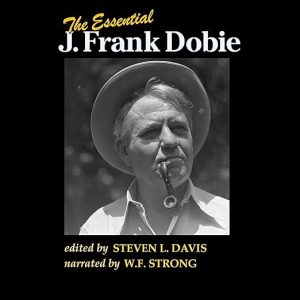
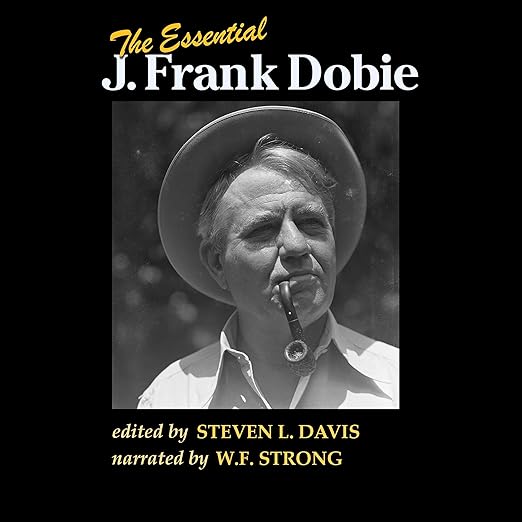
Dobie's folksy, erudite voice is the thing this audiobook is selling, and a different person supplies it. That is not a criticism, only the central fact of the enterprise. Nine hours and fifty-six minutes of J. Frank Dobie's stories and essays, selected by Steven L. Davis, read by W. F. Strong, published by Texas A&M University Press in July 2023. The copy promises that voice will come bounding back to life. Everything worth deciding about this recording sits in the gap between a writer's voice on a page and a reader's voice in a studio, and how far the second can stand in for the first across ten hours.
Editorial Labor With No Field to Record It
Davis is the name in the author field, Dobie is the name in the title, and both are accurate in a way that stays faintly disorienting. Davis, described here as a Dobie biographer, combed the works and gathered the most vital of them into a single volume. That is editorial labor rather than authorship, and the listing has no field in which to record it, so the credit lands where the form allows. Worth knowing before buying: every sentence you hear was written by someone other than the person named as author, and the order you hear them in was decided by someone other than the person named in the title.
Texas is the subject and also the boundary, and the copy is honest about both. Dobie captured social history that would otherwise have vanished, according to the description, bearing witness to pastoral ways of living as they ended. The selection ranges further than the state: Mexico, wartime Europe, a remote outback where he fell in among people hunting lost treasure. The copy also makes a claim it never develops, that Dobie ran decades ahead of his time on civil rights and on protecting the environment. Nothing on the page indicates whether the selected pieces demonstrate that, or whether it is offered for you to take on trust.
Never Before in Audiobook Form, Yet No Contents List
Campfire is the word the only written note on this page reaches for, and it turns out to be exactly right. Filed in June 2020 at five stars, it reports that you can set the book down for days at any chapter and pick it up again without losing anything, since each chapter carries a different story. It calls this spinning a yarn in the old sense, and it lists the range on offer: cattle drives, a scalping survived and later recounted, WWII stories. That note ends mid-sentence, just as it admits to never having read Dobie before this.
Unrecorded material is the pitch that justifies buying this in audio specifically. The description states that alongside previously published work, the collection features writing that has never before appeared in audiobook form, which is a claim about this product rather than about the text underneath it. What the page never does is say which pieces those are. No contents list appears anywhere on the listing, no piece titles, no count of them. A buyer who already owns Dobie in print therefore cannot work out how much of these ten hours is new, and that is the single question deciding whether the purchase makes sense.
Brushy Undergrowth, Pruned With No Account Given
Solitary is the condition of the written column here. Twenty-four people have logged a rating and exactly one has written anything, and that one entry is dated June 2020, just over three years before this recording was published. Whatever it is describing, it is not this edition. The gap is unremarkable for a university press title whose text long predates its audio release, and it does change what a four-and-a-half-star average means in practice. The figure is attached to a text that existed for years before the recording did, and the single written account belongs to that earlier era as well.
Wittliff Collections Literary is what the series field says, and the series number beside it sits empty, so the listing announces a sequence and then declines to place this title inside it. Texas A&M University Press is the publisher, which sets expectations correctly: a scholarly-adjacent edition rather than a commercial one, with the production values that usually implies. The genre tag is stranger. It reads Diaries and Correspondence, which describes neither the stories nor the essays making up the book, and would deliver anyone browsing that category to a place they did not mean to go.
Anthology is a form with a hidden editor, and this one announces itself. The copy states that the writings were meticulously edited to prune away some of the brushy undergrowth, a candid admission that what reaches your ears is not what Dobie published. Pruning is defensible and often necessary for a writer working in another century's rhythms. What is absent is any account of what came out. No note on the extent of the cuts, no marker in the audio signaling that you are inside a trimmed piece. For a collection calling itself essential, that is the one thing a listener would want flagged up front.
Folksy and Erudite Listening, Taken in Short Bursts
Folksy and erudite together make a genuinely unusual register, and anyone drawn to that combination is the reader this was assembled for. Listeners who like oral storytelling, who read Westerns for texture rather than plot, or who hold an interest in Texas before the highways arrived, will find ten hours of material that never demands they keep pace with an argument. Each piece begins and ends on its own terms, so the collection asks for attention in bursts rather than in one sustained block, which suits a lot of listening lives better than a continuous narrative does.
Anyone after a single sustained argument, or a biography of Dobie rather than a selection from him, should look elsewhere, because the shape here is deliberately loose and the book is his writing rather than his life story. Readers who want to know precisely which pieces they are getting will be frustrated by a listing carrying no contents at all. Existing Dobie readers face a purchase they cannot evaluate in advance, since the promise of previously unrecorded material arrives with no list attached to check it against.
Frequently Asked Questions
Who chose the pieces collected in this audiobook?
Steven L. Davis, who occupies the author field and is described in the copy as a Dobie biographer. The description also states the writings were meticulously edited to prune away some of the brushy undergrowth, so the texts have been trimmed rather than reproduced exactly as first published.
Is this audiobook a good first encounter with Dobie?
The copy positions it that way, describing a treasury that introduces new listeners to Dobie. The episodic build helps, since nothing assumes prior reading. The one caution is the editing: pieces have been trimmed, so a first encounter here is with a curated Dobie rather than the published one.