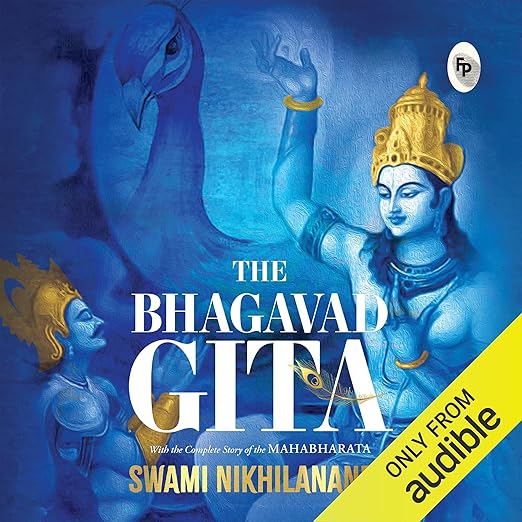
Quick Take
- Narration: Prashant Narula brings appropriate gravity and clarity to the Sanskrit-rooted material without over-performing the spiritual register.
- Themes: Self-realization, duty and righteousness, inner peace through action
- Mood: Contemplative and methodical, suited to reflective listening rather than background play
- Verdict: A lucid, accessible interpretation of the Gita that draws on Adi Shankara’s Advaita framework, best appreciated by listeners who want depth alongside accessibility.
I returned to the Bhagavad Gita during a quiet stretch last winter, the kind of stretch where the ordinary velocity of work slows down enough to ask larger questions. I have read several English versions over the years, starting with a classroom encounter with the Zaehner translation and moving through several commentaries since. What strikes me every time is how much depends on the interpreter’s angle of entry: the Gita is genuinely polysemous, and the same verses support dramatically different emphases depending on whether the commentator’s priority is action, devotion, knowledge, or some synthesis of the three.
This version, attributed in the metadata to Swami Kriyananda but introduced in the synopsis as Swami Nikhilananda’s interpretation, sits squarely in the Advaita Vedanta tradition. The review note about the commentary being based on Adi Shankara’s original is significant: Shankara read the Gita through his non-dualist framework, emphasizing jnana, knowledge, as the primary path to self-realization while subordinating karma and bhakti to that central axis. Listeners coming from a Vaishnava background, or familiar with Ramanuja’s counter-reading, will recognize that this is one interpretation among several major ones, not a neutral summary.
Our Take on The Essence of the Bhagavad Gita
The commentary’s strength, which multiple reviewers identify specifically, is the balance between simplicity of language and depth of exposition. One reviewer who had encountered numerous translations described it as the most lucid available in English, noting that it maintains philosophical rigor without demanding that the reader already know Sanskrit or have prior exposure to Vedanta. That is not a small achievement. The Gita’s eighteenth chapter is philosophically dense even in the original, and a commentary that makes Shankara’s reading genuinely accessible to an English-speaking listener unfamiliar with classical Indian philosophy is doing real work.
The practical guidance framing in the synopsis, language about finding purpose, overcoming challenges, attaining inner peace, reflects the contemporary marketing of the text rather than its classical character. The Gita’s teachings on duty and righteousness are demanding rather than comforting, and a good commentary does not soften them. Reviewers who encountered this through yoga teacher training and returned to it multiple times suggest the content rewards re-reading, which is consistent with how substantive philosophical texts work.
Why Listen to The Essence of the Bhagavad Gita
Prashant Narula’s narration is well-suited to the material. At sixteen hours and fifty-five minutes this is a substantial commitment, and the pacing needs to allow the philosophical content to settle between concepts. Narula reads with appropriate gravity without over-performing the spiritual register, a trap that audio narrators of sacred texts can fall into when they try to signal profundity through vocal texture rather than through pace and clarity. The result is an audiobook that feels like a reading companion rather than a recitation.
The length is appropriate given what is being attempted. A genuine commentary on the Bhagavad Gita that works through the text methodically, rather than offering a brief inspirational paraphrase, takes time. Listeners who want a quick orientation to the Gita would be better served by a shorter introductory text; this one is for people who are ready to engage with the philosophy in some depth.
What to Watch For in The Essence of the Bhagavad Gita
There is a metadata discrepancy worth noting: the audiobook lists Swami Kriyananda as author but the synopsis describes Swami Nikhilananda’s interpretation. These are distinct figures with distinct approaches. Kriyananda was a disciple of Paramahansa Yogananda and wrote his own Bhagavad Gita commentary in the Kriya Yoga tradition, while Nikhilananda translated and commented on the Gita from the Advaita Vedanta perspective. Reviewers describing the commentary as rooted in Adi Shankara align with Nikhilananda’s work. Worth verifying which commentary you are actually receiving before committing to seventeen hours.
The Advaita framing means the commentary is philosophically committed to a specific school. Listeners seeking a comparative or pluralist introduction to the Gita’s range of interpretations will find this too singular in its angle; it is better understood as a deep dive into one major reading tradition than as an overview of the text’s interpretive range.
Who Should Listen to The Essence of the Bhagavad Gita
This is for listeners who already have some orientation toward Vedanta, yoga philosophy, or Hindu thought and want to engage with the Gita’s central teachings in depth. It is also appropriate for serious practitioners of yoga whose training has introduced them to Vedantic concepts and who want a grounded, philosophically coherent account of the foundational text. The reviewer who described it as appropriate for yoga teacher training had exactly the right use case in mind.
Listeners looking for a quick spiritual inspiration hit will find seventeen hours of detailed commentary more than they need. Those who want an overview of the Gita across its major interpretive traditions would be better served by an introductory survey first.
Frequently Asked Questions
There appears to be a discrepancy between the listed author (Swami Kriyananda) and the synopsis (Swami Nikhilananda). Which commentary is this actually?
This is worth investigating before committing to seventeen hours. Kriyananda and Nikhilananda are distinct commentators with different approaches: Nikhilananda works from the Advaita Vedanta and Adi Shankara lineage, while Kriyananda comes from the Kriya Yoga and Paramahansa Yogananda tradition. Reviewers describing the commentary as based on Adi Shankara align with Nikhilananda. Check the Audible listing carefully before purchasing.
Is this commentary appropriate for someone with no prior exposure to the Bhagavad Gita or Hindu philosophy?
It is accessible in language but not designed as a first introduction. The commentary assumes some orientation toward why the Gita matters and what kind of text it is. A complete beginner would benefit from a brief introductory overview first. That said, reviewers without deep background have found it comprehensible, so it is not gatekept behind extensive prerequisite knowledge.
At nearly seventeen hours, is this structured so I can listen in sections, or does it require sustained linear attention?
The Gita has eighteen chapters and a systematic commentary works through them in sequence, which means the audio is naturally sectionable. You can follow one or two chapters at a time without losing the thread, provided you return to them in order. This format actually suits the reflective listening the material rewards – dipping in and sitting with a section before moving on.
How does this commentary compare to other popular English Bhagavad Gita versions like the Swami Prabhupada or Eknath Easwaran editions?
The Prabhupada version is deeply committed to Vaishnava Vaishnavism and Bhakti Yoga, with Krishna devotion as the central interpretive lens. Easwaran’s is more accessible and ecumenically spiritual, less philosophically committed. This commentary, rooted in Advaita Vedanta and Adi Shankara, prioritizes non-dualist knowledge as the path to self-realization. All three are serious but they disagree in important ways, and which one you engage with first will shape how you read the others.