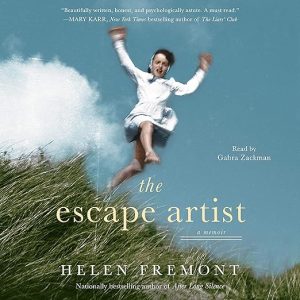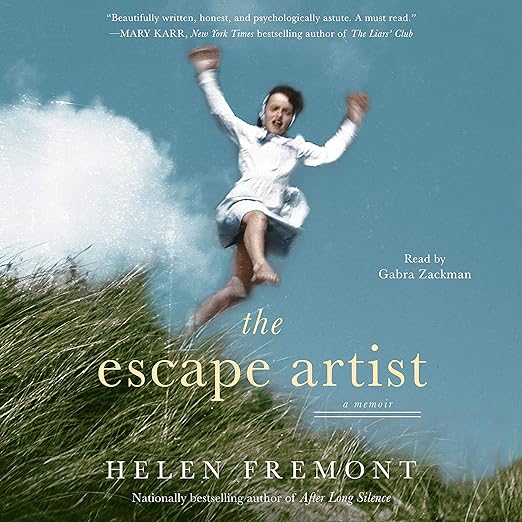
Helen Fremont's parents survived Nazi-occupied Poland by pretending to be Catholics. They brought that survival strategy into their postwar American lives, raising their daughters in a household organized around concealment so thorough that it extended to every domain: the family's Jewish identity, the parents' wartime experiences, the social rules that governed what could be said and to whom. This audiobook, narrated by Gabra Zackman, follows the particular cruelty of that inheritance - given in good faith by parents who believed concealment kept people safe because, for them, it had. What they transmitted to their daughters was not just a set of secrets but a complete orientation toward the world in which danger was the baseline assumption and disclosure was never, ever safe.
This audiobook, narrated by Gabra Zackman, is Fremont's account of navigating the adult consequences of that upbringing. The inciting event is the discovery that she has been disinherited in her father's will, which detonates the family structure that concealment had maintained and forces a reckoning with everything that structure had been protecting. What follows is memoir written with wit and candor, moving through family therapy sessions, her sister's unhinged meltdowns, her own disordered eating, and the long process of sorting out her sexual identity within a family framework where authenticity of any kind had been trained away. Zackman's narration runs 8 hours and 49 minutes, which is the right length for material this dense in family history and psychological detail.
What We Made of It
Fremont's previous memoir, After Long Silence, examined her parents' hidden Holocaust history. This audiobook functions as both a sequel and an inversion: where After Long Silence moved outward, investigating what her parents had hidden and why, The Escape Artist turns inward, examining what that history did to the daughters who grew up inside it without knowing its full dimensions. One reviewer who had been waiting for this book since After Long Silence describes the experience of reading it as finally getting the resolution she had been hoping for - and the specificity of that reader response, from someone who had clearly thought about Fremont's family story for years, speaks to what the audiobook accomplishes. It does not merely continue; it completes something.
Zackman's narration is one of the book's significant assets. Fremont writes with what reviewers have called frank humor about material that could easily collapse into unrelieved grimness - the family therapy sessions that go nowhere, the sister's explosive episodes, the memoir's own navigation of the difference between family loyalty and honest witness. Zackman reads those passages with the comic timing they require, which is harder to sustain in audio than it sounds: humor in the context of Holocaust memoir requires a narrator who understands that the humor is part of the honesty, not a defense against it. Zackman gets that calibration right.
The audiobook format does particular work for this memoir because Fremont's voice is, in the literary sense, her primary instrument. She writes in a register that is precise and self-aware, qualities that come through more clearly in a skilled audio performance than they sometimes do on a page where readers bring their own pacing. Zackman reads the self-aware passages with the appropriate absence of self-congratulation - these are not moments of performance but moments of achieved understanding, and the narration reflects that distinction.
The audiobook also works well for listeners who want to come to this memoir without prior knowledge of After Long Silence, because Zackman reads the necessary context from the first memoir into the listening experience naturally. Fremont does not require readers to have read the earlier book - she provides what she needs to provide, and no more - and hearing that provided context through narration integrates it smoothly rather than making it feel like a recap of something you were supposed to have already done.
Before You Commit to The Escape Artist
This memoir does not resolve neatly. Fremont's family relationships, by the end of the audiobook, have not been restored to health; her parents have not had a conversion experience; her sister has not achieved stability. What the memoir tracks is Fremont's own navigation of a situation that does not improve simply because she understands it better. For listeners who want memoir to deliver redemption arcs and reconciliations, this will be unsatisfying. For listeners who want memoir to tell the truth about what family damage actually looks like in the long run, that quality is precisely what makes it valuable.
The disordered eating material and the accounts of her sister's unhinged episodes are detailed and frank. One reviewer describes the book as putting down a memoir and being amazed at how the author survived her family - which is the right register of response, and indicates that the content is genuinely intense rather than merely described as intense. Listeners who are sensitive to detailed accounts of family dysfunction should factor that into their decision.
Best Suited For
Readers who found After Long Silence one of the essential Holocaust memoirs of the past two decades will want this audiobook as its natural companion. Listeners who are drawn to family memoirs in the vein of Mary Karr's The Liar's Club or Alison Bechdel's Fun Home - memoirs that combine psychological precision with structural sophistication - will find Fremont working in that tradition. Anyone interested in the multigenerational transmission of Holocaust trauma, examined from the inside of a family rather than from academic distance, will find this audiobook one of the most specific and honest accounts available.
Listeners who want uplifting resolution or who find detailed accounts of family dysfunction and disordered eating too close to their own experience should approach this carefully. Those looking for a conventional historical account of the Holocaust rather than a memoir of its aftermath in a single family will be better served by different material.
Before You Press Play
- Voice: Gabra Zackman brings a controlled but emotionally intelligent reading to this Holocaust-family memoir, understanding that the material requires restraint rather than performance to land with its intended force.
- Big ideas: Holocaust inheritance, family secret-keeping, sexual identity and belonging
- Atmosphere: Frank and searching, with flashes of dark humor that make the heavier passages bearable
- Worth it?: Helen Fremont's memoir of growing up in a family built on secrets earns its comparisons to the best of contemporary family memoir through its precision about what secrecy actually does to the people who live inside it.
A Few Questions About The Escape Artist
Do I need to have read After Long Silence before listening to The Escape Artist audiobook?
No. Fremont provides the necessary context from the earlier memoir within this audiobook, and Zackman integrates it naturally into the narration. The listening experience is complete without having read After Long Silence. That said, listeners who have read the earlier memoir will find The Escape Artist considerably richer, because they will already have lived with the family history that this audiobook processes.
Is The Escape Artist audiobook primarily about the Holocaust or about Fremont's own adult life?
Both, inseparably. The Holocaust history is the root system of everything Fremont examines in this memoir - her parents' compulsive secret-keeping, the family's hostility to disclosure, the dynamics that shaped her own relationship to identity and authenticity. But the narrative covers her adult life: the disinheritance, the family therapy, her sexual identity, her sister's instability. The Holocaust is not the subject but the source.
Does The Escape Artist audiobook reach a resolution or leave the family situation open?
It does not resolve cleanly, and that is deliberate. Fremont's family relationships have not been transformed by her understanding them better - her parents have not changed, her sister has not stabilized, the damage has not been undone. What the memoir tracks is Fremont's own navigation of that ongoing situation. Listeners who want memoir to deliver reconciliation and redemption will find this unsatisfying; those who want it to tell the truth about what family dysfunction actually looks like over time will find it compelling.