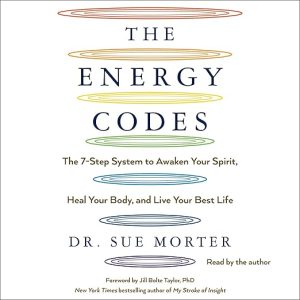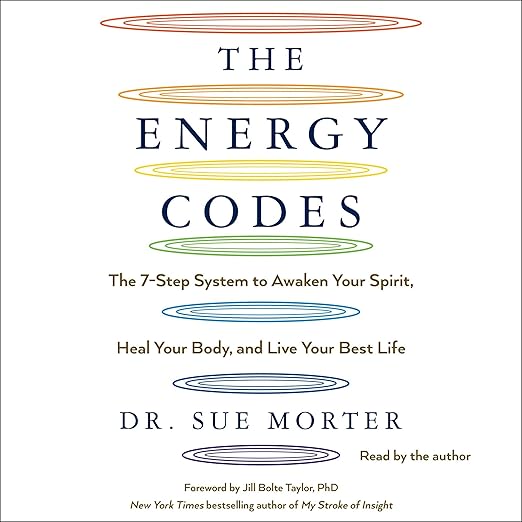
Twelve and a half hours is a serious commitment for a self-help program, and Sue Morter spends most of it teaching rather than persuading. The Energy Codes arrives as a seven-step system assembled from yoga, breathwork, meditation and Morter's own Bio-Energetic Synchronization Technique, and the audiobook is read by Morter herself. Whether the framing lands for you will depend almost entirely on how you feel about a book that puts energy medicine, neurobiology and quantum physics into the same sentence and then treats them as one continuous argument rather than three separate claims.
Morter's Meditation Origin Story Anchors the Program
The origin story is the spine of the whole program. Eighteen years before she wrote this, while meditating, Morter is described as spontaneously accessing "an energy field, a level of consciousness, beyond anything she had ever imagined", and the experience redirected her practice toward reproducing that shift for her patients. Years of study in energy healing followed, and the seven codes are what she distilled from them. That lineage matters because it explains the book's shape: it is a clinician's protocol dressed in the language of an awakening, not a memoir with exercises appended.
The endorsements tell you which shelf the publisher thinks this belongs on. Neale Donald Walsch supplies the front-of-copy line, "For those ready and willing to build a new life, here are the tools. Powerful, incisive, extraordinary writing." Anita Moorjani calls Morter an "extraordinary enlightened visionary". Jack Canfield credits the book with insights that "brilliantly merge the ever-blending worlds of science and spirituality". Read those three names together and you have an accurate map of the audience: this is written for people already inside the transformational-wellness conversation rather than for skeptics being invited in.
Morter Warms Up During the Guided Practices
Morter reads her own work, and the pacing belongs to someone used to explaining a protocol across a consulting room rather than performing a text in a booth. Unhurried, plainly committed, and consistent across the full runtime, which is not a given at this length. She is noticeably warmer in the guided practice passages than in the expository chapters, and that is the right way round for a program you are meant to do rather than merely finish. The instructional voice is the one you spend the most time with, and it holds.
The structure is more practical than the title suggests. Seven codes, each with exercises attached, each building on the last. Kathryn K's review is the most useful of the three attached, crediting the book with "detailed step by step guidance for using the 7 energy codes" and, more revealingly, describing it as "easy to understand" and not as "far out there" as others in the category can be. That second observation is the honest sales pitch. Within a genre where the vocabulary often outruns the instructions, this one keeps returning to something you can physically attempt.
The repeat-use pattern shows up in the other two reviews as well. Daniel C. writes that the book "has a wealth of information that has helped me heal many issues" and that he keeps it close by and returns to it repeatedly. Orchid's one-line verdict calls it "Filled with wisdom and years of practices with real result." Both are short, but both describe the same relationship: not a single listen, but a text people go back into. For a twelve-hour program, that is a more meaningful signal than a first-impression rave.
Yoga Sequences Get Lost Without the Page
The body-centered material does not fully survive the translation to audio. Breathwork and meditation are ideal for the format, because they are things you do with your eyes closed while a voice guides you. Yoga positions and the BEST protocol are not, and the sequence of what goes where is difficult to hold from listening alone. Kathryn K demonstrates the problem without meaning to: she mentions buying the hardcover because it is easy to keep open at the points she returns to, and her sentence is cut off there. Plan on a printed or digital reference alongside the recording.
Then the epistemic question, which deserves stating plainly rather than smuggled into a caveat. The copy grounds the program in energy medicine, neurobiology and quantum physics. Those three do not carry the same evidentiary weight, and the third is doing rhetorical rather than explanatory work here. If you need mechanisms that survive peer review, this program will not supply them, and no goodwill toward the breathing exercises changes that. What you can reasonably evaluate is whether the practices themselves are worth your time, which is a different and more answerable question.
The ratings pool attached to this listing is very small, small enough that the average carries almost no information. Judge the fit from the chapter list and a sample instead. It is also worth noting that two of the three reviewers describe handling a physical copy rather than listening, so their enthusiasm is evidence about the program and about Morter's writing rather than about the recording.
Pair the Recording With a Printed Reference Copy
This suits listeners already working somewhere in the somatic, yoga or energy-healing world who want a structured program rather than another manifesto. It suits people who respond to a practitioner's voice and who find a clinician's calm more convincing than a motivational one. And it suits anyone genuinely prepared to do daily breathwork, since the exercises are the product and the philosophy is the wrapper around them.
The right listener here is someone who will pair the recording with a printed copy and treat Morter's voice as the teacher rather than the reference manual. Anyone hunting for a clinically validated protocol, or who bristles when quantum vocabulary turns up in a wellness context, should look elsewhere; the friction will only grow across a runtime this long. And if you want a quick reset rather than a system, the seven-step architecture will feel like homework long before you reach code four.
- Narration: Morter reads her own program at a practitioner's unhurried pace, and the register warms noticeably when she moves from explaining a code to guiding a practice.
- Themes: Energy healing, breathwork and yoga, mind-body medicine, spiritual awakening
- Mood: Calm, earnest and steadily instructional
- Verdict: Worth the runtime if you will do the exercises and keep a printed copy nearby, not if you need peer-reviewed mechanisms.
A Few Questions About The Energy Codes
Can you follow the exercises from the audiobook alone?
Partly. The breathwork and meditations translate cleanly, since they are things you do with your eyes closed while a voice guides you. The yoga positions and the BEST protocol want a diagram, and one reviewer bought a hardcover specifically so she could keep it open at the sections she revisits.
Does Sue Morter narrate The Energy Codes herself?
She does, and it suits the material. She reads at the pace of someone accustomed to walking a patient through a protocol rather than performing a manuscript, and she is audibly warmer in the guided practices than in the explanatory chapters, which is the better balance for a program built around daily work.
How much real science is in this audiobook?
The copy names energy medicine, neurobiology and quantum physics as the grounding. In practice the neurobiology is illustrative and the quantum physics is metaphor. Treat the framework as a vocabulary for the exercises rather than as a mechanism and the program becomes considerably easier to use on its own terms.