- Narrator: Steve Quinn is the only name on the recording, and the material is thick with race jargon nobody stops to define.
- Subjects: Ultrarunning subculture, the design of deliberate failure, reclusive genius, what winning is actually for
- Tone: Wry and admiring, with an undertow of genuine strangeness
- Bottom line: A superb portrait of a man who built races nobody is supposed to finish.
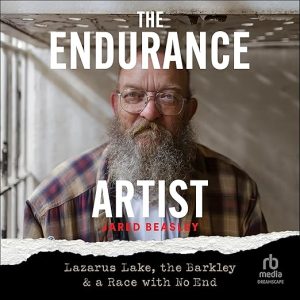
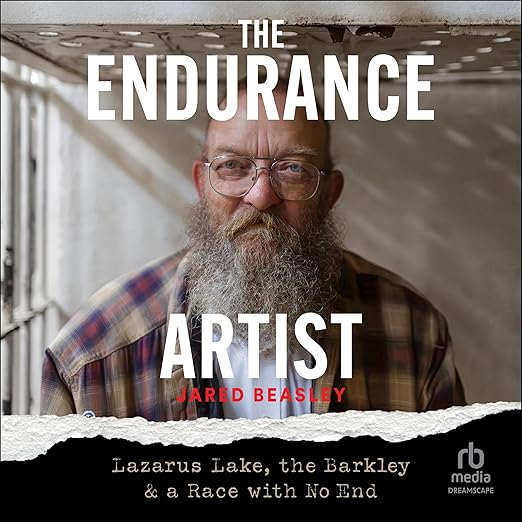
What kind of person hides books in the woods along a race course, starts a race with a lit cigarette, and designs a course whose climbing adds up to summiting Everest twice? An accountant from the Tennessee backwoods, as it happens. Gary Cantrell does business under the name Lazarus Lake, and Jared Beasley spent enough time inside his orbit to build a nine-hour-and-forty-one-minute audiobook out of him.
A Fight Club in the Wilderness, Run in Secret
Two events carry the book. The Barkley Marathons is described in the publisher's copy as the most difficult ultramarathon ever devised, "a fight club in the wilderness run in secret," and the details are exactly as strange as that suggests. Big's Backyard Ultra is the opposite kind of cruelty: a four-mile loop, run every hour on the hour, repeating until a single runner is left standing. The most recent winner named in the copy is "a high school teacher who ran 450 miles without sleep."
Cantrell himself is the harder subject, and the epithets attached to him do a lot of work. "Hillbilly genius" is one. "Leonardo di Vinci of pain" is the other, misspelling and all, which somehow suits a man whose hardest race is run in secret. The publisher's copy describes an enigmatic accountant who morphs into the world's most notorious race maker, and that verb carries the book: this is a study of a transformation rather than of a career.
Underneath the anecdotes sits an argument, and it is more interesting than the races. Beasley's subject is a recluse set on rewriting the rules of competition on purpose, and the copy states the stakes directly: Laz calls into question our obsession with winning and fairness, success and failure, and whether those ideas handicap potential. The races are the method. The argument about what failure is for is the actual content.
Too Strange to Invent for a Novel
Reach is the thing reviewers keep insisting on. Richard M opens a February 2026 response by asking what you get when an eccentric Tennessean with a gift for suffering designs the world's most brutal races, answers "Apparently, a life worth writing about," and calls the result "a page-turner that reaches far beyond the world of running." The same review issues an instruction to everyone else: "Don't let the ultramarathon setting put you off." Terri, at five stars, files it more simply as a portrait of "one of the most interesting race directors in the ultraverse."
Access is the other asset, and it is rarer than it sounds. Cy McMahon credits Beasley with patience and persistence in getting what the book needed and notes the payoff: "You get great insight into a world that is intentionally small." The same review states the problem of writing Cantrell at all: had Beasley invented this character for a novel, "pundits would claim it's not believable." Brian Nash, already familiar with Laz before opening it, still reports that the book "filled in lots of gaps in my understanding of his personal history as well as the history of his races." When a specialist audience says a book taught them something, the reporting held up.
Quinn Switches Between Three Names, Spoken Aloud
Steve Quinn is named as narrator, and the material hands him one specific structural problem. This is a reported biography, so it alternates between Beasley's own account and the talk he collected, and the man at the center answers to three names inside a single paragraph: Gary Cantrell on paper, Lazarus Lake in the race listings, Laz to everyone who has run for him. On the page your eye absorbs those as one person without effort. Spoken aloud, the switching has to be smooth enough that a listener never stops to reassemble who is being discussed.
A One-Star Verdict on a Shipping Decision
Examine what the score is actually measuring. The rating counter shows 4.8 across 243 ratings, and among the five written notices only one withholds a star. That one, filed in January 2026, is a complaint about packaging: "Beautiful softcover book. Sad that it was shipped in a soft side bag allowing the pages to become bent." It is a verdict on a shipping decision, not on Beasley. Strip it out and the four responses that assess the writing all award five stars, which makes the readable pool unanimous and also very small.
One review points somewhere the book does not go. Cy McMahon signs off anticipating a follow-up, "the sequel, Laz Walks, the story of Jared crewing for Gary" on a walk whose destination the visible text cuts off before naming. Take that as a signal about scope: this volume is a portrait of a race maker and his events, and at least one close reader already expects the walking project to need a book of its own. Do not come to this one looking for it.
Structure is the remaining caution. Brian Nash praises "just enough flashbacks to keep the reader engaged," which confirms the chronology moves around, and a listener has no page numbers to orient by when it does. Add a working vocabulary the book assumes you can follow, crewing, loops, backyard formats, cigarette starts, and the first hour asks more of a newcomer than the reviews quite acknowledge. It settles quickly, and the reward for staying is considerable, but it does not begin gently.
Waiting at Three in the Morning for a Headlamp
Ultrarunners are the obvious buyers, and Terri makes the recommendation for me: if you run ultras or love somebody who does, this is your book. I would widen it to anyone who crews, marshals, or has ever waited at three in the morning for a headlamp to come around a bend. The specialist detail is the pleasure here rather than the barrier, provided you already care about the specialty.
Conventional sports biography, with a career arc and a trophy case at the end, is not what Beasley wrote. Nobody in this story is trying to win anything, and readers who want their endurance writing to end in triumph will find the whole premise stubbornly pointed the other way. Anyone unmoved by eccentric Americans and their homemade institutions should also pass, because the eccentricity is not decoration on the subject, it is the subject.
Buried under the mileage is the argument that kept me listening. I find the question of whether our definitions of success quietly cap what people attempt more interesting than any finish line, and Cantrell has spent a working lifetime building experiments that test it on volunteers. Spending a commute with someone who genuinely does not believe in fairness the way the rest of us do turns out to be an excellent trade.