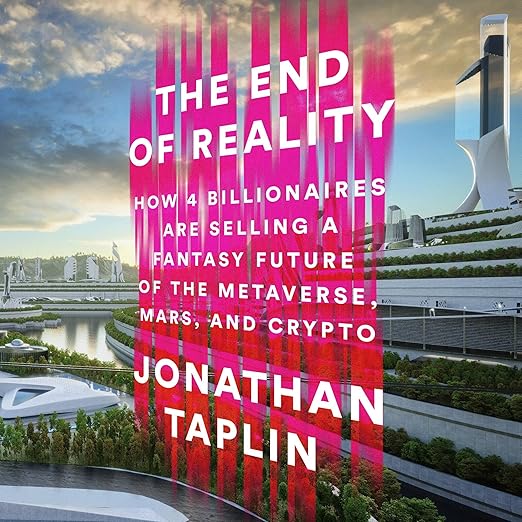
Quick Take
- Narration: Jason Culp reads with the measured gravity that the subject demands – clear and authoritative without tipping into alarm or editorializing.
- Themes: Tech billionaire power and ideology, metaverse and crypto as political distraction, regenerative economics as alternative
- Mood: Sharp and urgent, occasionally repetitive, consistently unsettling
- Verdict: A substantive critique of the four billionaires reshaping American society that has only grown more timely since its 2023 release.
I listened to The End of Reality during a week when the news had once again bent itself around the preferences of a small number of extremely wealthy men, and the experience of hearing Jonathan Taplin’s analysis in that context was something close to intellectual vertigo. Not because the arguments were new to me, but because the book had been published in 2023 and the events of 2024 and 2025 had validated its central anxieties faster than most political nonfiction gets the chance to be proven right.
Taplin is a former rock and roll manager turned film producer turned media scholar at the USC Annenberg Innovation Lab, and he brings that full range of experience to bear on a subject that most critics approach from a single angle. The result is one of the more complete accounts of how Peter Thiel, Elon Musk, Mark Zuckerberg, and Marc Andreessen – the four he calls, pointedly, just The Four – have used their platforms and capital to rewrite the terms of American life.
Our Take on The End of Reality
The book’s core argument is that the metaverse, cryptocurrency, space travel, and transhumanism are not merely speculative ventures but ideological projects designed to redirect public attention and public resources away from the compounding crises of income inequality, climate change, and democratic erosion. Taplin does not treat these as separate obsessions but as four facets of a coherent worldview that he traces back to specific intellectual influences and personal histories. The formative experiences of these men – the loneliness, the science fiction, the libertarian philosophy absorbed in youth – are presented not as armchair psychology but as documented origin stories with documented consequences.
What makes the analysis useful rather than merely polemical is the specificity. Taplin is working from documented public statements, financial flows, lobbying records, and policy outcomes. One reviewer compared it favorably to Chokepoint Capitalism and Survival of the Richest – both titles that share the same instinct for following the money rather than just the rhetoric.
Why Listen to The End of Reality
Jason Culp’s narration is well matched to the material. Political and economic nonfiction often suffers from narrators who either drone through statistics or punch up the outrage, and Culp avoids both errors. He reads Taplin’s more alarming passages with the same measured cadence as the expository sections, which paradoxically makes those passages land harder. The effect is of a careful thinker presenting an argument rather than a performer delivering a verdict.
At just under eleven hours, the audiobook is substantial but not bloated. Taplin moves through the personal histories, the ideological genealogy, the economic consequences, and his proposed alternative – regenerative economics that seeks sustainable growth with full employment – in a structure that rewards sequential listening rather than chapter-hopping.
What to Watch For in The End of Reality
The fair critique from at least one reviewer is that the book can feel thin and repetitive at points. The Four are examined from multiple angles over the course of the text, and listeners who track closely will notice some overlap between sections. This is partly a structural choice – the themes genuinely are interconnected – but it does occasionally produce a sense of circling rather than advancing. Andreessen in particular gets less probing treatment than the other three, a gap that the same reviewer noted as a missed opportunity.
The book also arrives with a distinct political perspective, which some readers will find clarifying and others will find tendentious. It is not disguised as neutral analysis. That transparency is probably a virtue, but it is worth stating plainly.
Who Should Listen to The End of Reality
Essential listening for anyone trying to understand how the technology industry intersects with political economy and democratic stability – and who wants an argument built from documentation rather than intuition. Those who have already read Shoshana Zuboff, Cathy O’Neil, or the titles mentioned above will find Taplin a complementary voice. Listeners seeking balance between pro-tech and skeptic perspectives will need to supplement this with other reading. Given what has unfolded since the 2023 publication date, it is arguably more relevant now than when it was released.
Frequently Asked Questions
Is The End of Reality still relevant given how quickly tech and politics change?
Arguably more relevant now than at its 2023 release. Multiple reviewers reading it during 2024 and 2025 noted that the trends Taplin identified had accelerated rather than reversed. The book’s predictions about policy capture and wealth consolidation have been substantially borne out.
Does Taplin offer any alternatives to the dystopian trajectory he describes?
Yes. The final portion of the book presents what he calls regenerative economics – a vision of sustainable growth with full employment that replaces the billionaires’ schemes. Whether you find it convincing depends on your prior commitments, but it is substantive rather than decorative optimism.
How does this compare to other big-tech critique books like Chokepoint Capitalism?
It shares the follow-the-money instinct and the structural critique, but Taplin’s focus is more biographical and ideological – he traces The Four’s worldviews back to personal and intellectual origins in detail that Chokepoint Capitalism does not. The books complement each other.
Is Jason Culp’s narration a good fit for dense political economy material?
Yes. He reads with measured authority rather than theatrical alarm, which suits Taplin’s analytical approach. The even pace allows the denser economic passages to register without becoming tedious.