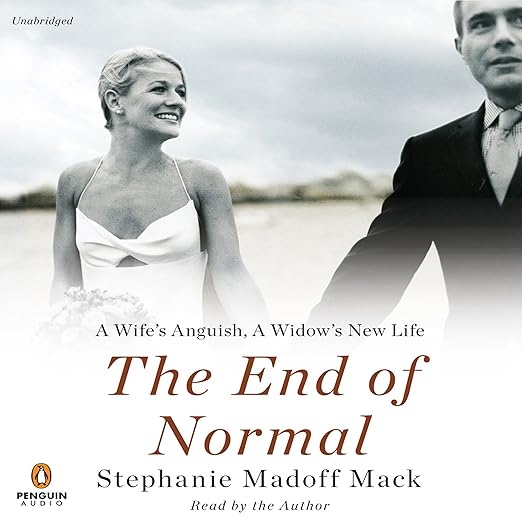
Stephanie Madoff Mack never asked to become a public figure through her husband's death, so what exactly is she owed by the public record that formed around her family before she had even begun grieving him? The End of Normal audiobook, narrated by Madoff Mack herself, spends six and a half hours answering that question on her own terms, and the self-narration is the single most important production choice this book makes.
An Explicitly One-Sided Personal Defense
This is a deeply personal insider account, and having Madoff Mack narrate it herself gives the book a credibility a hired narrator simply could not replicate: this is a widow defending her late husband's memory and processing genuine grief in her own voice, not a performance of someone else's testimony. That self-narration choice fits a pattern seen elsewhere in memoir, where the most emotionally exposed material benefits from the author's own voice precisely because the rawness reads as authentic rather than as a flaw to smooth over.
The synopsis itself frames the book's purpose plainly: Madoff Mack wrote it to give her children a sense of who their father really was, to defend his innocence, and to put her own account on record. That stated intent matters for setting expectations correctly; this is explicitly a one-sided, personal defense rather than an attempt at balanced journalism about the broader Madoff fraud, and the book is more honest for stating that purpose upfront rather than pretending otherwise.
For listeners who only know the broad outline of the Madoff case, the numbers are worth restating for scale: Bernard Madoff's scheme is widely regarded as the largest Ponzi scheme in history, with tens of billions of dollars in losses affecting thousands of investors, from individual retirees to major charitable foundations. Madoff Mack's memoir does not dwell on those broader statistics; it stays close to her own household, which is precisely what makes it a useful companion to, rather than a replacement for, the financial journalism already written about the case.
A Voice That Deserves to Be Heard
The specific details carry real weight: an idyllic wedding on Nantucket before everything changed, the day Bernard Madoff's Ponzi scheme became public and his sons Mark and Andrew turned their own father in, the two hundred million dollar lawsuit filed against family members in October of 2009, and Mark's death by suicide on the two-year anniversary of his father's arrest. Madoff Mack narrates her own attempt to build a fresh start for her two young children in the aftermath of all of it.
One review describes this as a voice that deserves to be heard specifically because so many of the scheme's other victims never got a public platform for their own stories, positioning Madoff Mack's account as filling a real gap in how the Madoff scandal has been told, from inside the family rather than through financial journalism or courtroom coverage.
The book covers the texture of daily life inside a family under sudden, total public scrutiny, adjusting to a husband she describes hardly recognizing anymore under the pressure, which gives listeners a genuinely different angle on a story most people only know through headlines about stolen billions.
Trading the Madoff Name for Mack
The decision to change her own surname from Madoff to Mack, mentioned directly in one listener review, is a small detail that captures the book's larger project: reclaiming an identity for herself and her children that is not permanently defined by a scandal neither of them caused. That name change runs as a quiet undercurrent through the memoir's second half, as she describes building a version of normal life for her children that does not require explaining the Madoff name at every turn.
The Only Account Narrated From Inside the Family
That one-sidedness has real texture worth naming directly. A listener review is candid about finding it hard to empathize with some of the material, specifically noting that Madoff Mack repeatedly returns to her inability to understand choices made by her mother-in-law, Ruth Madoff, in ways that reviewer found the book indulges more than the narrative needs to. That is a fair critique worth flagging honestly rather than smoothing over.
The subject matter includes suicide discussed directly and without euphemism, which listeners should be prepared for going in, even though Madoff Mack handles her husband's death with evident care rather than sensationalism. This title also carries a small review sample, just two ratings, so prospective listeners have less crowd-sourced confirmation than a book with wider reach would offer.
Because the book was written relatively soon after Mark's death, the prose carries an unprocessed rawness in places that a memoir written with more distance might have smoothed over; whether that immediacy reads as a strength or a difficulty will likely depend on how a given listener feels about grief writing that has not yet achieved full narrative distance from its subject.
This arrived among a wave of Madoff-related books published in the years immediately following the scandal's collapse, most written by journalists or prosecutors working from the outside. Madoff Mack's account stands apart from that wave specifically because it is the only one narrated from inside the family by someone who lost a spouse to the fallout, which is precisely the gap her book was written to fill.
One Family Member's Self-Narrated Reckoning
This suits listeners interested in the human and family fallout of the Madoff scandal beyond the financial-crime headlines, memoir readers drawn to grief and public tragedy specifically, and anyone who wants the family's own account rather than only the journalistic version of this story.
Skip it if you want an even-handed, multi-perspective account of the broader fraud; this is not built to be that, and it says so plainly. For listeners seeking one family member's honest, self-narrated reckoning with an impossible situation, it delivers exactly that.
Good to Know
Does Stephanie Madoff Mack narrate The End of Normal audiobook herself?
Yes. She narrates her own memoir, which gives the material a personal credibility a hired narrator would not bring to this specific story.
Is The End of Normal audiobook a balanced account of the Madoff scandal?
No, and it does not claim to be. This is explicitly a personal, one-sided defense of her late husband, written to put her own account on record.
How long is The End of Normal audiobook?
It runs 6 hours and 36 minutes.