Quick Take
- Narration: Greg Wagland delivers a clear and unhurried read that suits the measured analytical prose well, though the material’s complexity occasionally outpaces the audio format’s capacity for note-taking.
- Themes: The structural fragility of modern banking, the limits of economic theory, radical monetary reform
- Mood: Serious and rigorous, intellectually demanding but written with a deliberate clarity
- Verdict: The most authoritative insider account of what went wrong in 2008 and what genuinely needs to change, essential listening for anyone who wants to understand the banking system from the inside out.
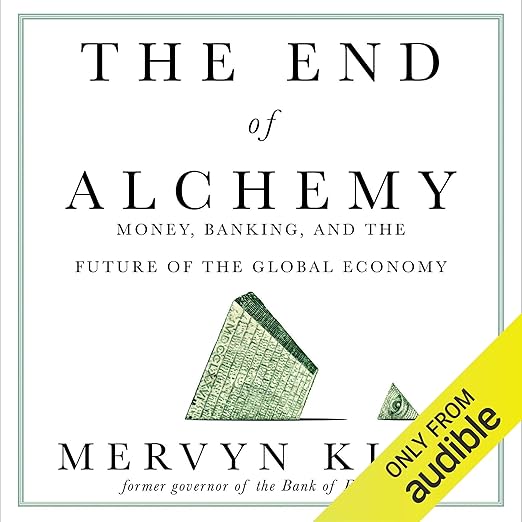
I came to The End of Alchemy during a period when I was working through a stack of post-2008 financial crisis books, trying to understand which ones were written by people who genuinely knew what they were talking about versus people who had read the same three papers everyone else had read. Mervyn King, who ran the Bank of England for a decade and sat at the center of the crisis as it unfolded, is in a category almost entirely by himself. When he describes the structural weakness of the banking system, he is not theorizing from the outside. He is describing the machine he operated.
That authority is the book’s defining characteristic and, in a way, also its limitation. King writes with the confidence of someone who does not need to prove his credentials, which means he sometimes assumes a level of economic literacy that general readers may not possess. The language is deliberately plain, and he works hard to explain the mechanisms of modern finance in accessible terms. But the underlying argument is genuinely complex, and the audiobook format removes the ability to pause, re-read, and diagram the chains of causation he is tracing. Listeners with a background in economics or finance will extract the most from a single pass.
What Financial Alchemy Actually Means and Why It Matters
King’s central metaphor is precise and illuminating. The alchemy of his title refers to the twin transformations that made modern finance possible: the conversion of paper into money equivalent to gold, and the transformation of illiquid long-term loans into safe short-term deposits. Both processes created extraordinary economic power. Both processes also created radical systemic fragility, because both depend on collective belief that can evaporate. When that belief fails, as it did in 2007 and 2008, the entire construction collapses at a speed that leaves even central bankers scrambling to respond.
The historical sweep of his argument is genuinely impressive. He traces these mechanisms from the Industrial Revolution through the development of central banking and the establishment of the lender of last resort function, showing how what seemed like a reliable safety net became, under modern conditions, an invitation to excessive risk-taking. The distinction he draws between his own position and Bagehot’s original formulation of the lender of last resort role is one of the more technically illuminating passages in recent financial writing, and it repays careful listening.
The Reform Agenda and Its Radical Implications
King is not content to diagnose. The back half of the book lays out a reform agenda that one reviewer accurately described as bold, which is an understatement. His proposals involve rethinking the relationship between banks and central banks at a fundamental level, moving toward what he calls the pawnbroker for all seasons model in which banks pre-position collateral with central banks in advance rather than scrambling for liquidity during a crisis. He is also clear-eyed about the structural imbalances in the global economy: China’s persistent export surplus, the euro’s fundamental design problem, the perverse effects of sustained low interest rates intended to stimulate investment that instead suppress it.
One reviewer described him as steering away from blaming the bad guys to explain structural weakness, and that is accurate and refreshing. This is not a morality tale about greedy bankers. It is an argument about system design, about how rational actors behaving sensibly within a flawed architecture will produce catastrophic outcomes reliably. That framing is more useful and more accurate than the narrative of individual malfeasance that dominated most popular crisis accounts.
Listening Versus Reading This Kind of Book
Fourteen hours of economic argument is a serious commitment, and the audiobook format suits some sections better than others. The historical and narrative passages, King’s account of how he experienced the crisis in real time, his sketches of the personalities involved in central banking decisions, listen beautifully. The more technical passages, particularly the discussion of equilibrium economics and its discontents, will leave audio-only listeners wishing for a whiteboard. Greg Wagland reads with appropriate gravity and does not rush the argument, but the format cannot substitute for the margin notes and re-reading that this kind of material rewards.
Either way, this free audiobook is essential listening for anyone who wants to understand what actually happened in 2008 from the perspective of someone who had to manage it. King’s willingness to propose genuinely radical reform rather than incremental adjustment is rare in a policy-maker memoir, and his insider credibility gives those proposals weight that outsider critiques simply cannot match. King’s willingness to propose genuinely radical reform rather than incremental adjustment is rare in a policy-maker memoir, and his insider credibility gives those proposals weight that outsider critiques simply cannot match. The historical passages alone justify the 14-hour commitment.
One of the book’s underappreciated strengths is King’s account of the human dimension of central banking: the pressure of decisions made under radical uncertainty, the relationship between economic theory and political reality, the way that models developed in relatively stable conditions fail catastrophically when conditions change. These passages read almost like memoir, and they give the technical arguments an emotional texture that pure economics writing rarely achieves. For a former central banker, the candor King brings to the book’s most politically sensitive sections is striking, and it elevates the work above the genre of comfortable institutional memoir into something closer to genuine reckoning. Understanding how the machine worked, and how it failed, remains the prerequisite for any serious conversation about what financial reform might actually accomplish.
Frequently Asked Questions
Is this accessible to listeners without a background in economics or banking?
King writes with deliberate clarity and defines his key concepts carefully, but the argument is genuinely complex. Listeners with basic economics literacy will follow the core argument. Those without any background may find the middle sections on monetary theory challenging in audio format.
How does King’s account of the 2008 crisis differ from other popular books on the subject?
King was a central participant rather than a journalist or academic observer. His account focuses on structural system design rather than individual behavior, and his reform proposals are more radical and specific than most popular treatments of the crisis.
Does Greg Wagland’s narration add anything to the listening experience, or is this primarily a text-driven book?
Wagland is a functional rather than a characterful narrator: clear, well-paced, appropriate to the material. The book’s value is entirely in King’s thinking rather than in any performative dimension of the narration.
How relevant is this book given it was written in 2016?
The structural diagnosis remains fully relevant because the underlying problems King identifies have not been resolved. Specific policy proposals and some market conditions have evolved, but his core argument about banking fragility and the need for fundamental reform is, if anything, more pertinent now than when it was written.