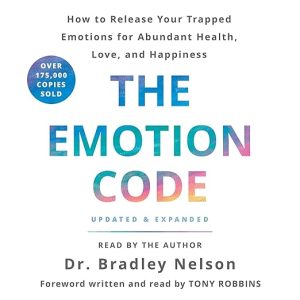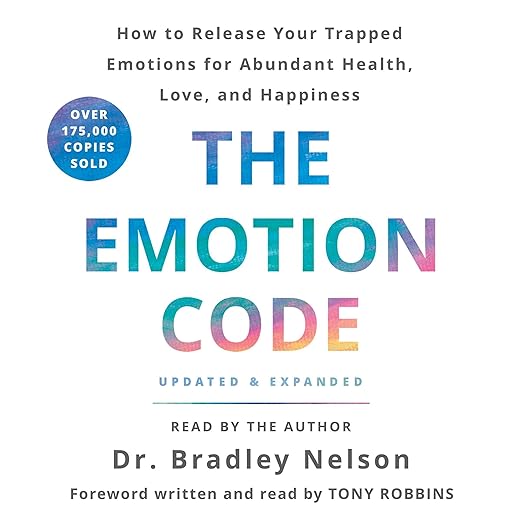
Dr. Bradley Nelson makes a genuinely specific, testable-sounding claim inside an otherwise unfalsifiable framework, and that tension defines the entire ten hours of this audiobook. The Emotion Code argues that emotionally charged past events leave behind trapped emotions, specific emotional energies Nelson says physically inhabit the body and eventually cause pain, dysfunction, and disease. This newly revised and expanded edition opens with a foreword that Tony Robbins wrote and narrates himself, which means two self-narrated voices with genuine public authority in their respective fields speak before Nelson's own ten-hour case for his method even begins.
Nelson Narrates His Own Clinical Case Studies
Nelson narrates his own material, and as a holistic physician describing his own clinical method built from years of practice, that self-narration functions as a real asset rather than a formality. He knows exactly where his own emphasis belongs, and the case studies that make up much of the book's evidence land with more direct authority coming from the practitioner who actually ran them than they would from a hired narrator reading someone else's clinical claims secondhand. Reviewer Cheryl's review captures the effect directly: she describes being introduced 'to the wonderful world of muscle testing' through the book and being skeptical at first before coming around, exactly the arc Nelson's own narration seems built to walk a listener through. That specificity is worth noting since plenty of energy-healing content stays deliberately vague by comparison.
It's worth being direct about where this book sits: muscle testing, trapped emotional energy, and the idea that releasing them can address physical pain are not concepts with mainstream clinical research behind them, whatever their popularity among alternative-medicine practitioners and their patients. Judged purely on its own internal terms, though, the book is coherent, Nelson lays out his system methodically across ten hours, connects concept to case study to practical technique in a consistent internal logic, and never asks a listener to accept something without walking through his own reasoning for it first.
The phrase trapped emotions itself is doing specific conceptual work in Nelson's framework, distinct from more general language like unprocessed feelings or emotional baggage that other self-help authors reach for. Trapped implies containment, something that can be physically located and released through a specific technique, which is exactly the promise the book makes, not just processing feelings through reflection or talk therapy, but identifying and releasing discrete units of stuck energy through muscle testing. Whether or not that literal framing holds up to clinical scrutiny, it gives listeners a concrete mental model to work with, which likely explains why the technique has built the devoted following it clearly has among listeners like Cheryl and LPower Inkhorn.
Quantum Touch and EFT Fans Will Recognize This
Reviewer LPower Inkhorn, identified as an NLP trainer, situates the book within a broader landscape of energy-based healing modalities, comparing it directly to Quantum Touch and EFT, which suggests real crossover appeal for listeners already engaged with that wider self-healing and energy-work community. For that specific audience, Nelson's system offers another structured tool alongside ones they may already practice, rather than requiring a first introduction to the underlying worldview.
At 4.6 stars, the reception here is strong among listeners who engage with the material on its own terms, and Cheryl's arc from skepticism to enthusiasm is echoed structurally in how Nelson builds his own case: he doesn't assume belief from the outset, instead walking through the mechanism, the case studies, and the practical release technique in a sequence clearly designed to bring a doubtful listener along step by step rather than demanding faith upfront.
This is explicitly presented as an updated edition, which signals real ongoing investment in the material rather than a book left untouched since its original publication. Publishers and self-published authors alike don't typically invest in revising and expanding a title unless the original has demonstrated sustained demand, and pairing that update with a fresh Tony Robbins foreword suggests Nelson and his team see continued, active audience growth for this specific framework rather than a one-time trend that already peaked. For a returning reader of the original edition, that expansion alone may justify revisiting the material in this newer form.
Nelson's Case Studies Are Anecdotes, Never Controlled Trials
Nothing about muscle testing or trapped emotional energy is falsifiable in any clinical, peer-reviewed sense, and listeners wanting evidence-based nonfiction grounded in controlled studies rather than case studies and testimonials will spend ten hours genuinely frustrated with the book's core premises. This distinction matters enough to state plainly upfront rather than let a strong star rating imply mainstream medical consensus that doesn't actually exist here.
One reviewer, tcreasman, offers a genuinely double-edged five-star review, praising the book while joking that readers should 'smoke joint before reading to make better sense' of it, a comment that, jokingly or not, captures something real about how polarizing this kind of material can be even among listeners who ultimately rate it highly. That tension, real enthusiasm paired with an acknowledgment the framework asks for a real leap, runs underneath the book's mostly positive reception.
It's worth being specific about what case studies means as evidence throughout this book: these are patient anecdotes drawn from Nelson's own clinical practice rather than controlled studies with comparison groups, which is a meaningfully weaker form of evidence than listeners might assume from how confidently they're presented. That distinction matters for calibrating expectations correctly, anecdotal case studies can be genuinely compelling as illustration and genuinely insufficient as proof at the same time, and a careful listener should hold both of those truths simultaneously rather than either dismissing the stories outright or treating them as settled science. Nelson's own narration, delivered with the same steady confidence throughout, doesn't naturally signal where that evidentiary line sits, so it falls to the listener to draw it.
Written for Believers, Frustrating for Committed Skeptics
Listeners already comfortable with energy-healing language and alternative-medicine frameworks, or at least genuinely curious enough to suspend skepticism for ten hours, will find a fully realized, internally consistent system here. It also suits existing fans of Tony Robbins specifically, given his self-narrated foreword, and listeners already engaged with modalities like EFT or Quantum Touch looking for a complementary technique. Listeners who have already tried more conventional therapy or self-help approaches without full satisfaction may find Nelson's alternative framework worth exploring with a genuinely open mind, even without embracing every claim wholesale.
Clinical, peer-reviewed validation simply isn't part of this framework's foundation, so committed skeptics wanting hard scientific proof rather than testimony and anecdote should expect ten hours of frustration rather than persuasion. This is a book for listeners willing to meet Nelson's premises on their own terms, not one built to convince a determined doubter.
- Narrator: Dr. Bradley Nelson's self-narration lends direct clinical authority, and Tony Robbins reads his own foreword, adding a second credible voice upfront.
- Subjects: Trapped emotional energy, muscle testing, alternative and energy-based healing
- Tone: Earnest and methodical, building a case step by step rather than assuming belief
- Bottom line: A coherent, well-organized case for a framework with no mainstream clinical backing, best for listeners already open to energy-healing concepts.
Frequently Asked Questions
Does Dr. Bradley Nelson narrate this audiobook himself?
Yes, and as the method's own creator, his self-narration adds direct authority to the case studies and technique explanations throughout.
Is the Tony Robbins foreword included as audio in this audiobook?
Yes, Robbins wrote and reads his own foreword, which opens the audiobook before Nelson's ten-hour explanation of his method begins.
Is The Emotion Code based on mainstream clinical research?
No. Muscle testing and trapped emotional energy are not concepts with mainstream peer-reviewed backing, though the book is internally coherent and methodically organized on its own terms.
Who is the audience for this audiobook?
Listeners already comfortable with or curious about energy-healing frameworks like EFT or Quantum Touch will get the most from it; listeners wanting clinical evidence-based nonfiction should look elsewhere.