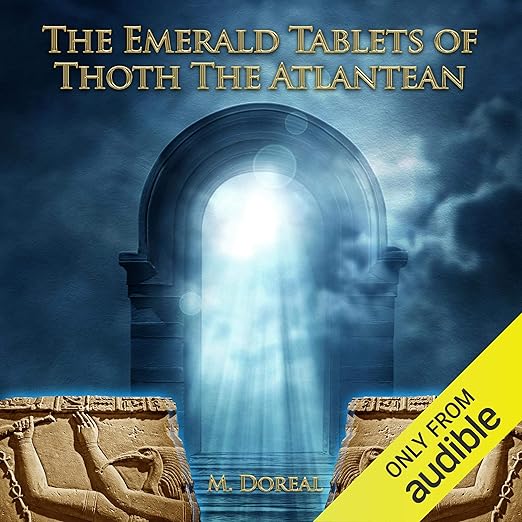
M. Doreal's translation of the Emerald Tablets of Thoth the Atlantean arrived in the mid-twentieth century claiming to render a text of staggering antiquity, some thirty-six thousand years by the author's account, written by an Atlantean Priest-King who founded a colony in ancient Egypt and built the Great Pyramid. None of that archaeology is supported by mainstream scholarship. The audiobook, narrated by John Marino, is something else: an encounter with a particular strand of Western esoteric thought, the Hermetic and Theosophical currents that run beneath academic history and resurface periodically in texts like this one.
Doreal presents himself as a translator rather than an author, though the nature of his access to the original tablets is not clarified in any way that would satisfy a historian. The tablets themselves are written in a distinctive register: rhythmic, aphoristic, cycling through cosmological declarations about light, the nature of consciousness, the structure of hidden reality, and the path of the spiritual initiate. The voice attributed to Thoth is not narrative in the conventional sense. It pronounces, instructs, and warns. The prose is ceremonial in character, built for incantation rather than for argument, and that quality shapes how the audiobook format serves the material.
Reviewer Nathan Shields described the work as quite possibly one of the most important works of all time, and reviewer MBS described it as touching their heart and offering a profound sense of hope and healing. These responses reflect the devotional relationship many readers bring to the text, treating it as a spiritual source rather than a historical artifact or literary curiosity. The Tablets sit within a clear esoteric lineage for those who know it: the Hermetic tradition, Theosophy, and the occult revival of the early twentieth century all contribute to the text's sensibility and have shaped how generations of readers have approached it.
For listeners approaching the Tablets through the lens of esoteric tradition, the text has accumulated a significant following precisely because it makes ambitious cosmological claims with a confidence that many spiritual readers find clarifying rather than dubious. The history of the tablets translated in this book is described as strange and beyond the belief of modern scientists, and Doreal makes no effort to reconcile his account with conventional archaeology. The text operates in a different epistemic register entirely, one that prizes inner knowing and spiritual authority over external verification.
Why It Works in Audio
The audiobook format is particularly effective for this kind of text. The Tablets are written to be heard rather than parsed. Their rhythms are incantatory, their repetitions deliberate, and their cosmological passages reward the kind of diffuse attention that listening enables more naturally than close reading does. John Marino's narration understands this. He reads with the gravity appropriate to ceremonial prose without performing mysticism in ways that would feel artificial. The two hours and thirty-three minutes pass in a state that some listeners will find meditative and others simply unusual.
The short runtime also makes the audiobook usable as repeated listening, which is consistent with how many readers of esoteric texts engage with them. The Tablets' aphoristic structure means that individual passages stand independently, and audio allows those passages to resonate differently across multiple encounters. A text that rewards repeated engagement is well suited to the audiobook format, where listening again costs nothing but time.
Weak Spots in The Emerald Tablets of Thoth the Atlantean
The historical claims in this audiobook deserve direct acknowledgment. Doreal's account places the Tablets at thirty-six thousand years of age, attributes the Great Pyramid's construction to an Atlantean priest-king, and treats Atlantis as historical fact. None of this corresponds to any accepted archaeological or historical record. Listeners who require a foundation in established scholarship before engaging with ancient texts will find this audiobook incompatible with their reading practice. Listeners who engage with esoteric and mystical traditions on their own terms, without demanding external historical verification, will find the material considerably more engaging.
The cosmological framework in the text also makes claims about the structure of reality, hidden dimensions of existence, and the nature of consciousness that sit entirely within the esoteric tradition rather than within contemporary physics or neuroscience. The Tablets do not attempt to bridge mystical tradition and modern science. They are fully committed to their own system, and readers engaging with them do so on those terms or not at all.
The tradition within which the Tablets circulate is also worth understanding for listeners who are new to it. Hermeticism, the tradition named for the semi-mythological figure Hermes Trismegistus who is identified with both the Greek Hermes and the Egyptian Thoth, encompasses a body of texts concerned with cosmological knowledge, alchemical transformation, and the path of spiritual initiation. The Emerald Tablets as Doreal presents them sit squarely within that tradition, drawing on the same framework of hidden knowledge that the serious spiritual seeker must work to uncover and internalize. For listeners who understand that context, the Tablets will feel immediately familiar. For those who do not, the audiobook offers an introduction to a tradition that has shaped Western esotericism for centuries.
Who Will Get the Most From It
This audiobook is for listeners already comfortable with esoteric, Hermetic, and Theosophical traditions who want to encounter one of the more widely read texts in that lineage. It works for those interested in the history of Western occultism, for listeners drawn to mystical prose on its own terms, and for anyone who approaches ancient wisdom traditions with genuine openness rather than academic skepticism. Listeners seeking historically verified ancient texts, reliable archaeology, or scientifically grounded spiritual guidance should look elsewhere. Those ready to engage with the material as a transmission from a tradition rather than as a document of history will find the audiobook a genuinely unusual listening experience.
Are the Emerald Tablets of Thoth historically verified ancient texts in this audiobook?
No. The claims made in Doreal's introduction, including the 36,000-year antiquity and Atlantean authorship, are not supported by mainstream archaeology or history. The audiobook is best approached as an esoteric and mystical text within the Western occult tradition rather than as a historical document.
How does John Marino's narration suit the material in this audiobook?
Well. The Tablets are written in an incantatory, rhythmic register designed to be heard rather than analyzed, and Marino delivers that quality with appropriate gravity. His pacing allows passages to resonate without overdramatizing the mystical content.