In Brief
- Performance: Kirk narrates his own work with evident enthusiasm that works well in action sequences but tips into keynote-speaker energy during analytical passages.
- What it covers: Entrepreneurial risk-taking, technological disruption, failure as strategy
- Feel: Fast-moving and energized, closer to a business thriller than a standard biography
- Our call: A brisk, admiring portrait of Musk's ambitions that suits fans and technologists more than listeners seeking balanced assessment or critical distance.
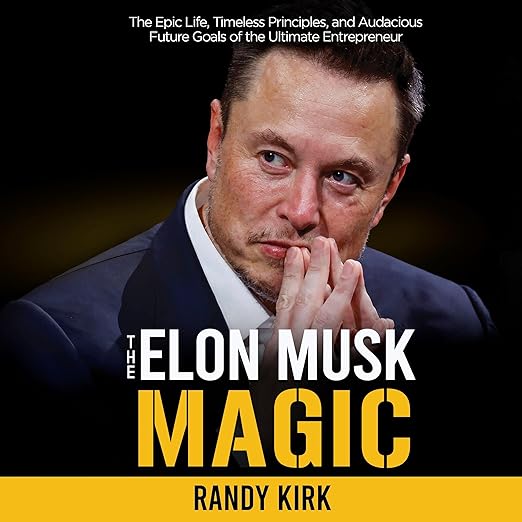
Randy Kirk poses a question worth sitting with at the start of this audiobook: what does it actually take to hold multiple civilization-scale projects in your head simultaneously and push all of them toward completion at once? The framing is not neutral. Kirk is an admirer, and he is upfront about it. But the question itself is legitimate, and The Elon Musk Magic spends seven hours trying to answer it through story rather than through analysis.
I started listening during a long drive and found that Kirk's narrative approach, heavy on scene-setting and real-time drama, suits the format better than a more traditionally structured biography might. The opening sequence, a midnight launch at Starbase with engineers bracing for catastrophe and Musk standing calm amid the tension, sets the tone immediately. Kirk is writing for pace, not for archive. Whether that serves the subject depends on what you are looking for.
Capturing the Romance of the Ambition
Kirk's thesis is that Musk operates by treating failure as accelerant and audacity as currency. He covers Tesla's near-bankruptcy and eventual dominance, SpaceX's reusable rocket revolution, Neuralink's brain-computer interface ambitions, xAI's stated pursuit of truth through artificial intelligence, and the Optimus robot project. That is a lot of ground, and at just over seven hours, the book moves quickly through each domain. The result is more portrait than deep dive, which Kirk appears to intend.
What distinguishes this from other Musk books, including Walter Isaacson's more critical 2023 biography, is the focus on what Kirk calls the romance of the ambition. He is less interested in contradictions or controversies than in capturing the feeling of watching someone do things that did not look possible. That is a legitimate editorial choice, though listeners looking for critical distance will need to look elsewhere. One reviewer described it as reading like an epic thriller unfolding in real time, which is precisely what Kirk is after.
Kirk's Analytical Passages Can Feel Like a Keynote
Kirk narrates his own work, which carries risks and rewards. His delivery is enthusiastic, occasionally to a fault. When Kirk describes launch sequences or near-failures, the energy works. When he moves into more analytical passages about first principles thinking or corporate strategy, the self-narrated pace can feel like a keynote speaker rather than a book. Listeners who share Kirk's genuine admiration for the subject will find the narration contagious. Those who prefer a more measured reading voice may find it grating.
Kirk is himself the author of 'AI Rising: How to Thrive in the Age of Abundance,' and his interest in the technological and entrepreneurial dimensions of Musk's work is evident throughout. He handles the SpaceX material with particular energy, and the Tesla chapters benefit from a clear understanding of what it means to try to disrupt an established industrial sector. The Neuralink and xAI sections are necessarily more speculative given how early those projects remain, and Kirk's optimism in those chapters is less grounded than elsewhere.
Both Companies on the Edge of Collapse in 2008
The book's admiring stance is its most significant limitation. Musk's complex public behavior, his use of social media to move markets, his management practices, his public disputes with employees and regulators, these appear briefly if at all. Kirk is writing about the magic, not the whole person. Listeners who want a balanced assessment of Musk's legacy, including his failures of leadership and the costs his companies have imposed on workers and the public, will find this book incomplete as a primary source.
Books about figures who are actively reshaping their companies and public profiles weekly face an inherent dating problem. Some of what Kirk describes was still unresolved at the time of writing, and the optimistic framing of certain projects may not have aged uniformly. That is not a flaw unique to this book, but worth noting for listeners who want current accuracy over narrative energy.
One aspect of Kirk's approach worth noting is how the book handles the tension between Musk's stated ideals and his operational methods. Kirk is not unaware of the contradictions. He acknowledges near-bankruptcies, failed timelines, and moments where the vision outran execution significantly. But his interpretive frame is consistently that these were necessary costs of attempting things no one had done before. That framing will resonate with readers who are already committed to the idea that civilization-scale ambition justifies a certain tolerance for collateral damage. It will feel insufficient to readers who think the human costs of that ambition deserve weight in the final accounting.
Kirk also provides context that often gets lost in coverage focused on Musk's more recent controversies. The early chapters on Tesla's founding and SpaceX's first years are written with the hindsight of someone who has watched the company survive conditions that would have ended most ventures. The specific near-failures, the time in 2008 when both Tesla and SpaceX were simultaneously on the edge of collapse, are described in enough detail to understand why the companies' eventual success feels to Kirk like the vindication of a particular philosophy rather than simply the result of luck and capital.
Seek Out Isaacson's Elon Musk Instead
This audiobook suits listeners who want an energetic, story-driven portrait of Musk's ambitions and methods, and who are comfortable with an author who is clearly a fan. Entrepreneurs and technologists drawn to Musk's specific brand of first-principles thinking will find Kirk's framework useful for articulating what the magic actually consists of. Tesla investors and SpaceX enthusiasts will recognize the events and likely enjoy the pacing.
Listeners who want critical biography, documentary accuracy, or journalistic skepticism should seek out Isaacson's 'Elon Musk' or Tim Higgins' 'Power Play' instead. Kirk is not trying to adjudicate Musk's legacy. He is trying to capture why the man is compelling, and on that narrower goal, he largely succeeds. If you already find the subject fascinating and want seven hours of narrative immersion in that world, this delivers what it promises.