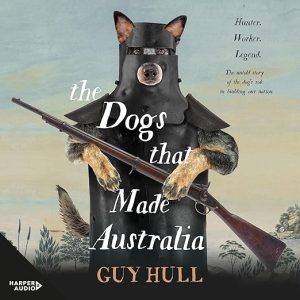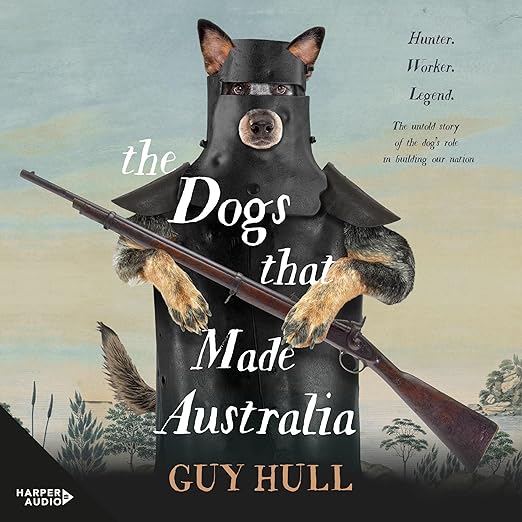
Guy Hull wrote a national history through its working dogs and then read the whole audiobook himself. Nine hours and thirty-nine minutes of Australian breed names, station vernacular and colonial place names would be a pronunciation minefield for an outside reader, and Hull removed the problem by not hiring one. That is not modesty about budget. It is the most defensible production decision available for this particular material.
Underneath the affectionate title sits a real argument. The book credits dogs with the material conditions of Australian settlement: hounds that fed colonies facing famine, heelers and collies that made beef and wool economically possible, terriers that kept the homestead and garden usable, and police dogs the description calls ahead of their time. The aggregate here rests on 135 scores at 4.5, and five of those people stopped to explain themselves.
One Breed Request, a Whole Country Delivered
Readers arriving for one breed keep reporting that they got a country instead. One five-star notice opens by admitting the expectation outright: 'I thought this would be about the Australian Cattle Dog, but it is so much more than that.' Another, written by somebody who has owned and trained heelers and border collies, calls the result 'an enthralling natural history' and lists Hall's heelers, kelpies and dingoes among what it covers. Both describe a scope wider than the cover promises.
Hull organizes the material as argument rather than breed appreciation, and that ordering does more for the book than any amount of affection could. Dingo first, then the imports, then the animals bred here for local conditions, then the humans who loved, feared and worked them. The last clause of that sequence is the honest one. Fear and use sit in this history alongside devotion, and a book that dropped either would be a smaller piece of work.
Two endorsements sit inside the description itself. Tony Parsons, credited as the author of The Kelpie, calls it 'a book for the ages,' while Narelle Hammond of the Australian Cattle Dog Society of NSW recommends it as 'a fantastic Australian history reference' for primary schools. Publisher blurbs are publisher blurbs, but the second one names a use case worth registering, since this is a work a breed society is comfortable putting in front of children.
Hull's Own Cadence for Kelpie and Dingo Names
Self-narration earns its keep on material like this in a way it does not on every book. Kelpie, dingo, heeler, the Bentley Mark, a dozen station and colony names: an outside reader would need a pronunciation guide for half the nouns, and the ones that survive a guide still carry an Australian cadence no guide transmits. Hull carries his own vocabulary, and on a book this dense with local terms that is not a small structural advantage.
History told sideways works especially well in audio, because a listener who would never choose a general colonial history will follow one routed through animals they already care about. One of the five reviewers arrived owning two Australian Cattle Dogs and wanting their true origins; another had trained heelers and border collies and wanted to know how such breeds developed. Both left having absorbed the settlement of a continent. That is a teaching structure, not a gimmick.
Willingness to correct the record gives the book a spine that popular history often lacks. One five-star notice credits it with debunking 'some of the theories put in place by self-professed experts' about how the Australian Cattle Dog developed. A second reviewer starts listing the specific origin myths Hull dismantles, and the review text cuts off mid-example. Correcting a beloved founding story inside a book partly aimed at enthusiasts takes nerve, and both reviewers awarded five stars anyway.
Where Was Tom Bentley? Filed Under Gardening Too
Melissa G. filed the only sub-five-star notice and the complaint is precise. A heeler on the cover raised an expectation of Tom Bentley and the Bentley Mark, and the review reports finding neither. 'Where was Tom Bentley?!' it asks, before conceding that 'the rest was interesting.' The product description never names Bentley either, so an enthusiast shopping for one specific chapter of cattle-dog lore should treat the cover art as decoration rather than a promise.
Filing is the other oddity worth naming. This listing sits under history and under home and garden, and the second tag appears to come from nothing more than Hull's chapter on terriers protecting the homestead and garden. Somebody browsing gardening audio will meet a nine-hour colonial history, while somebody browsing Australian history may never meet it at all. The tag does the book no harm, but word of mouth is clearly doing most of the discovery work.
Format enters the review pool by accident. One notice describes enjoying the book on an e-reader, three of the five review titles use the word read, and a fourth recommends it as 'A good read for those interested in the dogs of Australia.' Four of the five are plainly describing a printed or on-screen copy. Their verdicts on argument and prose still transfer, since neither depends on medium, but a buyer weighing nine and a half hours of listening is reading endorsements of a different object.
Dog Owners and Curious Historians Both Rewarded
Owners of Australian working breeds are the obvious core audience, and three of the five reviewers state outright that they own or follow such dogs. Anyone with a heeler, a kelpie or a border collie asleep on the floor will find the origin chapters landing differently than a general history would, because the argument keeps arriving through an animal they can look at while listening.
Australian history readers with no particular interest in dogs are the group most likely to be surprised, and pleasantly. The settlement narrative here is genuine history seen through a working-animal lens, so a listener who came for the colonies rather than the collies still gets a real account of famine, wool, beef and policing. The breed detail will run heavier than expected. The historical argument will run more substantial.
Skip it if you wanted a breed manual, a training guide, or a chapter on one particular dog you already have in mind, since one reviewer's search for Tom Bentley ended in disappointment and the description makes no promises in that direction. Skip it too if unfamiliar Australian nouns will pull you out of a narrative. Everyone else gets a national history read by the person who researched it, which is rarer on this shelf than it should be.
Quick Take
- Narrator: Author-read, which puts an Australian voice on Australian nouns, and the credit is the only production fact this listing supplies.
- Subjects: Colonial settlement history, working-breed development, myth correction, human dependence on animals
- Tone: Affectionate but argumentative, more history than tribute
- Bottom line: Buy it for the settlement history and the breed origins, not for any single dog you arrived looking for.
Is The Dogs that Made Australia an audiobook about one breed or about the whole country?
About the country. Several reviewers arrived expecting a history of the Australian Cattle Dog and reported getting a broad account of colonial settlement instead, covering dingoes, imported hounds, kelpies, terriers and police dogs. The breeds are the lens rather than the subject, so listeners hoping for a single-breed study will find the scope much wider.
Why does Guy Hull narrate the audiobook himself?
The listing credits him as both author and reader. On material this thick with Australian breed names, station vocabulary and colonial place names, an author reading his own research controls pronunciation of terms an outside narrator would have to be coached through. No reviewer comments on how the reading turned out, so the credit itself is the only production information available.
Do the reviews on this listing describe the recording or the print edition?
Mostly the print or e-book edition. One reviewer says outright they were enjoying it on an e-reader, three of the five review titles use the word read, and another recommends it as a good read. Their judgments on the history and the writing still apply, but none of them report on nine and a half hours of listening.
Does the book cover Tom Bentley and the Bentley Mark?
One four-star reviewer says no, and that omission is the whole basis of the only critical notice on the page. The product description does not mention Bentley either. Anyone buying specifically for that piece of Australian Cattle Dog history should treat the cover image as unrelated to the contents and look for confirmation elsewhere.