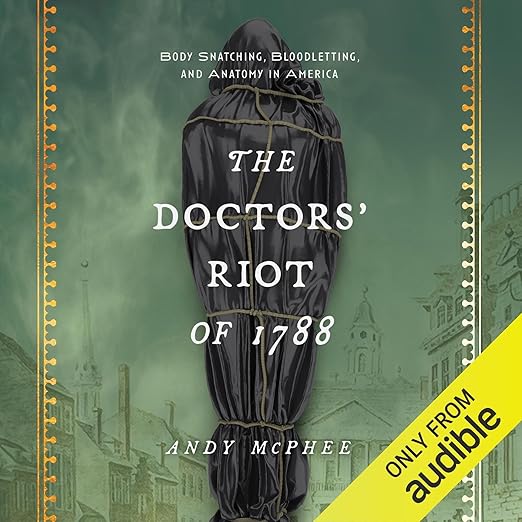
- Voice: Tim H. Dixon delivers a measured, authoritative performance that suits the book's scholarly register; steady pacing keeps complex historical threads clear without theatrics.
- Big ideas: medical ethics and cadaver supply, post-Revolutionary racial justice, the formation of American anatomy law
- Atmosphere: Scholarly and morally serious, with enough narrative propulsion to avoid feeling like a lecture
- Worth it?: A rich, wide-ranging historical listen that rewards patience, covering far more than the riot itself.
Medicine, Mortality, Race, and the Law
New York City in April 1788 was a place of exposed nerves and grievances, and it took only a single body snatching story to ignite thousands of residents into a dangerous mob. Andy McPhee's audiobook The Doctors' Riot of 1788 reconstructs that moment with precision, tracing the event from its causes to its long aftermath, and the result is a history that covers far more territory than its provocative title suggests. Narrated by Tim H. Dixon, this six-and-a-half-hour production draws you into a forgotten episode of post-Revolutionary America that genuinely shaped medical practice, constitutional thought, and racial justice in the United States.
I came to this one with modest expectations. A riot, some body snatchers, a few Founding Fathers called in to calm the crowd. What I found instead was a layered historical argument about medicine, mortality, race, and the law, told with enough narrative drive to hold attention across multiple listening sessions.
Lively Prose and Exhaustive Research
The book's great strength is scope. McPhee does not treat the riot as a standalone curiosity. He situates it within the broader history of body snatching in both England and America, explaining why the practice emerged and how the demand for cadavers from a growing medical profession created a genuinely untenable ethical situation. The detail about resurrectionists charging roughly $100 per body anchors the economic reality that drove the practice, and McPhee is careful not to flatten these figures into mere villains. Many of them were medical students themselves, caught between institutional pressure and community outrage.
The sections covering the riot itself have real narrative momentum. Alexander Hamilton, John Jay, and Baron von Steuben were summoned to intervene, and when the state militia ultimately fired into the crowd, several people died. McPhee renders these events without sensationalism, keeping the moral weight where it belongs. Reviewer Anthony Sciabarrasi noted McPhee's 'lively prose and exhaustive research,' and that assessment holds: the writing moves between the forensic and the human without losing either register.
What the book does particularly well is trace consequence. The riot prompted changes to New York's anatomy laws, influenced framers of the Constitution, and accelerated the formation of Black-only churches and cemeteries as community acts of protection against body snatchers who disproportionately targeted African American graves. McPhee also follows the thread to the present day, covering what body snatching looks like now and how the teaching of anatomy continues to evolve with new technologies. It is a longer arc than most readers will anticipate, and it makes the book genuinely worth the full runtime.
Dixon's Restrained Approach May Feel Flat
Reviewer Angie Boyter put her finger on the book's key tension accurately: the riot and the body snatching itself constitute a smaller portion of the text than the title implies. Listeners expecting a blow-by-blow account of street violence in colonial New York may be surprised to find themselves in a detailed survey of medical education history, embalming practices, and constitutional law. That is not a criticism exactly, but it is worth knowing before you start.
Tim H. Dixon's narration handles the material with measured authority. He does not overperform the dramatic passages or allow the drier historical sections to lose energy. His pace is steady and his voice carries enough warmth to keep the material from feeling like a lecture, though this is fundamentally an information-rich listen rather than a cinematic one. For listeners who prefer narrative audiobooks shaped more like dramatic reconstructions, Dixon's restrained approach may feel flat at moments. For those who value precision over theatrics, it is exactly right.
The book also raises the central moral question that underpins all of this history: does the need for medical students to learn anatomy on cadavers override society's demand for maintaining the dignity of its dead? McPhee poses this question honestly and does not pretend it has a clean answer. That intellectual honesty is one of the book's real assets.
One element McPhee handles particularly well is the racial dimension of body snatching. Resurrectionists disproportionately targeted the graves of Black New Yorkers, who had fewer legal protections and less institutional recourse. The community response, accelerating the formation of Black-only churches and cemeteries as acts of collective self-protection, is one of the book's most important historical contributions. It connects an episode in medical history to broader patterns of racial power and civic resistance that shaped American institutions well into the nineteenth century. McPhee draws these threads with care, neither overstating the connection nor allowing it to disappear beneath the surface of the medical narrative.
A Stone Thrown Into Water Creates Spreading Circles
This audiobook is built for listeners who bring patience and genuine curiosity to history. If you are drawn to the kind of popular history that follows a single event into its wider cultural and political implications, the way a stone thrown into water creates spreading circles, this is the format you enjoy and will reward you here. Medical professionals, history enthusiasts, and anyone interested in the formation of American legal and civic institutions will find plenty to chew on.
Listeners who want a tightly focused true crime narrative structured around the riot itself should know they are getting something broader. The book is as much about the development of American anatomy law, the history of embalming, and the race dynamics of grave robbing as it is about the riot. That breadth is a strength, but it shifts the genre from popular true crime toward historical nonfiction, and it is better to know that going in. At six hours and forty-six minutes, the runtime earns every chapter.
A Few Questions About The Doctors' Riot of 1788
Is the Doctors' Riot of 1788 audiobook primarily about the riot, or does it cover broader history?
Primarily broader history. The riot serves as the entry point, but McPhee uses it to examine the entire history of body snatching in England and America, the formation of anatomy law, racial justice implications for Black communities, and modern developments in medical education. Expect roughly equal time on pre- and post-riot history.
Does the audiobook explain why Alexander Hamilton and John Jay were involved?
Yes. McPhee covers the involvement of Hamilton, Jay, and Baron von Steuben in detail, including why prominent Founding Fathers were summoned to intervene and what their presence ultimately could not prevent once the militia was ordered to fire.
Is this audiobook suitable for listeners with a medical background looking for professional history?
Absolutely. The book covers the development of anatomy education and cadaver procurement with enough detail to satisfy readers with professional interest, including the ethical and legislative frameworks that emerged from the riot. It is written accessibly enough for general audiences while holding up for those who bring prior knowledge.