In Brief
- Narration: Adenrele Ojo is credited, and with no reviews yet posted nothing is known about the reading; the text asks for chronological clarity across two hundred years, a handful of countries and a long roster of named figures.
- Themes: The intellectual origins of diversity, academic freedom and free expression, affirmative action jurisprudence, institutions and better decision making
- Mood: Measured, scholarly and quietly urgent
- Verdict: A serious and unusually well-grounded defense of an idea in the middle of a political fight, best suited to professionals who need the history.
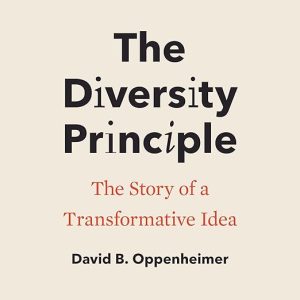
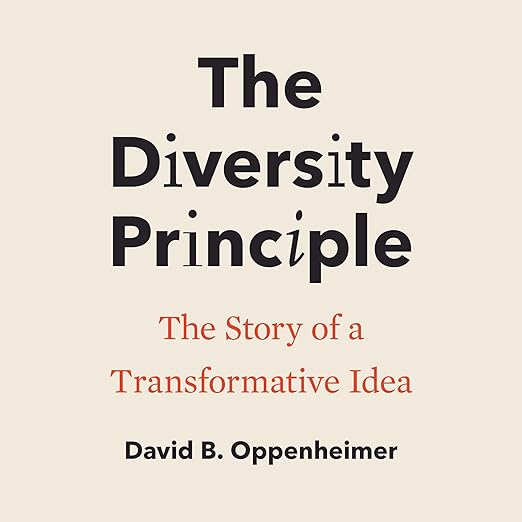
Yale University Press published this into the middle of the argument it describes, and the audiobook runs a full twelve hours. Government offices, corporations and campuses are dismantling diversity programs; the political fight has widened to curricula, scholarships and the teaching of exclusion itself. Into that, a Berkeley Law professor arrives with a two-century intellectual history and a claim that almost nobody in the current debate is making.
Public debate, on this account, has forgotten where the idea came from. David B. Oppenheimer reconstructs diversity not as a personnel policy invented in the late twentieth century but as a principle with roots in how the modern research university came into being, in the development of free speech doctrine, and in the science of how decisions get made. The book states its own thesis in one sentence: "The diversity principle is the idea, recognized for more than 200 years, that institutions function better when they include people with different backgrounds, experiences, and viewpoints."
Oppenheimer Traces Diversity From Humboldt to the Court
The genealogy is the substance of the book, and it is a genuinely surprising one. It begins in early nineteenth-century Europe with reformers such as Wilhelm von Humboldt opening universities to religious and cultural outsiders. It runs through John Stuart Mill and the defense of free expression. It arrives in the twentieth-century United States by way of courts, scientists, military commanders, business executives and universities, and along the way it underwrites academic freedom, supplies the marketplace of ideas, and shapes the legal architecture that governed affirmative action for close to fifty years.
Repositioning the argument that way does real work. If diversity is a two-century idea about how institutions think better, then the current fight is not a referendum on a hiring practice but on a claim about knowledge production, which is a different and much harder thing to dismiss. Oppenheimer contends that these attacks "risk undermining the very conditions that make learning, innovation, and democratic deliberation possible". Whether you accept that or not, it changes the terms of the disagreement, which is more than most books on this subject attempt.
In 2023 the Supreme Court refused to accept diversity as a justification for admissions that weigh race, discarding decades of precedent, and that ruling sits at the hinge of the book. That gives the history a destination and the reader a reason to care about Humboldt. It also means the book is arguing a position rather than surveying a field. The sourcing is described as "extensive historical research and decades of empirical evidence", but a listener should understand from the first minute that this is advocacy built on scholarship, not a neutral referee.
Ojo Keeps Two Centuries of Names in Order
Intellectual history of this shape suits listening better than most nonfiction does. The organizing structure is a chronology with a cast of named figures, which is close to narrative, and the through-line is a single idea traveling across countries and institutions. You are not asked to hold statistics or follow a table. You are asked to follow a sequence, and twelve hours is enough room to lay one out without hurry.
Timeliness is the other argument. Anyone currently sitting in a meeting about a program being wound down, drafting policy, teaching a course under scrutiny or reporting on any of it will find the historical depth immediately usable, which is exactly the readership the publisher has in mind. Having two hundred years of provenance for a principle under attack is a practical asset in an argument, not just an academic one.
Chronological clarity is what this text needs above all else. Adenrele Ojo is the credited reader. Two centuries, several countries and a long procession of institutions and named figures have to stay in order in a listener's head without a page to check, and the transitions between a Prussian university reform, a Victorian essay and a twentieth-century court have to be unmistakable. That is the specific difficulty of legal and intellectual history in audio, and it is largely a question of how firmly the joins are marked.
One Rating, No Reviews, and Real Advocacy
Nobody has written a word about this recording. The listing carries a single rating and not one written review, which is unusual enough to state plainly. Released at the end of March 2026, the book has had a matter of months to find an audience, and a specialist legal history from a university press is not a title that accumulates reviews quickly. Treat the 5.0 as a placeholder rather than a verdict, because a single rating is not a sample. With nothing to go on from other listeners, the usable signals are the ones already on the page: a university press behind the book, a named law faculty behind the author, and a description detailed enough to expose its own argument. Better proxies than most listings offer, but proxies all the same.
Twelve hours of legal history also carry the usual format costs, and they are real here. Case law, dates and statutory framework do not reward divided attention, and a book resting on decades of empirical evidence will cite studies you may want to see rather than hear. No accompanying material is advertised. Anyone planning to use this professionally should expect to want the printed edition alongside it for anything they intend to quote.
Then the politics, which the book does not hide and neither should a review. This is a defense of a principle currently under organized attack, written by a law professor who plainly believes the attack is destructive. Readers who share the conclusion will find the historical grounding satisfying. Readers who do not will find the opposing case presented as an object of study rather than as a position argued in good faith on its own terms. That is a legitimate way to write a book, and it is worth knowing before you commit twelve hours to it.
Twelve Hours for Policymakers, Lawyers, and Educators
The publisher names its audience precisely and gets it right. Educators, business leaders, policymakers, lawyers and journalists dealing with the current rollback will find this immediately applicable, and so will anyone working in university administration or in a corporate program facing scrutiny. Listeners who enjoy the history of ideas will find the Humboldt to Mill to American courts line genuinely interesting on its own, regardless of the contemporary stakes.
Hold off if you want a practical manual, since nothing in the description promises implementation guidance, or if you want the case against diversity programs argued by someone who believes it. Students needing precise citations should also plan for the printed text. And be realistic about length: twelve hours of legal and intellectual history is a serious commitment, and the reward is depth of argument rather than pace.
Frequently Asked Questions
Why are there no reviews for this audiobook?
It is new and specialized. The release date is the end of March 2026, and an academic legal history collects readers slowly. The listing shows one rating and no written responses, which means the 5.0 average carries no information and nothing at all is known about the recording.
Does the book cover the 2023 Supreme Court ruling?
Yes, and it functions as the hinge of the argument. The Court removed diversity as a permissible ground for admission decisions that consider race, setting aside long-settled precedent, and the two-century history is built to explain what that ruling displaced. The later chapters extend to the broader campaign that followed.
Is twelve hours of legal history manageable as an audiobook?
More than you might expect. It is built as a chronology populated by named figures rather than as a statistical argument, which suits listening. The parts that resist the format are the case citations and the empirical studies, so anyone intending to quote from it should plan on having the printed edition too.
Is this a balanced treatment of the diversity debate?
No, and it does not present itself as one. The author is a Berkeley Law professor defending a principle the book treats as being under organized attack, and the opposing campaign is analyzed rather than argued sympathetically. The historical research is serious; the conclusion is committed.