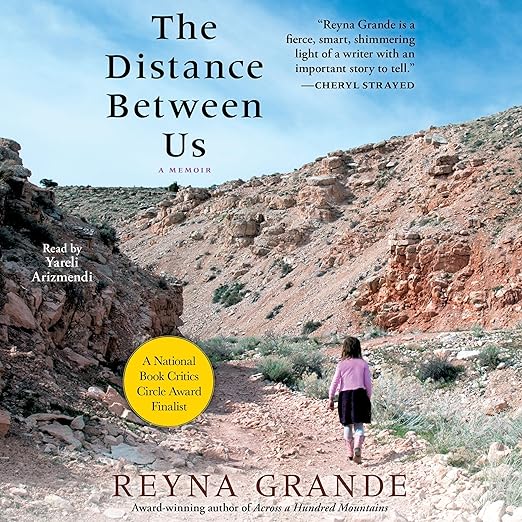
- Voice: Yareli Arizmendi reads the English edition alone, on a listing that also advertises a Spanish version without saying whether a recording of it exists.
- Big ideas: A childhood split by a border, parents who left first, a grandmother's crowded house, a father waiting on the other side.
- Atmosphere: Clear-eyed and aching, told at a child's height.
- Worth it?: Worth finding despite the shelf it landed on, and worth giving away afterward, which is what the reviewers keep doing.
Three tags sit on this audiobook: Art and Literature, Law, and Professionals and Academics. The book underneath them is a memoir of a childhood split between Mexico and the United States, written by someone who was a girl when her parents crossed the border without her. Yareli Arizmendi reads eleven hours and thirty-six minutes of it for Simon and Schuster Audio, released July 14, 2020. Whoever assigned those tags was not describing this book. Whatever a listener browsing under Law hopes to find, it is not a child waiting in a grandmother's house for a mother to come back.
Is The Distance Between Us Worth Your Time?
Filing under Law is the sort of error that decides whether a book gets found at all. The record dual-files this as biography and memoir and as politics and social sciences, and that pairing is defensible, since the second half of it is where migration writing usually sits. Then come the tags. Art and Literature is a stretch but survivable. Law and Professionals and Academics belong to an entirely different shelf, the one holding case books and career guides. The consequence is practical: a listener browsing memoirs may never surface this, and a listener browsing law will surface it and move straight past.
Two is what the vote counter reads. Five people have posted written responses. Those numbers cannot both describe the same page, and 4.7 cannot be produced by two whole-star votes under any convention, so whatever the badge measures, it is not the column sitting beneath it. Read the written grades straight down and they run five, five, four, five, five. The oldest was posted in September 2012, roughly eight years ahead of this recording's release date.
Why The Distance Between Us Works as an Audiobook
Separation happens twice over. Parents cross to El Otro Lado, the Other Side, chasing the American dream, and Reyna and her siblings are pushed into the already overburdened household of a stern grandmother. When the mother at last returns, the daughter begins preparing for her own crossing, to live with a father who has haunted her imagination for years without being present for any of them. Julian Correa's five-star response supplies the geography the description leaves out, placing the book between Iguala, Mexico, and Los Angeles, California, and calling it an intimate factual story about family separation, immigration and resiliency.
Elaine Campbell's response opens with a run of questions instead of a summary, and they are the right ones. What is it like to live south of the border and be poor. What happens to families broken up by poverty when someone has to leave and live in the shadows, sometimes for years, sometimes without returning. How are children affected by being separated from one or both parents, left with relatives who may not want them and may mistreat them. In reading this remarkable book, that response concludes, the reader will find out.
Andy's five stars carry the most honest sentence on the page: an admission of not having fully understood how difficult being an immigrant is, or how hard migration is on families and on the relationships inside them, until this book opened those eyes. That is the particular claim a memoir can make and an argument cannot. Nothing in the description promises it either. The copy sells adjectives, and the reader supplies the change.
Headlines here shout the same instruction three times over. Eye-opening, a must read. Must have. A must read. Three separate people reaching for the imperative, which on a memoir this quiet is a strange and telling unanimity. Andy is ordering copies for everyone with a birthday coming up and buying more for Christmas, and argues the book should be required reading for high schoolers. Lakers Fan arrived after friends recommended it more than once, and says it changes the way you see things.
Weak Spots in The Distance Between Us
Roxanne's four stars are the outlier, and the response is very nearly nothing: a headline calling it an in-depth look at life in Mexico and the hope of a better life, and then a body of three words. Compelling, sad, positive. The headline runs several times longer than the review it heads. As dissent it hardly qualifies, since all three of those words are favorable, but it is the only grade on this page below five and the only voice not raising itself. Worth noticing too: the description above works in threes as well, calling the book funny, heartbreaking and lyrical, and pulling a magazine quote that opens on compelling. Roxanne's three words open on the same one.
Description on this page closes with a line aimed at a different buyer: the book is also available in Spanish, under a different title. On a print page that is a sensible cross-sell. On an audio listing it raises a question nobody answers, namely whether the Spanish version exists as a recording, and if it does, who reads it. Yareli Arizmendi is credited here for the English. The blurb keeps two Spanish phrases in its text, El Otro Lado and that alternate title, and translates only one of them.
What the book asks of a listener deserves flagging plainly. Julian Correa started tearing up in the prologue. Elaine Campbell's questions include children left with relatives who mistreat them. The jacket promises unflinching honesty and names fears alongside hopes. None of that is packaged as spectacle, but close to twelve hours of childhood separation is a genuine emotional commitment, and not one line on this page prepares a buyer for that.
Should You Listen to The Distance Between Us?
Memoir listeners who want migration described from inside a child's experience are the core audience, and the enthusiasm here is unusually practical: people buying copies for other people, which is a stronger signal than any star. Teachers and parents of teenagers have a direct recommendation waiting in the column. Anyone whose own family history involves a border, a grandmother's crowded house or a parent who left first will recognize the shape of this long before the details arrive.
Put it aside if you need an outcome that resolves cleanly, because a memoir of separation does not owe you one; if you want policy argument, since this is a child's-eye account and the politics filing oversells that; or if the material sits too close to your own history. Start it on a day with room in it, because the reviewers who mention tears were not being decorative, and because a book one reader is buying by the armful as gifts is doing something for people that no badge, working or broken, can measure.
Questions Listeners Ask
Does a Spanish version of this audiobook exist?
The description mentions a Spanish edition under a title of its own and says nothing about whether it was ever recorded. Yareli Arizmendi is credited for this English reading, and no second narrator appears anywhere on the page. Anyone who wants the Spanish text read aloud will have to hunt for it as a wholly separate listing.
Would this audiobook work for high school students?
One reviewer argues it should be required reading for high schoolers, and another calls it eye-opening about immigration and family separation. The material includes poverty, an absent father, a stern grandmother and relatives who mistreat the children left with them. The listing itself offers no guidance on age at all.