Quick Take
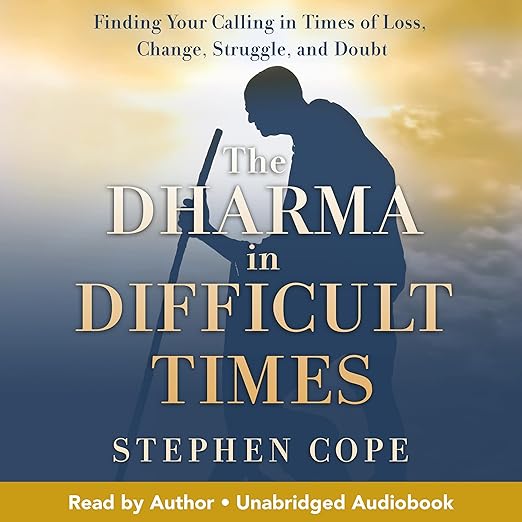
- Narration: Stephen Cope narrating his own work brings a quality of deep personal investment that is immediately perceptible; his voice has the cadence of someone who has lived inside these ideas for decades.
- Themes: Purpose in crisis, the Bhagavad Gita as practical guide, dharma as individual calling
- Mood: Contemplative and sustaining, like a long conversation with someone who has thought seriously about what you are going through
- Verdict: A genuinely wise book about finding purpose when everything is falling apart, best approached as an active practice rather than passive listening.
I started The Dharma in Difficult Times during a period when difficult was an understatement, and I came to it not expecting to be changed by it but hoping to be steadied. Stephen Cope has been at Kripalu Center for Yoga and Health for decades, and his writing has the quality of someone who has accompanied many people through crisis without having resolved it from a distance. His previous book, The Great Work of Your Life, introduced me to his framework. This one deepened it in ways I needed and did not anticipate.
The book extends the argument of The Great Work of Your Life, using the Bhagavad Gita as its central organizing text. For those unfamiliar, the Gita is the narrative of the warrior Arjuna, who on the eve of battle finds himself paralyzed by grief and confusion. His charioteer Krishna offers a series of teachings that form the foundational text of dharma philosophy. Cope uses this framework not as an exotic import but as a structurally sound map for what happens to human beings when their world falls apart and they have to decide how to act anyway.
Our Take on The Dharma in Difficult Times
What distinguishes Cope’s approach from most spiritually inflected self-help is the specificity of his historical examples. Gandhi appears not as an inspirational figure but as someone who had to learn to listen for his inner voice over years of failure, false starts, and genuine terror about whether he was equal to what history demanded of him. Sojourner Truth and Henry David Thoreau are examined as people who found what Cope calls the unmistakable signs of dharma in the midst of chaos, which Cope makes legible as a real and repeatable experience rather than a mystical one available only to the extraordinary. Marian Anderson and Ruby Sales appear later, with the quality of dharma’s mystic power and how we learn to trust in it.
Cope also draws on his own experience and on the stories of ordinary people he has known at Kripalu, which provides the kind of grounding detail that historical examples alone cannot supply. The book argues that crisis is not an interruption of purpose but often the mechanism through which purpose becomes clear, and Cope earns this argument rather than asserting it.
Why Listen to The Dharma in Difficult Times
Stephen Cope narrates his own work, and this is one of those cases where self-narration is not merely authentic but genuinely irreplaceable. His voice has the quality of someone who has read these ideas aloud many times in teaching contexts, who understands where the emphasis belongs and why, and who is not performing conviction but embodying it. The nine-plus hours pass with the rhythm of sustained contemplative inquiry rather than the forward momentum of a conventional self-help audiobook. This is not a book to listen to while driving and half-thinking about something else. It rewards full attention.
Multiple reviewers noted that this is a book to be read many times rather than consumed once, and the audio format supports that insight. Cope’s structure is clear enough that a second or third listen will surface material that the first pass contextualized but did not fully absorb. The Bhagavad Gita framework makes this particularly true: understanding Arjuna’s position more fully on a second encounter with the text deepens every figure Cope subsequently brings to bear on it.
What to Watch For in The Dharma in Difficult Times
The book is organized around the Gita’s framework rather than a simple chronological or thematic structure, which means some listeners may find the movement between historical figures and personal narrative and Gita commentary slightly non-linear on a first encounter. Cope signals transitions clearly, but the book rewards patience with its architecture. Comparable in spirit to Pema Chodron’s When Things Fall Apart, as publishers position it, though Cope’s approach is more historically grounded and less explicitly Buddhist than Chodron’s. The two books are companions rather than duplicates, and listeners who have found Chodron sustaining will find Cope operates in a related but distinct register.
The pandemic and climate crisis are referenced as the backdrop of difficulty against which Cope is writing, which dates the book slightly. But the framework he is offering predates those specific crises by several thousand years, and its application is not diminished by the passage of time or the changing nature of what we are all trying to navigate.
Who Should Listen to The Dharma in Difficult Times
Anyone who has asked what they are supposed to do with their life during a period when the usual answers feel hollow will find this book genuinely useful. Readers who responded to The Great Work of Your Life will find this a natural continuation that deepens rather than merely extends the earlier argument. Listeners with no background in yogic philosophy or the Bhagavad Gita will find Cope provides all necessary context. Those looking for quick prescriptive guidance should know that this is a contemplative book that asks something of you in return. It is not a passive listen. It works best when you bring your own crisis to it and let Cope’s framework help you think about what it is asking you to do.
Frequently Asked Questions
Do I need to read The Great Work of Your Life before The Dharma in Difficult Times?
No, though Cope explicitly extends the earlier book’s framework and readers familiar with it will find the connections meaningful. The Dharma in Difficult Times is designed to function as a standalone, and Cope provides enough context that the Bhagavad Gita framework is accessible without prior background.
How much knowledge of Hinduism or yogic philosophy is assumed by Cope?
None. Cope introduces the Bhagavad Gita and its key concepts from first principles. The book is written for readers who may have no prior exposure to the text, and the spiritual framework is presented in a way that is applicable regardless of religious background.
How does The Dharma in Difficult Times compare to Pema Chodron’s When Things Fall Apart, which publishers use as a comparison?
Both address finding ground in crisis. Cope’s approach is more historically grounded, using figures like Gandhi and Sojourner Truth as extended examples, while Chodron’s is more directly Buddhist in its framework. They are complementary rather than redundant, and readers who have found one sustaining are likely to find the other equally so.
Is Stephen Cope’s self-narration appropriate for listeners who want a more dynamic audiobook performance?
Cope’s delivery is contemplative and measured rather than dramatic. For this specific material, that quality is an asset, but listeners who find slower-paced, meditative narration difficult to sustain attention through should be aware that this is not a high-energy performance.