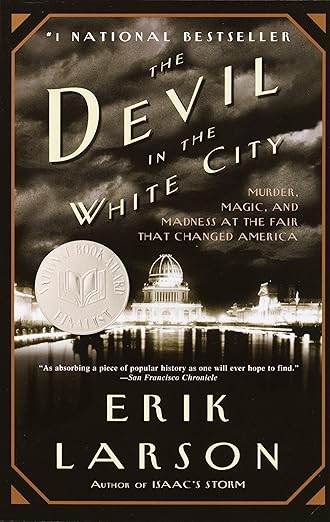
Erik Larson built this book on a split. One half follows the architect assembling the great fair on the Chicago lakefront; the other follows a young doctor who put up a hotel a short walk west of the fairgrounds and fitted it with a dissection table, a gas chamber and a crematorium. Just under fifteen hours of audiobook holds both halves without either one turning into filler, and the alternation is the actual design rather than a device laid over a single story. Scott Brick's name sits in the narrator slot. What is strange about this particular record is how much of it still points at a hardcover.
A Malign Parody of the White City
Daniel Hudson Burnham gets the harder assignment of the two, because construction is not naturally suspenseful and Larson has to make it so. The method is to treat the fair as a problem with a deadline: swampy ground at Jackson Park, a roster of famous collaborators to manage, and the obstacles and tragedies the description alludes to without spoiling. Frederick Law Olmsted, Charles McKim and Louis Sullivan all pass through, and the pleasure of this half is watching an enormous temporary city get argued into existence by people who mostly disliked each other.
Henry H. Holmes supplies the other half, and the phrase the copy uses for his hotel, a malign parody of the White City, is the sentence that justifies the whole structure. Both men are builders. Both are working on schedule, on a budget, with the fair's crowds as their raw material. Larson never has to state the rhyme because the alternation states it, and the effect on audio is stronger than it looks in summary, since you cannot skim ahead to see which thread the next chapter belongs to.
A March 2022 entry gets at why this title outlives most narrative history. Assigned for a class project, that listener expected homework and reported a surprisingly good read, crediting the author with folding historical fact into something enjoyable. That is the ordinary compliment this title keeps collecting, and it is worth taking seriously: a great many people who do not otherwise finish history books finish this one, and the class-assignment route is how a large share of them arrive.
The Coming Century Standing in One Place
The supporting cast is the underrated pleasure. Buffalo Bill, Theodore Dreiser, Susan B. Anthony, Thomas Edison and Archduke Francis Ferdinand all move through these pages, not as cameos but as evidence of how much of the coming century was standing in one place at one moment. Larson uses them to give the period density, and hearing those names surface inside the fair's crowd scenes does something a list of dates cannot.
Narrative nonfiction of this kind suits audio better than most history does, because the argument travels inside the scenes rather than beside them. Larson writes in set pieces with a clear sense of when to cut, and a listener who loses the thread for thirty seconds can pick it up again at the next paragraph without having missed a footnote. The chapters are short enough to be a commuting habit and structured so that each one closes on something.
Runtime is fair value here as well. Fifteen hours for two intertwined books, one about civic ambition and one about a murderer, works out to a long but never padded sit. The Gilded Age setting carries its own atmosphere, all smoke and electricity and improvised grandeur, and the record has the space to let that atmosphere accumulate rather than sketching it in a chapter and moving on.
The Written Column Is a Poor Guide to the Recording
Sharpest criticism on the page arrives in a November 2025 entry. It grants that nearly everyone has read this and nearly everyone liked it, then adds the qualification worth hearing: the book illuminates a handful of significant and mostly forgotten events without otherwise exploring the place and time in much depth. That is accurate. This is a book about two projects, not a portrait of Chicago, and anyone after the city's labor politics, its immigrant neighborhoods or its economics will be reaching for something else afterward.
The written column is a poor guide to the recording. Five responses sit under the badge, none of them says anything about the reading, and one consists of the phrase as advertised followed by a promise to get to it eventually. Several are grading a parcel or the condition of a secondhand copy rather than a performance. Enthusiasm on this listing is real, but every word of it attaches to the text rather than to what Brick did with the text.
The metadata is welded together from two different editions. A page count of 447 sits beside the running time, the publisher field names a print imprint rather than an audio one, and the subtitle about murder, magic and madness at the fair that changed America appears at the top of the description while the title field omits it entirely. None of this affects the listening, but it does mean the listing is describing a hardcover in several places where you would expect it to describe a recording.
The Fair Rather Than the Murders
Anyone who wants true crime with a genuine second subject should start here. So should listeners who like watching a large project get built, since the Burnham half is closer to a construction procedural than to a thriller, and readers who want an entry point into the Gilded Age that does not require prior reading. It also works well as a shared listen, because the alternating structure gives two people something to argue about after every other chapter.
Give it a miss if you want a straight social history of Chicago, or a criminological account of Holmes with the evidentiary caution a modern true crime reader expects. Anyone squeamish should also know what the copy states plainly about the hotel's fittings before starting. And if you already know the Holmes story from elsewhere, the value on offer here is the fair rather than the murders, since the construction thread is the half that rarely gets retold.
Key Details
- Voice: Scott Brick takes a fifteen-hour double narrative solo, with no cast and no production layer.
- Big ideas: Gilded Age ambition, serial murder, civic spectacle, engineering under deadline.
- Atmosphere: Grand and uneasy, alternating between drafting table and basement.
- Worth it?: The rare history title people actually finish, and the fair half is the better one.
Frequently Asked Questions
Does the audiobook alternate between the architect and the murderer?
Yes. The description sets the two men up as counterparts, one raising a temporary city and the other raising a hotel built to exploit it, and the book keeps both threads live rather than treating the architect as a prologue to the killer. Listeners arriving purely for the true crime should know that going in.
Is the audiobook the same text as the 447-page print edition?
Nothing on the listing indicates an abridgment, and the page count sitting beside the running time is print metadata carried onto an audio record rather than a statement about this recording. No abridgment marker appears in any field, so treat the number as a description of a different edition.
Do you need to know anything about the World's Fair beforehand?
No. The book assumes no prior knowledge and builds the fair from swampy parkland upward, introducing figures like Olmsted, McKim and Sullivan as they arrive. If anything the risk runs the other way, since readers who already know the fair's history will find the second thread more novel.