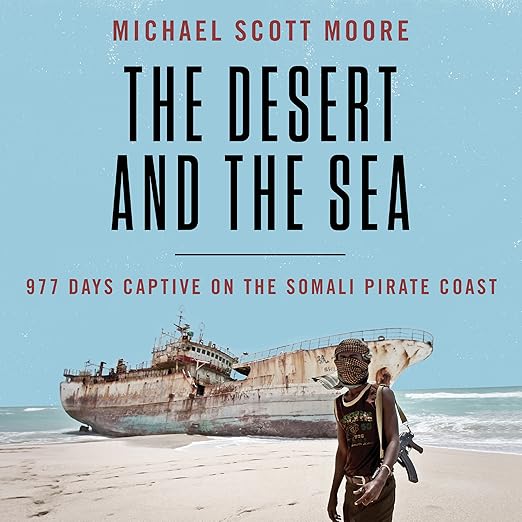
Quick Take
- Narration: Corey Snow handles Moore’s dual register, the journalist’s clinical distance and the captive’s raw fear, with skill, making the tonal shifts feel earned rather than dissonant.
- Themes: Captivity and psychological survival, the economics and politics of Somali piracy, the cost of witness journalism
- Mood: Tense and intellectually demanding, surprisingly darkly funny in moments
- Verdict: One of the most significant captivity narratives of the twenty-first century, and one of the few books about Somalia that takes its political complexity seriously.
I was about three hours into The Desert and the Sea when I realized I had been holding tension in my shoulders in a way I usually associate with fiction thrillers rather than journalism. Michael Scott Moore had been captive for approximately nine months at that point in the narrative, held on a boat off the Somali coast, and the conditions he was describing, the heat, the boredom, the terror of not knowing whether today would be the day the negotiations collapsed, were somehow more oppressive for being true. I put it down for the evening and came back the next morning, which I think is the appropriate way to listen to this book. It is not comfortable, and it is not supposed to be.
Corey Snow narrates twelve hours of material and does so with a quality I can only describe as disciplined. Moore’s prose operates in two registers simultaneously: the journalist who continues to observe and analyze even under extreme duress, and the captive who is genuinely afraid. Snow moves between these registers smoothly, and the dark humor that surfaces throughout the narrative, the Catch-22 quality the synopsis mentions, appears in his delivery at exactly the right moments. Moore’s ability to be funny about his situation, obliquely, never as performance, is one of the book’s genuine achievements, and Snow understands that it needs to be underplayed to land.
How a Journalist Becomes a Story
The setup is almost painfully ironic. Moore traveled to the Horn of Africa in January 2012 specifically to cover Somali piracy, funded by the Pulitzer Center on Crisis Reporting, having already covered a pirate trial in Hamburg. He understood the mechanics of the piracy industry, the ransom economy, the political conditions that enabled it, the international response. He then became a hostage within that same system. The 977 days of his captivity are, among other things, an extended immersive research project that he did not choose and could not control.
What distinguishes Moore’s account from other captivity narratives is precisely this background. He does not observe the world of his captors with naivety. He understands the economics of what is happening to him, the incentive structures, the organizational logic of the men who hold him. This understanding does not make his situation less terrifying. It makes the account richer and more analytically useful for anyone who wants to understand how the Somali piracy industry actually worked, at the level of individual actors and their motivations, not just as a headline phenomenon.
The Political Analysis Inside the Personal Narrative
The synopsis’s description of Moore as caught between Muslim pirates, Al-Shabaab, and the rise of ISIS is accurate, but the book does more than document his position between these forces. It examines the relationships between them, the ways in which the piracy economy interacted with Al-Shabaab’s territorial expansion, the limits of international counter-piracy policy, the specific failures of the Somali state that created the conditions for all of it. Moore was a journalist before he was a captive, and he never entirely stopped being one.
The sections on the politics of ransom negotiation are particularly valuable. The book documents how his ransom was eventually assembled through a combination of US and German institutional support, friends, colleagues, and his mother’s determination. The ransom economy that held Moore captive is the same economy that was funding the men who held him, and the book’s treatment of this circularity is more honest than most policy discussions of the same subject.
The Somalia That Surrounds the Prison
Moore was held in multiple locations over his 977 days, including on boats and in compounds in different parts of Somalia. The landscape writing, the specific geography of the Somali coast, the visual texture of the places where he was held, is some of the most precise writing in the book. He was not choosing to be there, but he was a trained observer, and the details he accumulated about the lives of the men who held him, their family obligations, their religious practices, their economic pressures, are more humanizing than dehumanizing, which is one of the book’s more quietly radical choices.
Who Should Listen, Who Should Skip
This audiobook is for listeners who want their captivity narratives to come with analytical intelligence and political depth. The reviewer who noted the language could be crude is accurate; Moore does not sanitize his account, and the profanity some readers flagged is consistent with the emotional conditions he was documenting. Listeners seeking a clean adventure narrative will find Moore’s analytical digressions long. Listeners who want both the personal and the political will find this extraordinary.
Frequently Asked Questions
Does Moore explain the ransom negotiation process, and how did he eventually get released?
Yes, the ransom negotiation process is covered in considerable detail. Moore’s release after 977 days was the result of ransom assembled through US and German institutional channels, personal networks, and his mother’s persistent advocacy. The book examines why the process took so long, including the political constraints on paying ransoms and the organizational complexity of dealing with multiple pirate factions.
How does the book handle Moore’s psychological condition during captivity?
With honesty and without melodrama. Moore documents depression, fear, the psychological effects of isolation and physical privation, and the mental strategies he developed to maintain coherence across nearly three years. The dark humor that surfaces throughout the narrative is part of this psychological account, not decoration.
Is The Desert and the Sea primarily a memoir or a work of journalism about Somalia?
It is genuinely both, and the combination is what distinguishes it. The memoir dimension covers Moore’s personal experience of captivity. The journalistic dimension covers the history and economics of Somali piracy, the political conditions that produced it, and the international responses to it. Neither dimension is subordinated to the other, which occasionally makes for demanding listening but produces a more complete account than a purely personal narrative would.
Does Corey Snow’s narration handle the book’s tonal range, from analysis to personal terror to dark humor?
Yes. This is one of the more technically demanding narration jobs in the genre, and Snow manages the shifts without forcing them. The analytical passages are read with appropriate clarity; the more personal sections carry genuine weight. The dark humor, which runs as an undercurrent rather than as explicit jokes, is handled with the restraint it requires.