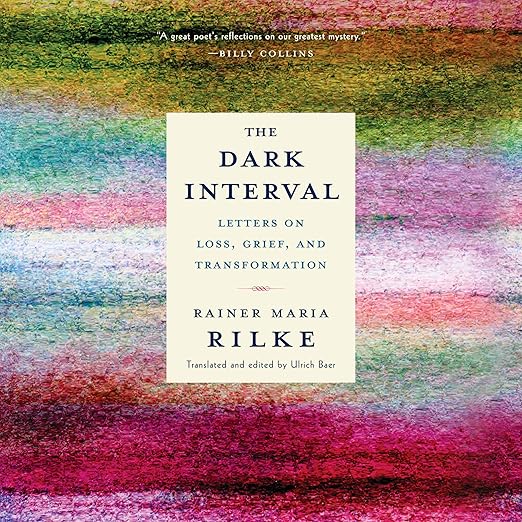
Rainer Maria Rilke's The Dark Interval is the kind of audiobook that works best when you are not trying to absorb it efficiently. The letters collected here were written to bereaved friends and acquaintances across the span of Rilke's long career, and translator Ulrich Baer has arranged them into an uninterrupted sequence, so that what might have been a miscellany of condolences becomes something closer to a sustained meditation on death's place in human experience. Rosanne Cash, reading these letters, brings a quality to the narration that purely professional audiobook readers rarely achieve: she sounds like someone for whom these sentences carry personal weight, not like someone executing a performance with technical skill.
The casting decision is significant and deserves attention before purchase. Cash is a Grammy-winning musician who has written extensively about grief, particularly in the aftermath of her parents' deaths, and that experiential gravity comes through in the narration without announcing itself. She does not impose emotion onto the text; she reads with a precision that allows Rilke's sentences to open at their own pace, which is the right editorial instinct for material that resists paraphrase and demands the kind of attention you give to lyric poetry rather than to prose designed for quick comprehension.
Grief as Intensification, Power, and Vitality
Rilke's approach to consolation runs counter to most of what contemporary grief culture offers. He does not promise resolution or suggest that loss diminishes with time in a way that restores the griever to their previous state. Instead, he describes grief as a deepening, a forced descent into levels of life that ordinary circumstances never access. One of the quotations cited in praise of the book, attributed to Henri Cole, captures this quality precisely: death, in Rilke's framing, is not negation but intensification, the life of others passing into us as a form of power and vitality rather than simply as absence and subtraction.
At two hours and fifty-one minutes, the collection is short enough to experience in a single sitting, which is actually the right way to encounter it. The letters were arranged as a sequence by Baer, and the cumulative effect of Rilke moving from correspondent to correspondent, each time finding a slightly different angle on the same profound fact of mortality, creates something that a piecemeal reading would disrupt. Cash's pacing makes that continuity audible, giving the listener a sense of movement through territory rather than a series of disconnected stops at unrelated stations.
Billy Collins Calls It Our Greatest Mystery
The literary stakes here are high and clearly identified by those who have engaged with the book seriously. Billy Collins described it as "a great poet's reflections on our greatest mystery," and the collection functions partly as a companion to Rilke's verse: several letters reprise the symbolic vocabulary of his major works, which means a listener familiar with the Duino Elegies or the Sonnets to Orpheus will find additional registers of meaning in what might otherwise read as private correspondence. The letters are not supplementary material; they are central to understanding how Rilke thought about the relationship between life and death, and Baer's arrangement makes that continuity visible across the full arc of the collection.
For listeners who are not Rilke specialists, the letters remain accessible as works of eloquent and unconventional consolation. A reviewer suggested starting elsewhere if you are new to Rilke, which is sensible advice for the verse, but the letters of The Dark Interval may actually be a more generous introduction to his sensibility than the poetry for general readers. The epistolary format grounds his metaphysical preoccupations in specific human situations, making the abstract less abstract and the consolation more legible even for those without a background in German literary modernism.
Cash Refuses to Smooth Over the Opacity
The book's brevity, under three hours, means it does not build toward a culminating argument or resolution in the conventional sense. Rilke returns to the same territory in different letters using different language, and the effect is accumulative rather than progressive. Listeners expecting narrative arc or systematic philosophical argument will need to adjust their orientation. This is a work of reiteration, the kind that functions in music and in lyric poetry: the same fundamental insight approached from multiple angles until it becomes something the listener has genuinely encountered rather than simply been told about in summary form.
Cash's delivery respects the opacity of Rilke's sentences, which is the correct editorial choice, and also means the audiobook will not smooth over the difficulty of the prose in the way that more interpretive narration sometimes does. For the listener who wants the sentences to carry their full weight, this is a virtue. For someone wanting grief processed quickly into something manageable, this is not that book.
A Companionship for Those Sitting With Loss
Listeners in grief, or those accompanying someone through loss, will find this a rare kind of literary companionship: not prescriptive, not reassuring in a facile sense, but genuinely illuminating about the nature of what they are experiencing and what it may eventually do to them. Literary listeners who appreciate Rilke's poetry and want to hear it read by someone whose voice carries equivalent emotional weight should seek this out specifically. Those who are new to Rilke entirely might benefit from starting with Letters to a Young Poet, which shares the format and is more widely discussed as an entry point, before approaching this darker and more specialized collection. At under three hours, the commitment is small. The resonance, for those the book reaches, tends to last considerably longer.