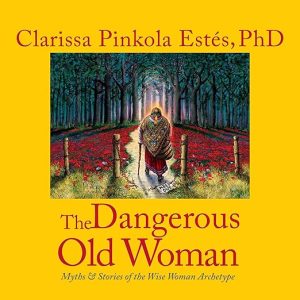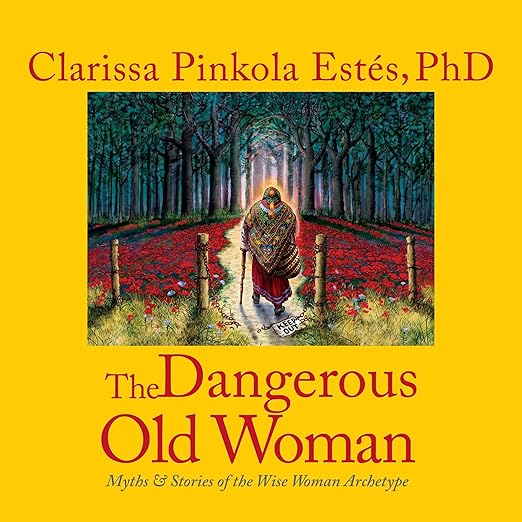
- Performance: Clarissa Pinkola Estes narrates her own work, and the difference between this and any external narrator is immeasurable. Her voice, cadence, and storytelling breath are the material itself.
- What it covers: Archetypal feminine wisdom, creative legacy and eccentricity as giftedness, the integration of wildness and age
- Feel: Fireside and incantatory, deeply intimate
- Our call: One of the rare audiobooks where listening, rather than reading, is genuinely the superior experience. Estes' spoken word carries dimensions the page cannot hold.
I put on The Dangerous Old Woman on a Sunday evening in November, one of those nights when the light disappears too early and the temptation to retreat entirely from the world feels almost reasonable. I expected something interesting. I did not expect to stop what I was doing, sit down, and simply listen. But that is what Clarissa Pinkola Estes does when she begins to speak. The room changes quality.
This is not a conventional audiobook in any useful sense of that term. It is closer to what happens when a cantadora, a keeper of old stories in the Latina tradition, sits down at a fire and begins. The six sessions here, drawn from three decades of work, present part one of what Estes calls her masterwork on the archetype of the Wise Woman: the Dangerous Old Woman.
A Closer Look at The Dangerous Old Woman
The title requires unpacking, and Estes unpacks it beautifully. Dangerous in its ancient sense meant protection, not threat. The Dangerous Old Woman is the one who cannot be domesticated into silence, whose wisdom and instinct function as a shield for those around her. Estes moves through a remarkable range of cultural manifestations of this archetype: La Anciana, the Ancient One; the Midwife Exemplar; La Tejadora, the Weavers of Fate; figures from world mythology and fairy tale alike. The Snow White interpretation she offers here is among the most illuminating readings of that story I have encountered anywhere, treating the poisoned apple as what happens when gifts are suppressed or corrupted rather than as simple villainy.
Estes' central argument, which she makes through story rather than lecture, is that we are born with two forces: the wild and ever-young imagination that holds intuition and instinct, and the wise elder force that carries boundaries and visionary knowledge. The book is about how these two forces can be held simultaneously, about being old while young, and young while old. That is not an abstract philosophical proposition in Estes' hands. She makes it feel like something you already know but have been given permission to acknowledge.
The answer is simple: because Estes reading her own material is a categorically different experience from any other narrator reading it. Multiple reviewers describe the experience as transformative in ways that are difficult to attribute to content alone. One listener described the stories as being driven with all the sounds, depth and colorful language that the tale itself is, and that aliveness comes from Estes' vocal presence. She is a Jungian psychoanalyst and an award-winning poet, and both of those identities are audible in how she paces a sentence, where she chooses silence, how she enters and exits a narrative voice.
The seven hours and fifty minutes do not feel like a single sitting commitment. This is a recording that rewards being revisited in pieces, returning to a particular session when the need arises. Several reviewers describe listening to it repeatedly over years.
Things to Know Before Starting The Dangerous Old Woman
This is part one of a larger work, and while each of the six sessions has internal coherence, there is an awareness that the full masterwork is larger than what is contained here. That is not a flaw exactly, but listeners who want clean resolution should know the project is deliberately ongoing.
The content is dense and layered in the way that Jungian depth psychology tends to be. Estes does not move quickly through her stories. She circles, she elaborates, she returns. For listeners accustomed to information-delivery formats, the pace can require adjustment. For those willing to make that adjustment, what opens up is considerable.
Who Clarissa Pinkola Estés PhD Is Writing For
This is essential for readers of Women Who Run With the Wolves who want to hear Estes in her element as a storyteller rather than as a written voice. It speaks most directly to women navigating the second half of life, but the material on eccentricity as giftedness and the integration of wildness and wisdom has no age requirement. Those drawn to Jungian psychology, mythology, and the intersection of story and healing will find this genuinely nourishing. Listeners who need brisk pacing or prefer analytical nonfiction over narrative-mythic exploration will find this territory uncomfortable.
Do I need to have read Women Who Run With the Wolves before listening to this?
No prior reading is required. The Dangerous Old Woman operates independently, though familiarity with Estes' Jungian framework and her approach to feminine archetypes will enrich the experience. Think of it as entering a larger body of work from a different door.
What does 'dangerous' actually mean in the context of this title?
Estes explains early on that in its ancient meaning, dangerous referred to protection rather than threat. The Dangerous Old Woman is the figure who cannot be silenced or domesticated, whose instinct and wisdom actively protect those around her. The title is reclaiming a word that was distorted over time.
Is this an audiobook or more of a recorded lecture or spoken-word performance?
It occupies its own category. Estes calls herself a cantadora, a keeper of old stories in the Latina tradition, and this recording functions as six storytelling sessions rather than a read book or academic lecture. It includes original stories, poetry, commentary, and blessings, all performed in a fireside register that defies easy categorization.
Is this appropriate for younger women or primarily for those in the later stages of life?
Estes speaks explicitly to the archetype of the elder woman, and some material addresses aging, legacy, and the second half of life directly. However, the sections on eccentricity as giftedness and on holding wildness alongside wisdom have genuine resonance for listeners of any age. Several reviewers across different life stages report finding it deeply relevant.