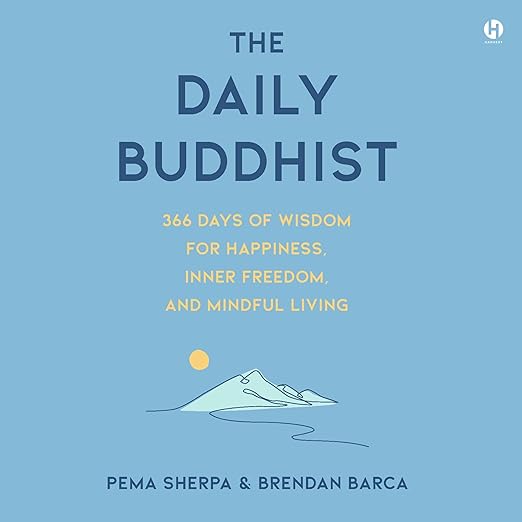
Quick Take
- Narration: Emily Woo Zeller brings genuine warmth and measured pacing to the daily entries, making her voice an ideal companion for a morning ritual listen.
- Themes: Mindfulness, impermanence, self-compassion, taming difficult emotions
- Mood: Calm and grounding, with moments of unexpected depth
- Verdict: A well-crafted daily companion that earns its place in a morning routine, particularly for listeners who want accessible Buddhist teachings without dogma or jargon.
For about three weeks in early spring, I started each morning the same way: before coffee, before my phone, I’d listen to one entry from The Daily Buddhist. It was an experiment in attention, really. I wanted to see whether a brief, structured daily reflection could do what longer meditation sessions had failed to do for me, which is to set an intentional tone before the noise of the day took over. By the end of the first week, I had my answer.
Pema Sherpa’s 366 daily entries are structured around a quote from a significant Buddhist master followed by a reflection that draws the teaching toward contemporary relevance. The roster of masters cited is extensive and impressive: Nagarjuna, Santideva, Milarepa, Patrul Rinpoche, Chogyam Trungpa, and the Buddha himself appear across the year, giving the book both historical range and thematic variety. The framing is explicitly non-sectarian and practical, aimed at listeners who may have no formal Buddhist background whatsoever.
Our Take on The Daily Buddhist
The Daily Buddhist works because it refuses to be precious about its subject. The entries are short and plainly written, but they’re not shallow. The most effective of them do something deceptively difficult: they take an idea from a tradition that is two-and-a-half thousand years old and find the point where it touches a recognizable contemporary experience. One reviewer who describes themselves as knowing very little about Buddhism noted that ‘it doesn’t assume you know anything,’ and that accessibility is genuinely achieved rather than performed. The teachings on why you are not your thoughts, on taming the inner critic, and on why compassion produces happiness rather than simply consuming energy are the ones I kept returning to.
At ten hours and forty-two minutes, this is a long audiobook, but it’s not designed to be consumed linearly in one sitting. Its natural unit is the single daily entry, a few minutes at most, which means the audio format rewards exactly the kind of intermittent, habitual listening that many longer works don’t. One reviewer described listening each morning for several weeks, and that’s probably the optimal approach. The format creates accumulation rather than argument: you’re not building toward a conclusion; you’re building a practice.
Why Listen to The Daily Buddhist
Emily Woo Zeller is an excellent choice for this material. She’s a narrator with wide range who often takes on much more dramatic work, and her decision to bring a steady, unhurried warmth to these entries feels deliberate. There’s no performance here, no interpretive flourish. The voice is simply present, which is exactly what the content asks for. She reads each entry as though she has sat with it before speaking, and the effect is calming in the best possible sense. For a book that is asking you to slow down, having a narrator who doesn’t rush is not incidental; it’s part of the experience.
The accompanying PDF referenced in the product description provides supplemental material, which may be useful for listeners who want a visual anchor for particular teachings or want to revisit specific quotes without scrubbing through audio. This kind of hybrid design is well-suited to a devotional format, and it’s worth knowing the PDF exists if you’re listening on a device that can display it alongside.
What to Watch For in The Daily Buddhist
The book covers a lot of ground across 366 entries, and the thematic organization means some topics recur in different guises throughout the year. This is intentional: impermanence, the nature of the mind, and the relationship between thought and emotion appear in multiple chapters because they are foundational to the tradition. But listeners who are already practicing Buddhists or who have read widely in this area may find some of the ground familiar. The book is pitched at curious beginners and lapsing practitioners, not scholars of the Dharma.
The reviewers are overwhelmingly positive, which creates the usual caveat: a book with near-universal five-star ratings and recent publication is hard to assess against a longer track record. What I can say is that the quality of the writing in the entries I heard was consistent and clear, and that the practical orientation, specific techniques for managing difficult emotions rather than purely philosophical exposition, distinguishes this from more abstract treatments of the same tradition.
Who Should Listen to The Daily Buddhist
This is for listeners who want a structured daily practice that doesn’t require prior knowledge of Buddhism, as well as those who have dabbled in mindfulness apps and want something with more philosophical depth. It works well for morning listeners and commuters who have five to ten minutes to spare at the start of the day. Seasoned practitioners looking for advanced teaching or scholarly engagement with Buddhist philosophy will want to supplement this with other sources. Anyone who finds the daily devotional format frustrating because it resists binge-listening should know that’s a feature, not a flaw, and this book is specifically designed to reward patience over weeks and months.
Frequently Asked Questions
Can I listen to The Daily Buddhist out of order, or should I follow the day-by-day structure?
Either approach works. The daily structure is designed for sequential listening across a year, but the entries are self-contained enough that you can jump in at any point. Many reviewers describe listening each morning in sequence, which seems to be the most effective way to build a consistent practice.
Is The Daily Buddhist suitable for non-Buddhists or complete beginners?
Yes, explicitly so. The authors wrote for listeners with little or no background in Buddhism. Multiple reviewers with no prior knowledge of the tradition found the entries accessible and non-preachy. No meditation experience is required to benefit from the content.
How long is each daily entry when listened to as an audiobook?
The full audiobook runs 10 hours and 42 minutes across 366 entries, which works out to roughly 1.5 to 2 minutes per entry on average. This makes it practical for a brief morning listening habit without requiring significant time commitment each day.
Which Buddhist traditions does The Daily Buddhist draw from?
The book draws from multiple traditions, including Indian Madhyamaka philosophy, Tibetan Buddhism, and general Mahayana sources. Masters cited include Nagarjuna, Santideva, Milarepa, Patrul Rinpoche, and Chogyam Trungpa, among others. The approach is non-sectarian and focuses on practical application rather than doctrinal specifics.