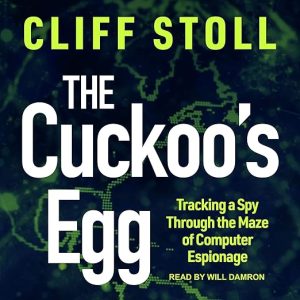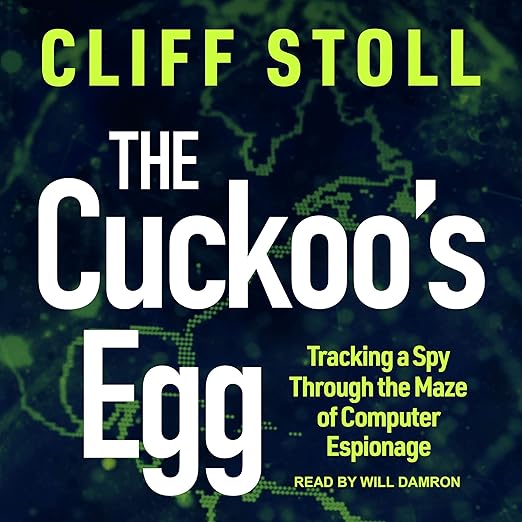
Seventy-five cents is where this begins. An accounting error worth less than a cup of coffee turns up in the billing records at Lawrence Berkeley Lab, an astronomer recently reassigned to keeping the computers running decides to find out why, and a year later he is on the phone with agencies he had never expected to speak to. The audiobook has one advantage over almost every cybersecurity book written since: none of this was theoretical when it happened.
Stoll Turns Network Forensics Into a Detective Story
Cliff Stoll wrote the first great account of intrusion detection before the phrase existed, and he did it as a first-person procedural rather than as a technical postmortem. The method is the story: printouts, logged sessions, a patient reconstruction of what an unauthorized account was reaching for. He is also very funny about himself, which is the quality that keeps twelve hours of network forensics from turning into a manual.
System administration is not obvious material for narrative, and the book's solution is to treat the hunt as detective work with unusually specific tools. Broken codes, satellites and missile bases turn up in the description because they turned up in the investigation, and the trail runs from a billing discrepancy to a spy ring the description ties to cash, cocaine and the KGB. That escalation is the engine.
Pushback comes from the page's only reservation, four stars in June 2013, which says the sales copy over-dramatizes the book and then recommends it anyway to anyone curious about the mechanics of network intrusion and the earliest days of the internet, back when it was a hobby for a handful of enthusiasts. That is a fair correction. The description promises menace, and what the book delivers is patience, curiosity and a lot of paperwork.
Will Damron Balances Deadpan Comedy With Precise Detail
Dial-up connections, nascent networks, a research lab where security meant knowing everyone by name: the world this book documents is genuinely gone, and hearing it described from inside is the appeal. A December 2024 response calls it a journey into the dawn of the internet and praises the cat-and-mouse structure, and it is right that the historical setting has become the main attraction rather than the technical content.
Will Damron takes the recording for Tantor Audio, and the casting question here is tone rather than range. Stoll's prose swings between deadpan comedy about his own domestic life and precise accounts of what a compromised account was doing at three in the morning, so a reader has to be able to sell both without treating either as a joke. A single voice covering a first-person memoir is the right structure for it.
Bureaucracy is the real antagonist, and that is what makes the book still relevant. Nobody wants the case. The agencies pass it around, the lab wants the accounting sorted, and the pursuit continues largely because one person will not let it go. Anyone who has ever reported a security problem to an organization that would rather not hear about it will recognize every institutional response in this story.
Twelve hours and forty-six minutes is generous for a book whose plot is one man reading logs, and the length is mostly justified. The investigation genuinely took a year, and the accumulation of small findings is the texture. It does sag in the middle stretch, where surveillance becomes routine, and that is the point where a listener who wanted a thriller starts checking how much is left.
Most Reviews Predate This 2020 Audio Edition
Three of the five written responses were posted before the recording existed. The audio edition arrived on January 31, 2020, and verdicts from 2013, 2014 and 2016 sit above it, so a majority of what you are reading was written about a printed book. The ratings counter compounds it by recording three votes while five graded responses are visible. The reception is real, it just is not reception of this edition.
Language comes up in an unexpected way. A five-star response filed from the Spanish storefront in March 2016 has no trouble with the English, calls the book educational and intriguing, and then regrets that no translation exists, because the family and friends it wants to recommend the book to cannot read it. That is a real limitation for a title that has otherwise traveled everywhere, and nothing on this page addresses it.
Dated framing is the last caution. The description opens by invoking the internet as a global tool for terrorists, a sentence written in another decade, and it oversells the danger in a way the book does not. Some of the technical detail has also aged into history rather than instruction. Come for the account of how the work was done, not for anything you would apply on Monday morning.
Founding Literature for Anyone Working in Security
Security professionals should treat this as founding literature, and anyone who works in incident response will recognize their own week in it. Beyond that audience, it suits listeners who like procedural nonfiction where the protagonist is out of their depth and gets methodical about it. Curiosity about how the network became what it is now matters more than any technical background you might bring.
Give it a miss if you want current security guidance, since the tooling described belongs to a different era entirely. Listeners who need constant forward motion will also struggle, because long passages consist of waiting, watching a connection and writing things down. The description sets up an international thriller, and what follows is closer to a lab notebook kept by somebody with a sense of humor.
Stoll's real subject is attention, which is why the book has outlived its technology. He noticed something nobody else considered worth noticing and then refused to stop pulling at it, and the account of that stubbornness is what has kept this in print across decades and formats. The seventy-five cents is a great hook. What stays with you afterward is how much of security work turns out to be clerical.
- Performance: Will Damron handles a first-person memoir for Tantor Audio, casting that has to carry deadpan domestic comedy and precise technical narration in the same chapter.
- What it covers: Early internet history, one-man counterintelligence, institutional indifference, curiosity as a professional virtue.
- Feel: Patient, wry, quietly obsessive.
- Our call: Essential listening for anyone in security, and a fine procedural for everyone else, as long as you want the paperwork rather than the chase.
Common Questions
Do I need a technical background to follow this audiobook?
No. Stoll explains what matters as it comes up and the investigation is described in plain terms, so a listener who has never used a command line can follow the logic. A UK response from July 2021 summarizes the whole book as an astronomer given a junior computing job who gets obsessed with a small billing discrepancy, which is exactly the level of prior knowledge required.
Is the information in The Cuckoo's Egg still useful, or is it purely historical?
Mostly historical for the technology and entirely current for the human parts. The specific systems belong to the eighties, but the account of how institutions respond to an inconvenient security report, and how much of the work is documentation, has not dated at all. Read it as founding literature rather than as practice.
Is this a good audiobook for a long trip?
It works well for that, with one caveat. The chapters are episodic and the investigation advances in small steps, which suits interrupted listening, but the middle stretch of surveillance is repetitive by design. Twelve hours and forty-six minutes is easier to take in several sittings than in one determined run at it.