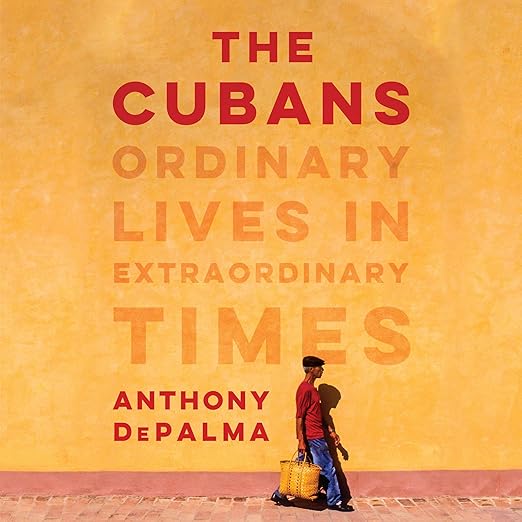
Quick Take
- Narration: Robertson Dean brings DePalma’s ensemble of Cuban characters to life with a warmth and vocal flexibility that honors the book’s humanizing ambition.
- Themes: Revolutionary loyalty vs. national identity, ordinary life under totalitarianism, the Cuban diaspora’s grief and complexity
- Mood: Rich and bighearted, with an underlying sadness that never tips into despair
- Verdict: The most humane portrait of contemporary Cuban life I have encountered in audio, essential for anyone trying to understand the island beyond its political shorthand.
I was halfway through The Cubans when I stopped to look up Guanabacoa on a map. Anthony DePalma had made this Havana harbor neighborhood feel so specific and so inhabited that I wanted to orient myself physically, to locate Cary Luisa Limonta Ewen’s small manufacturing business and Lili’s revolutionary committee and Arturo Montoto’s studio within actual geography. That impulse, that desire to locate yourself inside the world a book has created, is the surest sign a piece of narrative nonfiction is working.
DePalma spent years as a reporter in Cuba, and that accumulated relationship with the country shows on every page. This is not a book written from the outside looking in. It is the product of access and trust and time, and the people at its center, Cary, Lili, Arturo, and Jorge García, the Miami exile still seeking justice for the sinking of a tugboat that killed his son and grandson, feel like people DePalma actually knows rather than characters assembled to illustrate a thesis.
Our Take on DePalma’s Portrait of Guanabacoa
The central structural choice here is the neighborhood. Rather than trying to describe Cuba as a whole, DePalma focuses on one community across the harbor from Old Havana over roughly twenty years. That compression produces depth rather than breadth, and the result is a portrait of Cuba that feels more real than anything produced by parachute journalism or political argument.
What makes the book genuinely complex is the range of relationship to the revolution that DePalma captures. Cary, a former Communist Party member who has become an entrepreneur navigating black markets, occupies one position. Lili, the loyal Communist who runs the neighborhood’s watchdog revolutionary committee, occupies another. Arturo, the artist who left for Mexico and came back when conditions seemed to improve, sits somewhere between. And Jorge, in Miami, exists in a completely different relationship to the island and to justice. DePalma does not editorialize about which of these people is right. He trusts the reader to hold the complexity.
Why Listen to The Cubans
Robertson Dean’s narration is excellent. He has the range to move between DePalma’s journalistic prose and the direct quotation of people speaking in a second language without either flattening the personalities or caricaturing the accents. There is genuine warmth in how he renders the Cuban subjects at the book’s center, which mirrors DePalma’s own evident affection for the community he has documented.
At nearly thirteen hours, this is an audiobook that rewards sustained attention rather than commute-length listening. The book is structured episodically, following different subjects through different periods, and Dean’s consistency of voice across those episodes helps maintain coherence over the full length. Several reviewers who have personal connections to Cuba, including one who left the island as a child in 1962 and another who visited Havana with an art group, found the book both accurate and revelatory, which is probably the best endorsement any journalism-based nonfiction can receive.
What to Watch For in the Jorge García Sections
The thread following Jorge García in Miami is structurally different from the Guanabacoa chapters, and it functions almost like a counterpoint. While the island-based sections document people navigating daily life under a system that has defined their existence, Jorge’s pursuit of justice for the tugboat massacre, a deliberate government killing of refugees for which official Cuba denies any responsibility, gives the book its most politically direct material.
DePalma handles this with the same restraint he applies throughout, but the emotional weight is different here. Jorge’s grief is decades old and still acute, and the audiobook’s pacing through these sections gives that grief room to register without becoming manipulative. The contrast between the resignation and ingenuity of those still on the island and the unresolved anger of those who left is one of the book’s most lasting impressions.
Who Should Listen to The Cubans
Anyone trying to understand Cuba beyond its role as a geopolitical symbol will find this essential. DePalma’s portrait is neither a defense of the revolution nor a Cold War polemic. It is a record of what it actually looks like to live inside a system that has been defining and redefining itself for more than half a century, told through the specific lives of people who have not had the option of watching from a safe distance.
It works equally well for listeners with personal Cuban connections, who will find their own experience reflected or complicated by what DePalma documents, and for listeners with no prior knowledge of Cuba, who will emerge with a far more textured understanding of the island than any news cycle provides. Robertson Dean’s narration makes the long runtime feel earned.
Frequently Asked Questions
Does The Cubans require prior knowledge of Cuban history to be meaningful?
No. DePalma provides enough historical context throughout to orient listeners unfamiliar with the revolution and its aftermath. The focus on individual people rather than political events makes the book accessible without reducing it to a primer.
How does Robertson Dean handle the multiple Cuban characters whose voices DePalma directly quotes?
Dean is careful and respectful in his rendering of Cuban voices, warming the narration without tipping into caricature. The transitions between DePalma’s authorial voice and direct quotation are smooth throughout.
Is this book politically neutral, or does DePalma have an obvious point of view about the Castro regime?
DePalma writes with journalistic restraint and genuine empathy for people across the political spectrum he documents. The book includes devoted Communists, disillusioned former party members, and diaspora exiles, and none of them are treated as merely illustrative. His own politics are not prominently declared.
When was this book originally published, and does the material feel dated given Cuba’s changing situation?
Published in 2020, the book covers roughly twenty years of Guanabacoa life. Some specifics of the US-Cuba political relationship have shifted since then, but the portrait of daily Cuban life and the fundamental tensions DePalma documents remain as relevant as ever.