Quick Take
- Narration: Robert J. Eckrich reads with the measured pace appropriate to scholarly argument, clear and precise, letting Stern’s demolition of the official record carry its own weight.
- Themes: The gap between official memory and documented history, the mythology of Camelot, the politics of memoir-writing among the powerful
- Mood: Rigorous and occasionally unsettling, the kind of listen that reshapes something you thought you already understood
- Verdict: Essential listening for anyone who has read RFK’s Thirteen Days or taken the ExComm story at face value, Stern’s use of the actual White House tapes changes the picture substantially.
I was fourteen when I first read accounts of the Cuban Missile Crisis and came away with the impression that Kennedy and his advisors had navigated thirteen days of existential brinkmanship with a combination of resolve, wisdom, and just enough restraint to avoid catastrophe. That impression is common, and it is largely the product of the memoirs written by the ExComm participants themselves, particularly Robert Kennedy’s Thirteen Days, published posthumously in 1969. Sheldon Stern’s The Cuban Missile Crisis in American Memory exists to correct that impression, systematically and without particular gentleness.
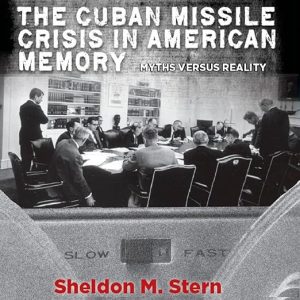
Stern spent decades as the historian at the John F. Kennedy Presidential Library, which means he had access to materials most historians do not. He draws on the actual recordings of the ExComm meetings, the raw, often chaotic deliberations between Kennedy and his advisors, and compares them directly to what those same participants later claimed had happened. The discrepancies are not minor.
Our Take on The Cuban Missile Crisis in American Memory
The book’s central argument is that the popular narrative of the crisis, that it was managed wisely, that Kennedy’s leadership was decisive and measured, that the ExComm functioned as a unified deliberative body, is a mythology constructed after the fact by men who had strong personal and political reasons to present themselves well. Stern does not argue that the crisis was mismanaged catastrophically; he argues that the sanitized version distorts our understanding of how close to the edge things actually came, and what factors shaped the decisions that were made.
For a reader who lived through the crisis, and several reviewers are in that category, including a former Army officer who described the book as hard-hitting and accurate, the effect is a kind of historical vindication. For a reader who knows the crisis primarily through textbooks and popular history, the effect is closer to a ground shift. Stern is not revisionist in the polemical sense; he is corrective in the archival sense. The tapes say what they say.
Why Listen to The Cuban Missile Crisis in American Memory
Robert J. Eckrich’s narration is suited to the material, measured, precise, and unflashy. This is a scholarly book, and Eckrich does not try to inject drama that the author has deliberately subordinated to argument. The prose moves through the ExComm deliberations methodically, and the narration matches that rhythm. At seven hours and forty minutes, it is a serious but not imposing commitment for a nonfiction listener.
The book is published as part of the Stanford Nuclear Age series, which positions it within a tradition of careful archival history about the Cold War. That context matters, Stern is writing for an audience that takes historical documentation seriously, and the audiobook delivery reflects that. This is not popular history in the mode of Erik Larson; it is closer to the analytical end of the spectrum, where the argument is built from primary sources and the narrative is subordinate to the evidence.
What to Watch For in The Cuban Missile Crisis in American Memory
The book assumes some familiarity with the basic facts of the Cuban Missile Crisis and with the principal figures of the Kennedy administration. Listeners who come in with that background will follow Stern’s argument easily; listeners who are completely new to the subject may find themselves wanting a more foundational account first. Thirteen Days is the obvious starting point, even though, or perhaps especially because, Stern systematically challenges its reliability.
The argument is also specifically targeted at the ExComm memoirs. Stern is not writing a comprehensive history of the crisis from the Soviet or Cuban perspective, though he incorporates some of that material. Readers expecting a full geopolitical account will find the focus narrower than they expected. This is a book about American memory specifically, about how the men in that room chose to represent what had happened, and what the tapes reveal about the distance between that representation and the record.
Who Should Listen to The Cuban Missile Crisis in American Memory
This audiobook is most valuable for readers with some prior investment in Cold War history who want to understand why the popular account of the crisis looks the way it does. It is an excellent companion to, or corrective to, RFK’s Thirteen Days and the memoirs of other ExComm participants. History teachers, students of American political memory, and readers interested in how official narratives get constructed will find it particularly rewarding.
It is not the right entry point for a general listener with no background in the period. Start with a narrative account of the crisis, develop the context, and then come to Stern for the archival correction.
Frequently Asked Questions
Do I need to have read RFK’s Thirteen Days before listening to this audiobook?
It is strongly recommended. Stern’s argument is structured as a direct correction of Thirteen Days and the memoirs of other ExComm members. Familiarity with those accounts makes Stern’s counter-argument much more legible and impactful. You can follow the book without having read them, but you will lose significant context.
What recordings does Sheldon Stern draw on for his analysis?
Stern uses the White House taping system recordings of the actual ExComm meetings during the October 1962 crisis. These recordings were declassified over time and provide a contemporaneous record that can be compared directly to what participants later claimed in their memoirs. Stern spent years as historian at the JFK Presidential Library working with this material.
Is this audiobook appropriate for listeners who already know a lot about the Cold War?
Yes, it is actually best suited for listeners with some prior knowledge. The book assumes familiarity with the key figures and basic timeline of the crisis. Its value comes from what it reveals about the gap between official memory and the archival record, which is most striking if you already know the official version.
How does Stern’s account change the conventional understanding of Kennedy’s crisis leadership?
Stern’s argument is not that Kennedy was incompetent, but that the subsequent memoirs, including his brother’s Thirteen Days, significantly cleaned up the record, presenting more consensus, deliberation, and resolve than the tapes actually document. The crisis was more chaotic and the decision-making more contested than the canonical account suggests.