In Brief
- Performance: Author and reader are the same credit, which puts the Syrian family names, the Arabic, and the place names in the mouth of the person whose claim to them the title disputes.
- What it covers: Inherited displacement, the private cost of war reporting, identity when no available label fits.
- Feel: Searching and unsentimental, with the adrenaline of the assignments running underneath.
- Our call: Strongest where the ancestral home and the dateline are the same place; go in for that rather than for a regional survey.
Blonde hair, blue eyes, and a Syrian surname: the collision packed into that combination drives this audiobook from its opening minutes. Hala Gorani spent a career as a globe-trotting anchor and correspondent, and the book pulls that career apart to ask what belonging means for someone born to Syrian parents in America, raised mainly in France, and at home in neither Aleppo nor Seattle nor Paris nor London. Eight hours and forty-eight minutes, delivered by the person who lived them, and the answer she reaches is not a comfortable one.
Gorani's Own Voice Undercuts the Accusation
Start with the category label on this listing, which reads history with a Middle East tag attached, because that placement quietly costs the book its natural audience. The response pool corrects the record without being asked: two of the five visible write-ups put the word memoir in their headline, and the material behaves accordingly. Anushay Hossain, grading it at the top eight days after release, describes years of watching Gorani anchor on CNN International and then wanting the stories behind the stories, including what the work costs mentally.
Underneath sits a double structure. A reporting record runs from Cairo during the Arab Spring through the Syrian civil war, suicide bombers in Beirut, chemical attacks in Damascus, the growth of ISIS and the war in Iraq, and it is laid alongside a genealogy reaching back to the courts of Ottoman Empire sultans. Gorani does not treat those as separate books. The family scattering explains why she kept returning to the country that produced it, and the reporting supplies the evidence the genealogy cannot.
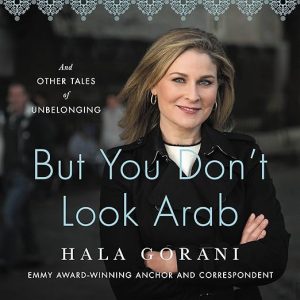
Author and reader are the same name on this credit, and the format does something strange to the title. That accusation is about appearance: blonde hair, blue eyes, a face that does not match the surname. Audio deletes the face. What reaches a listener instead is the surname, the Arabic, the family names, and a voice, which is precisely the evidence the accusation ignores. A book written for the page gains an argument from the medium it was not written for.
Aleppo Was Her Family's Home Before It Was a Dateline
Five visible responses, five top grades, against a counter displaying 4.4 across seventy-eight votes. Run that: the seventy-three people who left a number and no sentence average somewhere near 4.3 between them. The written record is the flattering end of the distribution rather than a sample of it, which is worth knowing before you weigh the enthusiasm. It is not a warning about quality. It is a map of who bothered to type.
David Michelson, writing nine days after release, frames the pull precisely: the draw is watching a correspondent cover an ancestral home while it comes apart. That is the strongest sequence here and the one nothing else replicates. Aleppo arrives not as a dateline but as the town her family left, and the doubling gives the war coverage a second floor. For anyone who follows international journalism, the professional half alone would justify the hours.
Humanizing a century of upheaval is the stated ambition, and the method is unusual. Instead of a survey, Gorani runs one family's dispersal as the through line and hangs the wider history off it. Ottoman courts, a family forced to scatter when their home country was torn apart, a citizen of everywhere and nowhere: each arrives attached to people who are named. Listeners who bounce off geopolitical history because the casualties stay abstract will find this the friendlier route in.
Neither Syrian Enough nor French Enough, She Writes
Three of the five visible write-ups use an explicit reading verb, and one of them describes the object rather than the experience: a pre-order that arrived, got admired for its cover, and sat on a coffee table waiting for a free evening. That account, filed a year and a half after publication, is the clearest sign this pool was assembled around a printed edition. The grades are genuine. What they grade is a book somebody held.
Expect the identity thread to interrupt the reporting rather than alternate neatly with it. Anyone arriving for a correspondent's greatest hits will meet long stretches about not feeling Syrian enough in Aleppo and not feeling French enough in Paris. Gorani announces this in the title, so it is not a bait and switch, but the tag on this listing points at a region rather than at a self-examination, and the mismatch is easy to walk straight into.
One more thing the copy soft-pedals. This is not a survey of the modern Middle East, whatever the shelving suggests. A century of upheaval arrives filtered through one family and one career, so events carry the weight Gorani's own proximity gives them rather than the weight a historian would assign. That is a legitimate method and she is open about it. It does mean anybody wanting a balanced regional overview should treat these hours as a supplement, not a foundation.
Skip It If You Want the Region Without Her
Reach for this if the phrase citizen of everywhere and nowhere describes something you have felt. skyone1, filing in the same opening week, locates the appeal in a way I would not improve on: the family history mixed with dispatches from the assignments is the draw, but the thread setting it apart is the private one. Listeners who came for a war correspondent's memoir get one, wrapped around something considerably more searching.
A second listener is served just as well: the person who followed Gorani's on-air work for years and never got more than a few minutes of her at a stretch. The format inverts that entirely: one voice, no producer counting down, and room for material a broadcast slot cannot hold. An ancestral map, a displaced family, the assignments she describes escaping by a hair, all of it at length, in sequence, with the connective tissue left in.
Skip it if you want the region without the person. Anyone hunting a straight history of Syria, Iraq, or the Arab Spring will find those events here but always angled through one life, and the identity material is not an aside you can wait out. Give it a pass, too, if a memoir read by its own subject strikes you as uncomfortably close, because nothing in this one keeps its distance. Everyone else gets a rare thing: reporting with a stake in it.
Frequently Asked Questions
Several responses praise how Gorani handles narrating her career. Does that refer to the audiobook performance?
No. Jay K., filing a top grade nine days after release, applies the word to the writing: how genuine and transparent the author is in narrating different stages of her career on the page. Because the credits list Gorani as her own reader, the two senses sit unusually close together here, but that compliment is aimed at the prose.
Is this shelved correctly as history, or is it really a memoir?
It is a memoir braided with reporting, and the shelving undersells it. The listing files it under history with a Middle East tag, yet the material runs from Ottoman-era ancestors to the Arab Spring, Beirut, Damascus, and Iraq through one reporter's family and one reporter's sense of self. Anyone searching for memoirs will have trouble finding it where it currently sits.
How much of the audiobook is war reporting versus family history?
The copy promises both and never splits them into halves. Assignments in Cairo, Beirut, Damascus, and Iraq arrive threaded through a search for belonging that runs from Aleppo to Seattle to Paris to London. Across eight hours and forty-eight minutes, treat the identity thread as continuous rather than confined to a few early chapters.
Do you need to know Gorani from television before starting?
It helps but is not required. The text introduces the career from scratch: Syrian parents, a childhood mainly in France, an anchor's chair, and assignments she describes escaping by a hair. Familiarity with the broadcast years adds recognition rather than comprehension, and the identity material needs no prior context whatsoever.