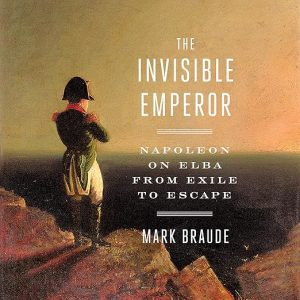
Quick Take
- Narration: Mark Braude narrates his own history with a measured, conversational authority that keeps the pacing close to the novelistic quality of the prose.
- Themes: Exile and ambition, the psychology of defeat and reinvention, European power politics
- Mood: Brisk and suspenseful, with occasional wry humor
- Verdict: A sharp, well-paced narrative history of Napoleon’s Elba exile that makes a largely forgotten chapter feel genuinely consequential.
I had spent most of a Saturday with a thick Napoleon biography sitting on my nightstand, the kind that covers everything from Corsica to Saint Helena in exhaustive detail, and I found myself wanting something more focused. The Invisible Emperor arrived at exactly the right moment. Mark Braude’s account of Napoleon’s ten-month exile on Elba is precisely that: a close, granular study of a single period that most biographies treat as a transition. The subtitle could reasonably have been what happened in between, because that is precisely how this episode tends to be framed. Braude refuses that framing.
The premise is almost absurd in retrospect. Having governed roughly eighty million people across half of Europe, Napoleon was exiled to Elba, a Mediterranean island of less than a hundred square miles. His captors evidently assumed this would be the end of him. It was not. Within ten months, he had escaped with just over a thousand supporters, marched to Paris, and retaken the Tuileries Palace without firing a shot. Braude’s task is to explain how a man in that position, stripped of his empire and watched by a British minder, managed to make such an improbable return.
Our Take on The Invisible Emperor
What Braude does exceptionally well is cast the exile as something more than a waiting room. Napoleon on Elba is an administrator, a schemer, a husband figure of a sort, and a man navigating the peculiar social politics of a tiny island he suddenly controls. The portrait that emerges subverts some of the archetypal mythology around him without dismantling what is genuinely remarkable. Braude has a journalist’s instinct for the telling detail, and the Seattle Times description of his prose as glinting with humor and humanity is accurate. This is not a dry, dutiful account.
The secondary characters are also given real texture. Neil Campbell, Napoleon’s official British minder, is drawn with considerable sympathy as a man who will be permanently disgraced for having let Napoleon slip away, a failure he could not have predicted from the available evidence. Marie Louise, Napoleon’s young second wife, is twenty-two to his forty-four at the time of the abdication, and her story runs as a tragic parallel thread through the exile narrative. One reviewer noted that the short chapter structure was a genuine gift, and I agree: the pacing here is designed for sustained listening rather than reference reading.
Why Listen to The Invisible Emperor
The author-narrated format rewards listeners who want proximity to the material. Braude’s delivery is confident without being performative, and he reads his own prose with the sense of someone who knows exactly where the story is going. A reviewer with extensive Napoleon biography experience noted this was a pleasant and well-sourced account that exceeded their hopes, particularly valued for giving just the right amount of historical context without overwhelming the central story. For listeners who came to Braude through his earlier work on Monte Carlo, this delivers a similar blend of narrative drive and archival rigor.
What to Watch For in The Invisible Emperor
At least one reviewer flagged grammatical inconsistencies and incomplete sentences in the text, which may have carried through to the audio. They also noted that some secondary characters were introduced and then absent for long stretches, particularly in the first third, which can be disorienting if you are not tracking the cast carefully. A brief character list would have helped. These are editorial rather than fundamental issues, but listeners who value tight copy may notice them.
The book also deals primarily with the exile itself rather than the broader Napoleonic arc, so it works best when you arrive with at least a general sense of the historical context. That said, Braude provides enough background that it is not inaccessible to listeners who are new to the period.
Who Should Listen to The Invisible Emperor
History readers who enjoy narrative nonfiction written with novelistic craft will find this deeply satisfying. Those who have read one of the comprehensive Napoleon biographies and want to dwell longer in a single episode will get particular value here. Listeners wanting a broad overview of Napoleon’s life should look elsewhere. Anyone who enjoyed Braude’s earlier Monte Carlo book should move this up the queue immediately.
Frequently Asked Questions
Do you need prior knowledge of Napoleon’s life to enjoy The Invisible Emperor?
Not extensively, though some familiarity with the basic arc helps. Braude provides enough historical context that the book works as a standalone narrative, but it is richer when you arrive knowing the larger story.
How does Mark Braude’s self-narration compare to a professional narrator?
Very well. His delivery is measured and confident, and he reads with the pacing of someone who knows the material intimately. It suits the conversational, novelistic quality of his prose.
Is this book primarily about the escape from Elba, or does it cover the entire exile?
It covers the full ten-month exile, with the escape forming the climax. Braude gives substantial attention to what Napoleon actually did on the island day to day, which is the most overlooked part of this period.
Are there any notable weaknesses in the audio edition?
One reviewer noted some grammatical inconsistencies and characters who disappear for long stretches, particularly early in the book. These are editorial rather than narrative issues, but worth knowing about.