Quick Take
- Narration: Bryan Mark Rigg narrates his own 30-hour work with the conviction of a historian who spent years in the field with survivors. The intimacy is unchallengeable and essential to the material.
- Themes: Pacific War ground combat, Medal of Honor heroism, the institutional memory of the Marine Corps
- Mood: Immersive, often harrowing, and deeply human in its treatment of ordinary men under extraordinary conditions
- Verdict: At 30 hours this is a serious commitment, but Rigg delivers one of the most thorough reconstructions of a single Marine’s Pacific War story available in audio.
Thirty hours is a long time to spend with a single book, and I want to be honest about what that length actually means here. This is not a streamlined narrative that happens to run long. Bryan Mark Rigg is an academic historian who treats the oral and documentary record comprehensively, which means Flamethrower moves at the pace of the evidence rather than the pace of a thriller. One Audible reviewer wrote it directly: fantastic story and research, needs an editor. That tension is real, and any listener considering this one deserves to know it going in. But I also think that assessment undersells what the comprehensiveness actually produces, which is a sense of the Pacific War at the ground level that is unavailable from shorter, tighter accounts.
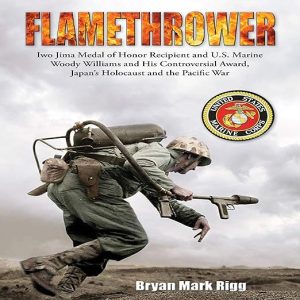
The subject is Woody Williams, a West Virginia dairy farmer who enlisted in the Marines and, during the battle for Iwo Jima in February 1945, spent four hours maneuvering a 70-pound flamethrower across open ground to destroy seven Japanese pillboxes while under continuous enemy fire. He was awarded the Medal of Honor. The action itself takes fewer pages to describe than you would expect; what Rigg is doing is something harder, which is establishing the full context that makes the action comprehensible rather than merely incredible.
The Weight of Seventy Pounds
The physical reality of what Williams did on Iwo Jima does not fully land without Rigg’s extensive preliminary work. The flamethrower was not just heavy and clumsy; it was a specific death sentence for its operator, who instantly became the highest-priority target on any Japanese soldier’s field of view. Rigg reconstructs the tactical situation with precision: the honeycomb of interlocking tunnels and bunkers that made Iwo Jima unlike anything American forces had previously encountered, the specific terrain Williams crossed, the Marines who covered him and some of whom died in the process. By the time Rigg reaches the action itself, the listener has enough context to understand not just what Williams did but the near-impossibility of surviving it.
The connection to the larger Pacific War strategy is one of the book’s most valuable contributions. Rigg makes clear that Iwo Jima was not simply a brutal battle for a small volcanic island; it was essential for the B-29 campaign against Japan, which required P-51 fighter escorts operating from Iwo’s airfields. He also establishes the island’s role as a potential emergency landing site for the Enola Gay, a detail that connects Williams’ story directly to the atomic bomb and the chain of events that ended the war.
What the Research Methodology Produces
Rigg conducted hundreds of interviews with Williams himself and with surviving Marines, family members, Japanese veterans, and historians over a four-year period spanning two continents. The result is a documentary record of extraordinary density. Several reviewers describe the book’s avoidance of hero worship as a distinction, and that is accurate. Rigg is interested in Williams as a human being operating under conditions most humans cannot imagine, not as a simplified icon. The book engages with Williams’ post-war life, his faith, his family, and the long aftermath of survival, which prevents the Medal of Honor action from becoming the totality of the portrait.
The trade-off is that Rigg includes most of what he found, including material that a commercial editor would likely have cut. Several sections on institutional Marine Corps history and on the broader Iwo Jima campaign serve the completist but slow the narrative. One reviewer was explicit about this; another described it as a fabulous book that drew them in throughout its entirety and that they plan to re-read. Both responses are valid and reflect different listener orientations rather than a flaw in the book itself.
Why Rigg Had to Narrate This Himself
Rigg narrating his own 30-hour work is an act of serious commitment, and it shows. He reads with the intimacy of someone who spent years with these men and carries the weight of that relationship into every hour of audio. There are moments where a trained narrator’s technical skill might have varied the rhythm more effectively, but the authority is unchallengeable. When he is recounting survivor testimony, the sense that he was physically present in those conversations, that these are real people he knows rather than historical subjects he is describing, changes what the words do.
Who Should Take On the Thirty Hours
This book is for listeners with a serious commitment to Pacific War history who want ground-level specificity rather than strategic overview. If you have already read James Bradley’s Flags of Our Fathers and want something that goes deeper into the individual soldier’s experience on Iwo Jima, this is the logical next step. If you want a more compact single-volume history of the Pacific campaign, start with shorter works and return to Rigg when you want to go deeper. The 30-hour runtime is not for the casually curious; it is for the genuinely committed.
Frequently Asked Questions
Does the book cover the entire Pacific campaign or focus primarily on Iwo Jima?
Rigg covers Williams’ full Marine experience, including Guadalcanal and Guam, but Iwo Jima is the central focus. The book also provides substantial context for the broader Pacific War strategy, including the B-29 campaign and the atomic bomb decision chain.
Is the 30-hour runtime justified?
That depends on what you want. Rigg includes documentary material that a commercial editor would cut, and some sections on Marine Corps institutional history slow the narrative. But the density produces a ground-level texture unavailable from tighter accounts. Several reviewers describe planning to re-listen.
What is the legal controversy some reviewers mention?
Some reviewers note purchasing the book partly in response to legal pressure applied against the publisher by Williams. Rigg addresses the complexity of Williams as a historical subject within the book itself, and the legal backstory does not affect the historical content.
How accurate is the book given the reliance on oral testimony?
Rigg cross-references oral testimony against documents, records, and multiple independent accounts. Reviewers with direct connections to the Marines and Iwo Jima note that the book contains accurate information they had not previously encountered, suggesting the documentation is thorough.