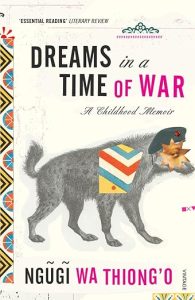
Ngugi wa Thiong'o is one of the great living writers in any language, and Dreams in a Time of War is the audiobook that gives you access to the formation of that sensibility. It is his memoir of childhood in colonial Kenya, of growing up as the fifth child of his father's third wife among twenty-four children born to four mothers, of discovering through school a thirst for learning that his community regarded as unusual, and of watching the Mau Mau uprising reshape everything he understood about the world. Hakeem Kae-Kazim narrates with an instinct for the prose's oral roots, and the combination of Ngugi's writing and Kae-Kazim's voice makes for one of the more memorable memoir listening experiences in recent memory.
The craft at work here is the kind that hides itself. Ngugi was born in the 1930s, and this memoir reconstructs that era not through nostalgia but through the kind of precise, selective memory that produces literature rather than autobiography. He etches the landscape, the people, and the daily texture of life under colonialism without reducing any of it to social argument. The argument is present, but it rises from the particular.
Ngugi's Brothers Bring the Mau Mau Home
One reviewer called this 'a treasure-house of childhood memories,' which captures the density of detail without suggesting it is merely anecdotal. Ngugi draws on the stories told by his oldest step-mother around the fireside, stories that inspired his lifelong love of storytelling, and the memoir is partly about the transmission of narrative across generations. It is also, beneath the personal, about the catastrophic pressure of colonialism on that transmission. What happens to a culture's stories when its land, its language, and its governance are seized by an occupying power? Ngugi's childhood was lived inside that question without yet being able to name it.
The Mau Mau uprising arrives in the memoir not as background history but as something that enters the family directly, through his brothers' involvement in the violent resistance movement. Ngugi treats this with the honesty of a memoirist who was a child at the time: he conveys the fear and the fractures without claiming adult understanding he did not have then. The restraint is one of the book's significant achievements, and it is a restraint that Kae-Kazim's measured narration honors throughout.
The memoir is also a portrait of education as both liberation and complication. Ngugi's 'bizarre thirst for learning,' as the synopsis describes it, sets him apart from his immediate community even as it gives him access to a wider world. The school sequences are some of the book's most vivid, capturing both the excitement of discovery and the alienation that accompanies any child who learns that knowledge comes at a cost.
Kae-Kazim Honors the Fireside Storytelling Rhythm
Hakeem Kae-Kazim is a Ghanaian-British actor with extensive experience across multiple registers, and he approaches Ngugi's prose with what feels like genuine reverence. The memoir's rhythms are those of spoken Kenyan oral tradition, stories shaped by the fireside, by repetition and digression and return, and Kae-Kazim honors that architecture. A reviewer noted the book's 'wistful and lyrical' quality, and in audio that quality is amplified by a narrator who understands that the text is performing memory, not transcribing it.
At under eight hours, the audiobook is compact for a literary memoir of this scale. Ngugi covers his childhood through adolescence without hurry but also without the kind of extended digression that can lose a listener in a longer format. The economy serves the prose. Ngugi's 'deep thinking, light irony and clean eyes,' as one reviewer described them, come through clearly in this listening-length format, and Kae-Kazim delivers those qualities without overplaying any of them.
This is also a memoir that rewards multiple listens. The first time, you follow the story. Subsequent listens reveal the structural sophistication: the way certain images recur, the way family members are introduced and deepened, the way the political slowly infiltrates the personal until they are indistinguishable. Few memoirs of childhood achieve this kind of layering.
Ngugi's Writing Career Starts After This Ends
The memoir covers Ngugi's childhood and early adolescence, ending before his emergence as a writer. Readers seeking the story of how he came to write his novels, or his later imprisonment and exile from Kenya, will need to look to his other autobiographical writings, particularly In the House of the Interpreter and Birth of a Dream Weaver. Dreams in a Time of War is specifically the origin story, the formation of the consciousness before it knew what it would become.
The depictions of colonial Kenya include violence and dispossession that some listeners may find difficult, particularly the passages relating to the Mau Mau emergency. Ngugi does not sensationalize, but he also does not protect the reader from what was happening. The historical accuracy, which one reviewer praised for 'enlightening my understanding of Kenya colonization and fight for freedom,' is also the source of the book's emotional weight, and Kae-Kazim carries that weight responsibly.
Fans of Ngugi's Fiction Will Want This Too
Literary listeners familiar with Ngugi's fiction, particularly Weep Not, Child and A Grain of Wheat, will find this memoir the essential companion to that work. Those new to Ngugi will find it an ideal introduction: it is more accessible than his experimental later novels while sharing the same moral seriousness and clarity of observation.
Anyone interested in African literature, postcolonial history, or memoir as a form will find this audiobook rewarding. The audio format adds a layer of intimacy that the subject matter earns: Ngugi's childhood was saturated in oral storytelling, and hearing his memoir rather than reading it feels like the appropriate mode of reception for a book that is, at its heart, about the power of spoken narrative to transmit what written records cannot.
Frequently Asked Questions
Do I need to have read Ngugi wa Thiong'o's novels before listening to the Dreams in a Time of War audiobook?
No prior knowledge of Ngugi's fiction is required. The memoir stands completely on its own as a childhood narrative. Readers familiar with his novels will find connections to his themes and preoccupations, but the audiobook is fully accessible as a first encounter with his work.
Is this audiobook appropriate for listeners who want to understand Kenyan colonial history more broadly?
Yes, with the understanding that it is a personal memoir rather than a historical survey. Ngugi's account of the Mau Mau uprising and the daily conditions of colonial life provides vivid, intimate documentation, but listeners seeking comprehensive history should supplement this with dedicated historical sources.