Quick Take
- Narration: Derek Perkins handles the scope and register of Asbridge’s 25-hour history with consistent authority, the stamina and intelligence the material demands across a very long runtime.
- Themes: The dual Christian and Muslim perspectives on holy war, religious ideology as political instrument, the centuries-long contest for Jerusalem
- Mood: Epic in scale, pulsing with narrative momentum, Asbridge writes fast without sacrificing depth
- Verdict: The definitive one-volume account of the Crusades for general listeners, balanced, rigorously researched, and genuinely compelling across a subject that is all too easy to reduce to simple moral accounting.
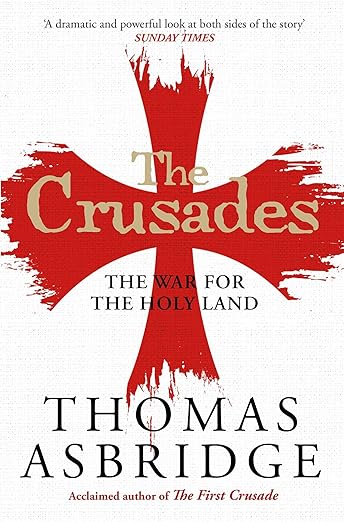
I spent a weekend with Thomas Asbridge’s The Crusades the summer after I had been to Jerusalem for the first time, and the timing was almost too apt. Walking through the Old City, through the Muslim Quarter and the Christian Quarter and the Jewish Quarter, past the Church of the Holy Sepulchre and the Dome of the Rock and the Western Wall, everything compressed together in a space smaller than most American shopping malls, had given me a visceral sense of why this particular geography had attracted two hundred years of catastrophic violence in the name of God. Asbridge gives that violence its full context without making it either cartoonishly brutal or falsely symmetrical.
The book’s most important structural decision is the one the synopsis describes directly: telling the story from the perspective of both Christians and Muslims, reconstructing the experiences and attitudes of those on either side of the conflict. This sounds like a reasonable balanced-history approach, and it is, but Asbridge executes it with more rigor and more genuine attention to the Muslim sources than most comparable works. He reads Arabic. He worked extensively with the primary Islamic chronicles. The result is a book where Saladin is not a romanticized opponent and the crusaders are not simply religious zealots, but where both sides are understood as products of their specific political, religious, and cultural contexts.
Two Centuries in a Single Volume
The book covers the First Crusade’s extraordinary success in 1099, which shocked the Islamic world and established the Crusader States, through the gradual erosion of Latin Christian presence in the Levant, through Saladin’s reconquest of Jerusalem in 1187, through Richard I’s campaign in the Third Crusade, and into the longer twilight of crusading endeavor that followed. Two hundred years is a significant span, and Asbridge does not sacrifice the texture of specific moments to maintain the chronological momentum. The siege of Jerusalem in 1099 receives the kind of granular treatment that makes you understand what the theology of holy war actually meant to the people enacting it. The relationship between Saladin and Richard during the Third Crusade, the peculiar code of chivalric respect that existed between enemies who were trying very hard to kill each other, is one of the book’s most quietly remarkable achievements.
Derek Perkins narrates at the top of his considerable range for this kind of material. Asbridge’s prose moves quickly, The Times review quoted in the synopsis notes his tendency to whip the narrative along, and Perkins matches that pace without sacrificing the weight the subject requires. At 25 hours and 32 minutes, this is a substantial commitment, and Perkins sustains it. The 4.5 rating across 544 reviews is strong evidence of sustained listener satisfaction across an extended listening experience, which is harder to achieve than high ratings on shorter books.
Navigating the Contemporary Resonance
Books about the Crusades written after September 2001 have to navigate a minefield of contemporary relevance. The Crusades have been invoked by both Western political figures and Islamic extremists as historical precedents for their contemporary conflicts, and a historian writing in that environment has to decide how explicitly to engage with the question of relevance. Asbridge is careful. He neither pretends the history has no contemporary echoes nor allows those echoes to distort the medieval reality into something that serves a modern argument. The reviewer who notes the book is a very balanced look at an important period in history is identifying something real: Asbridge refuses the easy narratives that both sides of the contemporary culture war around the Crusades tend to prefer.
Comparisons and Complements
For listeners who want deeper immersion in the first crusade specifically, Jonathan Riley-Smith’s work provides more sustained focus. For the Muslim perspective in greater detail, Carole Hillenbrand’s The Crusades: Islamic Perspectives is essential reading alongside this. But for a single volume that gives a general listener the full sweep of two centuries of crusading history from both sides of the conflict, Asbridge’s book has not been superseded. At 4.5 across more than 500 reviews, the audience has made a clear judgment, and in this case the audience is right.
Frequently Asked Questions
Does the book cover all eight or nine Crusades, or primarily the first three?
Asbridge focuses most intensively on the First, Second, and Third Crusades, which represent the era of greatest dramatic intensity and historical consequence. The later crusading expeditions receive coverage in the context of the longer decline of Latin Christian presence in the Levant, but this is not an encyclopedic treatment of every crusading campaign, it is a narrative history organized around the most significant turning points.
How does Asbridge treat the Muslim perspective? Is this genuinely balanced or primarily a Western-oriented account?
The balance is genuine rather than rhetorical. Asbridge works directly from Arabic primary sources, including the chronicles of Ibn al-Athir and the biography of Saladin by his secretary Imad ad-Din, and integrates the Muslim perspective as a primary narrative voice rather than as commentary on the Western account. Reviewers with knowledge of the Islamic sources have noted the research is serious and substantive.
Is the book appropriate for listeners with no prior knowledge of the Crusades, or does it assume familiarity with the period?
Asbridge writes explicitly for general audiences without assuming prior knowledge of the Crusades or medieval history more broadly. He establishes the religious, political, and social context of both the Christian and Muslim worlds before the First Crusade begins, giving listeners without background the framework they need. The book is regularly described by reviewers as an entry point that opened the subject for them.
At 25 hours, does the book maintain narrative momentum throughout, or does it slow in the later sections covering the post-Third Crusade period?
Reviewers consistently describe the book as difficult to set aside, which suggests the narrative momentum is sustained. The final sections covering the decline of crusader presence in the Levant necessarily have a different energy from the early sections of conquest and counterattack, but Asbridge manages the elegiac quality of an ending rather than allowing the later material to feel like an extended coda to the book’s real story.