Quick Take
- Narration: Melanie Crawley’s performance is repeatedly cited by reviewers as elevating the story, she brings the warmth and specificity the three-character ensemble requires, and the Croatian coastal atmosphere comes through in the audio in a way that surprises listeners who almost read the book instead.
- Themes: Reinvention and self-discovery, the healing power of books and community, grief and chosen family
- Mood: Warm, escapist, and emotionally generous, the literary equivalent of an August afternoon on the Adriatic
- Verdict: A deeply pleasant listen that earns its emotional moments through character work rather than sentiment, better than its genre conventions suggest.
I picked this one up on the recommendation of a reader who described it simply as “the book that made me look up flights to Croatia.” That is a specific effect, and it is not the kind of thing you can manufacture through writing craft alone; it requires a genuine sense of place combined with characters you want to spend time with. The Croatian Island Library by Eva Glyn, the third in her Bookish Escapes series, achieves both, and Melanie Crawley’s narration makes it the kind of audiobook that listeners specifically regret not having discovered sooner.
I listened to the back half of this on a Sunday evening with no particular agenda, the kind of listening session where you tell yourself you will stop after one more chapter and then find it is two hours later and the ending has arrived before you decided to let it. That quality, the one where a book moves at exactly the right speed for where you are, is harder to produce than it sounds.
Our Take on The Croatian Island Library
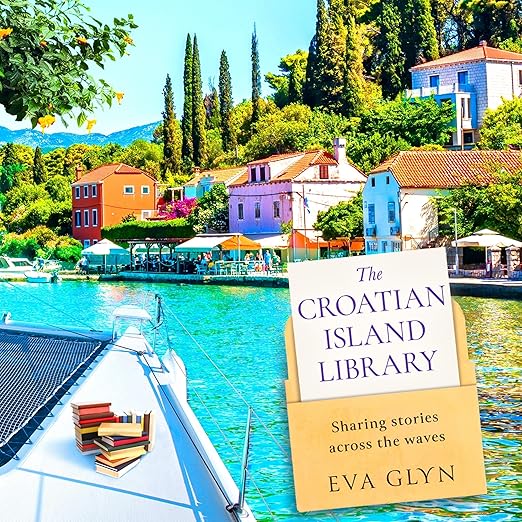
The premise is one of those concepts that immediately sounds appealing in summary but requires execution to justify: a catamaran converted into a floating children’s library, sailing between the small islands near Dubrovnik across a summer. Ana Meštrović owns the boat; Lloyd, a widowed English librarian carrying a past that “threatens to overshadow everything,” is hired to run the library; Natali, a young mechanic “afraid of her own shadow,” completes the crew. Each character arrives with weight that the novel takes seriously rather than using as backdrop.
What Glyn does well is resist the pressure to resolve her characters too quickly. Lloyd’s grief is not processed in a montage; Natali’s arc from fearfulness to confidence has specific texture rather than generic beats. Ana’s search for clarity about her own future runs through the whole narrative and lands with an ending that multiple reviewers describe as genuinely satisfying without feeling predetermined.
Why Listen to The Croatian Island Library
The audiobook format is, by genuine reviewer consensus, the better version of this story. One listener who picked up the audio because they were unsure about finishing the book in time describes being “so glad” they made that choice, noting specifically that “the narration was excellent and added so much to the story” and that she is not certain the experience would have felt the same in print. That is not a diplomatic compliment, it reflects a meaningful difference in how Crawley’s performance brings the ensemble to life.
The twelve-hour runtime is appropriate for the scope of the story. Glyn is working across three character arcs simultaneously, with Croatia itself as a fourth presence, and the audio gives each strand room to develop properly. The coastal setting, the picturesque harbours, the Adriatic light, the island rhythms, is rendered with the kind of specificity that makes listeners who have not visited Croatia want to, and those who have want to return.
What to Watch For in The Croatian Island Library
This is the third book in the Bookish Escapes series, but reviewers consistently describe it as readable independently. There is no apparent need for familiarity with the earlier books to enjoy or fully understand this one. Glyn has constructed it as a self-contained story that shares a thematic space with its predecessors rather than requiring their narrative context.
The novel is unabashedly feel-good in its intentions, which will be either a recommendation or a caveat depending on what you are looking for. Readers who want moral complexity or narrative darkness will not find it here. What they will find is genuine emotional intelligence in the character work, a setting rendered with care and affection, and the specific kind of satisfaction that comes from a story that knows exactly what it is trying to do and does it without apology.
Who Should Listen to The Croatian Island Library
Readers who love contemporary fiction with a strong sense of place, ensemble casts where each character has genuine interiority, and narratives that center friendship and self-discovery alongside (or instead of) romantic resolution will find this a comfortable home. The literary travel element, Croatia rendered in enough detail to feel like research without feeling like a guidebook, makes it appealing to readers who use fiction as a form of destination dreaming.
Listeners who specifically enjoy the audiobook experience of being transported somewhere will do well here; Crawley’s narration genuinely achieves that effect. Those who want propulsive plotting, thriller tension, or emotional bleakness should look elsewhere. This is a book that rewards a slow Sunday, a long commute, or an afternoon where you want to be somewhere warm and beautiful for a few hours without actually going anywhere.
Frequently Asked Questions
Is The Croatian Island Library part of a series, and does it need to be read in order?
It is the third book in Eva Glyn’s Bookish Escapes series, but reviewers consistently describe it as fully accessible without having read the earlier books. The series shares a thematic space around books and community rather than a continuous narrative, so this works as a standalone listening experience.
Does Melanie Crawley’s narration handle the three distinct characters, Ana, Lloyd, and Natali, with differentiation?
Yes. Reviewers specifically cite the narration as elevating the ensemble rather than flattening it. One listener notes that the story would not have felt quite the same in print, which suggests Crawley brings genuine character differentiation rather than just clean delivery. The warmth of her performance is frequently mentioned alongside the story’s emotional impact.
Is this a romance novel, or does the love story take a secondary role?
The romantic element exists but is not the primary engine of the story. The novel is more centrally about friendship, self-discovery, and the three characters finding their footing in circumstances that required courage to enter. Readers looking primarily for romance will find it present but not dominant; readers interested in character-driven contemporary fiction will find the balance well-calibrated.
How accurate and immersive is the Croatian island setting?
Reviewers who know Croatia describe the setting as transportive and accurate; those who have never visited consistently report wanting to book a trip after listening. Glyn grounds the story in specific details, island harbors, Adriatic light, the particular quality of summer in that part of the Adriatic, that give the setting genuine presence rather than generic “European vacation” texture.