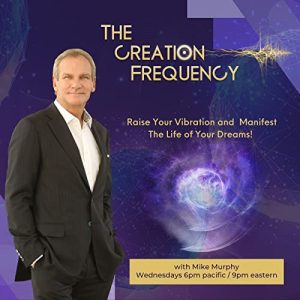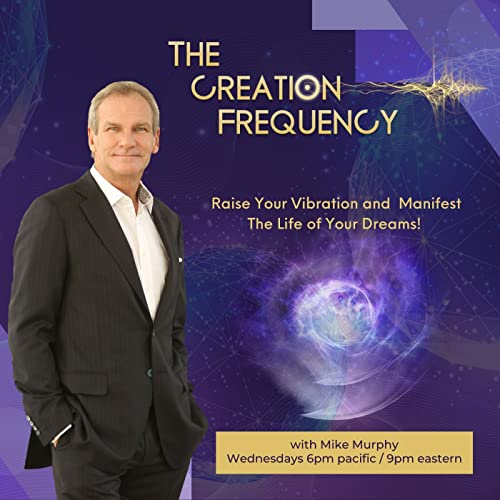
Mike Murphy built The Creation Frequency around a straightforward proposition: your desires align with a universe that is ready to meet them, and the obstacle between you and that alignment is a vibrational mismatch you can consciously correct. Narrated by Tom Parks across a compact 4 hours and 3 minutes, this audiobook delivers Murphy's law-of-attraction framework through a combination of practical intention-setting exercises and the kind of energized personal conviction that the self-development genre at its best can sustain across an entire listen. The 4.8 rating across nearly 1,500 reviews reflects an audience that came prepared to engage and found the material met them where they were.
The Creation Frequency Formula, Defined Operationally
Murphy's framework draws on the familiar law-of-attraction vocabulary but anchors it more specifically in what he calls the Creation Frequency Formula: a structured method for generating clear intentions, aligning them with desire, and releasing the resistance that prevents manifestation from occurring. He is not presenting a passive wishful-thinking model. The audiobook's tone is active and directive: "get ready to take back your power," "create powerful intentions," "tap into the law of attraction" are the book's operating verbs. For listeners already familiar with Abraham-Hicks material or titles like The Secret, Murphy's framework will feel like a more systematized version of territory they know. For those new to the genre, it serves as a clean, accessible introduction that does not require prior exposure to the tradition.
The book's origin in Murphy's podcast and coaching practice gives it a different texture than most self-development titles written purely for the page. It reads and sounds like someone who has delivered these ideas to live audiences many times and has refined the language to its most accessible form. The technical vocabulary is kept minimal: "vibration," "frequency," "energy," "universe" are the primary terms, and Murphy defines each operationally rather than philosophically. He is not asking the listener to accept a cosmological claim before proceeding; he is asking them to run the experiment and assess the results. This is a pragmatic framing for a speculative subject, and it gives the audiobook more practical traction than the genre average for a short-runtime title.
Parks Balances Deliberate Pacing With Real Momentum
Tom Parks's narration is energetically matched to the material. Parks has a warm, forward-leaning delivery that suits Murphy's directive tone without turning the audiobook into a motivational rally that feels exhausting rather than activating. He reads the intention-setting passages with enough deliberateness to signal that the listener should slow down and actually absorb the exercise, while the conceptual sections move at a pace that keeps momentum up. This balance between instructional deliberateness and narrative energy is not easy to sustain across four hours of self-development content, and Parks manages it consistently throughout.
At just over four hours, the runtime is one of the audiobook's genuine assets: this is completable in a single extended session, which matters for material designed to produce an immediate shift in orientation rather than a gradual education accumulated over weeks of listening. The compact length also lowers the barrier for listeners who are curious but uncommitted, it is worth the experiment at four hours in a way it might not be at twelve. The 4.8 rating suggests that listeners who make that experiment reliably find it worthwhile. Murphy's combination of practical method and personal conviction produces an audiobook that feels actionable rather than merely inspiring, which is the harder thing to achieve in this genre.
Skip the Exercises, Miss the Practical Activation
Murphy's approach combines elements from multiple self-development traditions, law of attraction, intention-setting, gratitude practice, and what he calls "unique technology" for raising vibrational frequency, without stopping to explain the epistemological foundations of any of them. This is a deliberate choice for a work of practical instruction rather than philosophical argument, but it means listeners who arrive with skeptical questions about the claims being made will not find those questions addressed. The audiobook is built for the listener willing to suspend the skeptical frame and try the method. Murphy operates from the assumption that results will make the case more effectively than argument, and the audiobook's structure reflects that bet.
The exercises woven into the material deserve specific attention. Murphy does not merely describe intention-setting in abstract terms; he walks the listener through specific practice structures that can be applied immediately after the audiobook ends. Parks narrates these sections with a deliberately slower cadence, which is the correct production choice, it signals that these are not passages to absorb intellectually but moments to pause and actually do the thing being described. Listeners who skip past the exercise sections will get the conceptual framework but miss the practical activation that Murphy has designed the audiobook to deliver.
Four Hours Is a Low-Risk Experiment
This audiobook is well-suited for listeners already operating within the self-development and law-of-attraction space who want a structured, practical framework for applying principles they have encountered before in less systematic form. It is also a reasonable entry point for listeners new to the genre who prefer a short, high-conviction commitment before deciding whether the underlying philosophy fits their worldview. At four hours, the time investment is low relative to most self-development titles, which makes it worth the experiment for the genuinely curious. Listeners who require empirical evidence and peer-reviewed research before engaging with any self-development framework will find the audiobook's reliance on personal testimony and universal energy claims unsatisfying. Murphy is writing for believers and the soon-to-be-convinced, and the audiobook does not pretend otherwise, which is at least an honest positioning of its own ambitions.
Questions Listeners Ask
How long is The Creation Frequency audiobook, and is it worth the time investment?
4 hours and 3 minutes, which is unusually short for a self-development title. The compact runtime is one of its genuine assets, it is completable in a single extended session, which matches material designed to produce an immediate shift in orientation.
Is The Creation Frequency audiobook suitable for listeners new to law-of-attraction material?
Yes. Murphy's approach uses the genre's core vocabulary but explains each term operationally rather than assuming prior familiarity. It works as a clean introduction to the territory or as a more systematized version for listeners who already know the material.
Does The Creation Frequency audiobook include practical exercises, or is it primarily conceptual?
Murphy specifically builds practical exercises into the framework, the Creation Frequency Formula includes active intention-setting methods, not just conceptual orientation. Tom Parks narrates the exercise passages with a deliberately slower cadence that invites the listener to pause and engage.
Does The Creation Frequency audiobook address skeptics, or does it assume the listener already believes in manifestation?
Murphy does not make the empirical case for his claims. He frames the approach pragmatically, run the experiment, assess the results, but does not engage with skeptical epistemological objections. The audiobook is built for the listener willing to try the method.