Quick Take
- Narration: Stephen Bel Davies reads Sitchin’s dense, citation-heavy prose with measured clarity, making the ancient textual references accessible without editorializing on the theory.
- Themes: Ancient astronaut theory and the Anunnaki hypothesis, the Hebrew alphabet as encoded cosmic knowledge, the intersection of mythology and human origins
- Mood: Earnest and encyclopedic, more academic in register than conspiratorial
- Verdict: The sixth volume of a long-running alternative history series that rewards existing believers and is unlikely to convert skeptics, but Davies makes the journey listenable regardless of where you stand.
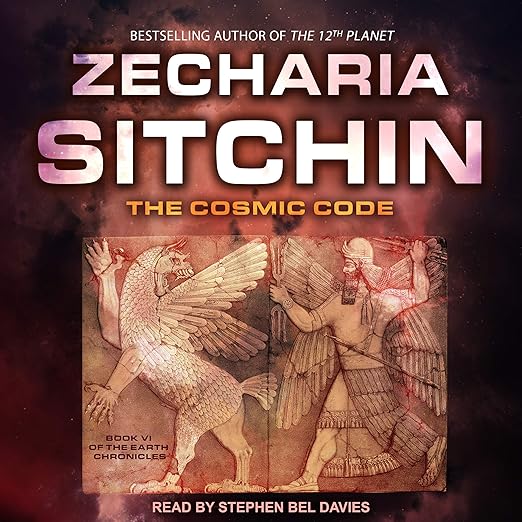
I want to be honest with you about something before we go any further: Zecharia Sitchin’s Earth Chronicles series occupies a genuinely unusual space in the audiobook landscape. It is not archaeology in any peer-reviewed sense. The ancient astronaut hypothesis that Sitchin developed across these books, that an extraterrestrial civilization from a twelfth planet called Nibiru came to Earth millennia ago and shaped human evolution, is not accepted by mainstream scholarship. It is also, as The Cosmic Code demonstrates, a remarkably internally consistent and elaborately argued alternative framework, and Sitchin was a serious scholar of ancient Near Eastern languages working from primary sources rather than from secondary speculation.
I say all of this not to dismiss the book but to frame it accurately. If you come to The Cosmic Code as a sixth installment in a series you have already invested in, you will find Sitchin at his most ambitious, attempting to decode the numerical values of the Hebrew alphabet and read them as a link between human DNA and celestial design. If you come to it expecting conventional archaeology, you will need to recalibrate your expectations within the first few minutes of listening.
Where Volume Six Fits in the Earth Chronicles
The synopsis describes this as a book in which Sitchin unveils writings from the past to decipher prophecies and reveals how the DNA-matched Hebrew alphabet and the numerical values of its letters serve as a code connecting mortal man’s fate to mankind’s celestial destiny. That is a lot to cover in eight hours and forty-six minutes, and Sitchin approaches it with the methodical patience of someone who has spent decades building toward this synthesis. The earlier volumes established the Anunnaki framework, the Nibiru orbit, the interventions in human development. The Cosmic Code is concerned with what all of that means for the future, using ancient texts as prophetic documents rather than historical records.
One reviewer described the series as connecting the dots in history, taking Bible stories, myths from ancient stele, and archaeological findings and assembling them into a coherent alternative account. That is exactly what Sitchin is doing, and the coherence is real even if the premises are contested. Another reviewer, six books into the series, noted that the approach is thought-provoking in a way that holds up even on reread. The enthusiasm of the established audience is genuine and notable: these are not passive consumers. They are listeners who have been rereading and rethinking these arguments for years, returning to find new connections in the framework Sitchin spent his career building.
Stephen Bel Davies and the Challenge of Dense Citation
Sitchin’s prose requires a narrator who can move through ancient textual citations and numerical analyses without making the listener feel like they are being read footnotes. Stephen Bel Davies manages this with competence. His voice is clear and measured, and he does not tip into the portentous register that some narrators adopt with alternative history material. That restraint serves the text well: Sitchin’s own tone is scholarly rather than breathless, and Davies matches it throughout the full runtime.
The Tantor Media production is clean and consistent. At eight hours and forty-six minutes, this is a sustained listen that rewards attention rather than background listening. The density of the argument means that dropping in and out will leave you behind. Davies’s steady pacing helps, but the material itself demands a listener who is prepared to follow an extended textual argument rather than a narrative one.
The Alternative History Framework and Its Demands
The question of whether to recommend this book cannot be separated from the question of where you are coming from when you pick it up. Sitchin was, whatever his conclusions, a serious researcher who read Sumerian and spent his career engaging with primary ancient sources. His arguments are internally consistent and genuinely engaging as a system of ideas. The mainstream scientific community does not accept his conclusions about Nibiru, the Anunnaki, or human genetic manipulation, and the book does not engage with those objections in any sustained way. That is a feature for readers invested in the framework and a frustration for those who approach it critically.
An Honest Assessment of the Audience
Existing fans of the Earth Chronicles series and listeners drawn to ancient astronaut theory, alternative archaeology, and the intersection of mythology and human origins will find this a rewarding entry. The free audiobook availability makes it easy to sample without commitment. Listeners who require peer-reviewed scientific frameworks will find this frustrating rather than stimulating. But for the audience it is written for, The Cosmic Code represents Sitchin at his most systematically ambitious, synthesizing decades of research into a final argument about what the ancient texts were always trying to tell us and what that means for human destiny. Davies delivers that argument with exactly the right seriousness.
Frequently Asked Questions
Can I listen to The Cosmic Code without having read or heard the earlier Earth Chronicles volumes?
It is possible, but the book assumes familiarity with the Anunnaki framework and the Nibiru hypothesis established in earlier volumes. New listeners would benefit from starting with the first book to understand the context Sitchin is building on here.
How does Sitchin’s approach differ from more popular ancient astronaut programs like Ancient Aliens?
Sitchin was a trained scholar of ancient Near Eastern languages who worked from primary Sumerian, Akkadian, and Hebrew sources. His arguments are more methodical and text-based than the television format, even if the conclusions are similarly contested by mainstream archaeologists.
Is Stephen Bel Davies’s narration appropriate for listeners who are skeptical of the content but curious about it?
Yes. Davies reads without performative credulity or skepticism. His measured delivery means the listener is not being pressured in either direction, which is particularly valuable for material this contested.
How does The Cosmic Code’s focus on the Hebrew alphabet and DNA connect to the earlier books in the series?
The earlier volumes established the Anunnaki’s role in human genetic development. This sixth volume attempts to decode that legacy through the numerical values of the Hebrew alphabet, reading it as a cosmic communication system left for humanity. It is the series’ most esoteric volume.