Quick Take
- Narration: Peter Wicks delivers Kay’s dense, erudite prose with academic clarity, maintaining evenness across fourteen hours without quite generating the urgency the material sometimes demands.
- Themes: The crisis of corporate legitimacy, shareholder value as a destructive myth, the knowledge economy and its discontents
- Mood: Incisive and occasionally provocative, but patient rather than urgent
- Verdict: A rigorous and often brilliant reframing of what corporations are for, though listeners will need to be honest with themselves about their appetite for economic history at this length.
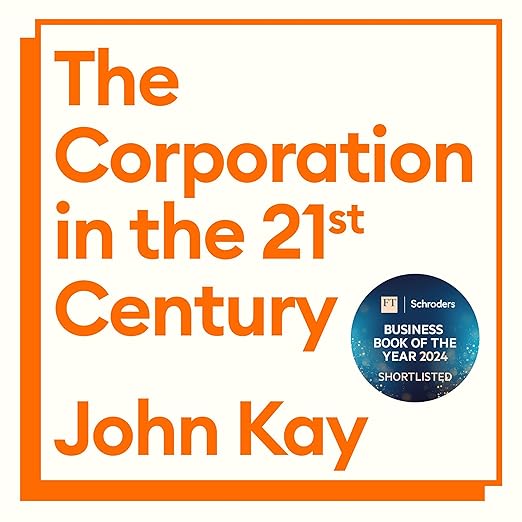
I picked up The Corporation in the Twenty-First Century during a stretch of reading about institutional failure: how organizations that were built to create value end up destroying it, and why smart people inside those organizations keep doing the same things. John Kay is the right companion for that kind of inquiry. He is one of those economists who writes like a humanist, and this book, shortlisted for the Financial Times and Schroders Business Book of the Year 2024, carries the ambition of someone who has spent decades thinking carefully about a question most practitioners treat as settled.
The question is deceptively simple: what is a corporation actually for?
Our Take on The Corporation in the Twenty-First Century
Kay's central argument is that the twentieth-century model of the corporation, built around accumulated capital, physical assets, and shareholder primacy, no longer describes reality. The most valuable companies in the twenty-first century produce things that appear on your screen, fit in your pocket, or occupy your attention. Their assets are intangible: intellectual property, network effects, trust, or the absence of it. The old frameworks not only fail to capture this reality; they actively distort how we manage and evaluate these organizations.
The indictment of shareholder-value doctrine is sharp and well-documented. Kay traces how the single-minded pursuit of returns to shareholders has hollowed out companies with genuine productive capability, alienated workforces, and eroded the public trust that organizations need to function. His case studies range across pharmaceutical companies that create life-saving vaccines while losing public confidence, to the extraordinary consumer scale of Facebook and Google combined with their widespread unpopularity. These are not paradoxes, Kay argues. They are the predictable output of a model that optimizes for the wrong things.
Why Listen to This Audiobook
Peter Wicks narrates with the clear diction and steady pace that serves academic nonfiction well. He does not editorialize or impose emotional color where Kay has not placed it. For fourteen hours of economic history and institutional analysis, that steadiness is appropriate. Kay's prose is described by the Financial Times as brilliantly erudite, and Wicks gives it room to breathe.
The book rewards sustained attention. Kay is not writing a listicle of corporate failures. He is building an argument across a long arc of economic history, from the early corporate forms through the industrial age, into the current knowledge economy. Listeners who approach this with patience will find the architecture genuinely satisfying.
What to Watch For in This Book
The most critical review in our dataset describes the book as irredeemably tedious, and while that is a minority position, the underlying complaint, that Kay illustrates his points with what can feel like an endless accumulation of examples and digressions, is worth considering honestly. The concept of rents, which refers to income derived from ownership of scarce assets rather than from productive activity, receives extensive treatment. If you are unfamiliar with the term or resistant to economic vocabulary, the middle sections of this book will require some patience.
Kay also has a tendency to approach his conclusions in long, spiraling circuits. The Literary Review describes him as standing above and apart from conventional political attitudes, which is accurate but can also mean that readers looking for a clear policy prescription at the end of the argument may feel the book concludes more tentatively than they hoped.
Who Should Listen to The Corporation in the Twenty-First Century
Essential for readers interested in economic history and institutional theory who want a rigorous alternative to standard MBA-era thinking about corporate purpose. Recommended for business leaders and policy thinkers who have some appetite for intellectual provocation. Those who found Thomas Piketty's Capital in the Twenty-First Century worthwhile despite its length will be comfortable here. Listeners who need a faster pace, concrete action steps, or low tolerance for economic abstraction should look at shorter-form treatments of similar themes before committing fourteen hours to this one.
Frequently Asked Questions
Do I need an economics background to follow John Kay’s argument?
A background helps but is not strictly necessary. Kay writes accessibly for an educated general audience, and the Financial Times describes his work as erudite rather than technical. The concept of rents receives extended definition, and listeners who engage with that terminology will find the argument easier to follow. Some patience with economic vocabulary is required.
How does this compare to other recent books on corporate capitalism and shareholder value?
Kay approaches the subject from a longer historical arc than most popular treatments. Rather than focusing on recent scandals or a single argument about inequality, he traces the evolution of the corporate form across centuries. This gives the book unusual depth but also means it moves more slowly than a focused polemic on a single company or practice.
Is Peter Wicks’ narration energetic enough for a fourteen-hour economics listen?
Wicks is precise and reliable rather than dynamic. For listeners who prefer clarity over performance in their nonfiction narration, this suits the material. For those who need an animated narrator to stay engaged across long stretches of economic history, the steady academic register may become harder to sustain.
Does the book offer concrete recommendations, or is it primarily diagnostic?
Primarily diagnostic. Kay is more interested in accurately describing what has gone wrong with the shareholder-value model than in prescribing a specific replacement. The book redefines terms like successful commercial activity and the knowledge economy, but readers expecting a tidy policy framework at the end may feel the conclusion is more open than they wanted.