Quick Take
- Narration: Randal Schaffer handles the dual-voice structure of the hypnosis sessions credibly, improving as the audiobook progresses according to listener accounts.
- Themes: Past life regression, metaphysics, Atlantis and Earth mysteries, quantum consciousness
- Mood: Dense and expansive, requiring genuine open-mindedness to engage
- Verdict: Essential listening for followers of Dolores Cannon’s work and those already immersed in metaphysical study; a significant ask for skeptical or newcomer listeners.
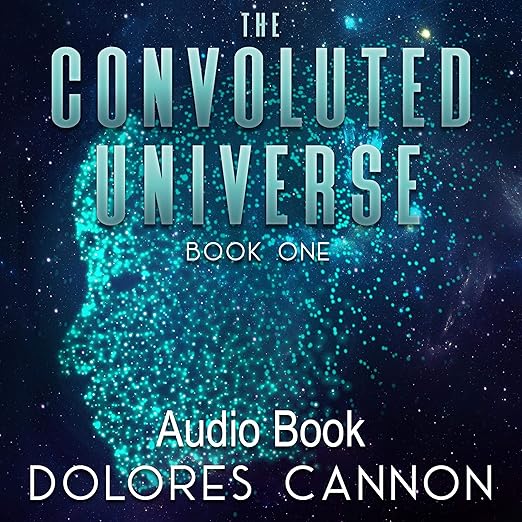
I want to be upfront about where I stand with this one. Dolores Cannon’s methodology, which involves using deep hypnosis to access what she describes as the subconscious mind and from there receiving information about Atlantis, parallel universes, the Loch Ness Monster, and the construction of the Pyramids, operates well outside the territory of peer-reviewed inquiry. The Convoluted Universe: Book One is not a text making scientific claims, and it should not be evaluated as one. It is a work of metaphysical exploration, and evaluated on those terms, it is a substantial and carefully assembled piece of work from someone who spent twenty years doing this research before her death in 2014.
The audiobook runs nearly twenty-two hours, which is substantial for any genre but particularly so for material this conceptually dense. The content is structured around transcripts of Cannon’s hypnotherapy sessions, with her asking questions and the subjects responding in trance states. The topics covered include the origin and destruction of Atlantis, the mysteries of Easter Island, the Bermuda Triangle, the Ark of the Covenant, Nazca Lines, parallel lifetimes, and other dimensions. The range is genuinely broad, and Cannon connects these threads with the kind of cross-session pattern-matching that her admirers find compelling and her critics find circular.
Our Take on The Convoluted Universe: Book One
What comes through clearly, regardless of your position on the material, is that Cannon was a genuine original in her field. One reviewer who is a practicing hypnotherapist described her as a pioneer who blows the lid off what we were erroneously sold as history. Another framed the book as helping them process and understand the events of our current world because the patterns Cannon identifies have, in their view, all happened before, with Atlantis specifically cited as a parallel to our present moment. This is the register in which the book operates: it provides a framework for meaning-making that many readers find deeply useful, regardless of whether the framework can be empirically verified.
One longtime Cannon listener observed that this narration by Randal Schaffer is better than several of her other audiobooks, particularly in the way he differentiates between Cannon’s voice and the subjects’ voices in the hypnosis transcripts. The dual-voice challenge in a book structured this way is real, and Schaffer handles it more successfully as the audiobook progresses, even if the opening chapters are somewhat less polished. For twenty-two hours of this kind of material, consistent narration quality matters enormously.
Why Listen to The Convoluted Universe: Book One
If you have already read Cannon’s books on Nostradamus or Jesus and the Essenes, this series represents a deepening of her methodology rather than an introduction to it. The convoluted in the title refers to the increasingly complex and overlapping nature of the metaphysical information her subjects provide, and this book is genuinely more conceptually demanding than her earlier work. One reader described it as expanding what we believe about ourselves as humans, Earthlings, mortals, three dimensional, and more. For readers already in that metaphysical space, the depth here is a genuine reward. The book is intended, as the synopsis states directly, for listeners who want their minds expanded by complicated ideas that border on quantum physics.
What to Watch For in The Convoluted Universe: Book One
New listeners who have not read Cannon before should know this is the second book in a sequence following The Custodians. While it can be approached without that background, the methodology and the framing of the hypnosis transcripts will make more sense with prior context. The book is also genuinely demanding in that the material requires active engagement and, frankly, a suspension of conventional epistemological standards. If you are not already open to the framework, the experience will be frustrating rather than illuminating.
Who Should Listen to The Convoluted Universe: Book One
Followers of Dolores Cannon’s previous work, practitioners in the hypnotherapy and metaphysical communities, and readers whose worldview already accommodates past lives and parallel dimensions will find this essential. Anyone approaching from a skeptical or scientifically orthodox position should know they are unlikely to find the evidence standard satisfying. This is a book for believers and the genuinely curious, not for the unconvinced.
Frequently Asked Questions
Do I need to read The Custodians before starting The Convoluted Universe?
The Convoluted Universe is described as the sequel to The Custodians. While it can be approached independently, the methodology and recurring subject matter will make more sense with that prior context.
How does Randal Schaffer handle the hypnosis session transcripts in the narration?
He differentiates between Cannon’s voice and the subjects’ voices, with performance quality improving as the audiobook progresses. Listeners who found narration in other Cannon audiobooks flat may find this a step up.
Is this book suitable for someone entirely new to Dolores Cannon’s work?
It is designed for readers who want their minds expanded by complex metaphysical ideas. Complete newcomers would benefit more from starting with Cannon’s earlier, more accessible titles before approaching this series.
How is the material organized across nearly 22 hours of content?
The book is structured around hypnosis session transcripts covering distinct topics, including Atlantis, Earth mysteries, parallel universes, and other dimensions. There is a loose thematic progression rather than a linear narrative.