Quick Take
- Narration: Jason Culp brings a measured, authoritative presence to Bharat Anand’s academic argument; the narration suits the professorial tone of the source material without becoming dry.
- Themes: Digital strategy and content economics, the danger of product-centric thinking, connections and network effects as competitive advantage
- Mood: Analytically rigorous and case-study-driven, with the Harvard Business School lecture quality of its source
- Verdict: One of the more durable books on digital media strategy available in audio; Anand’s argument about connection over content has aged well and still challenges assumptions about what makes media businesses succeed.
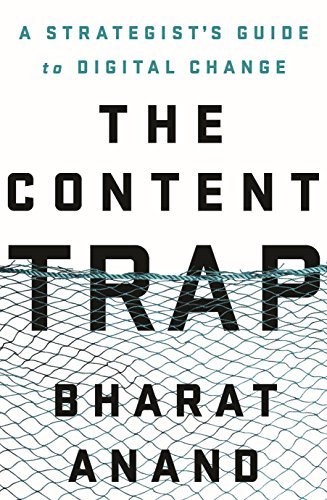
I first encountered Bharat Anand’s argument by accident, three years after The Content Trap was published, when a media executive I was interviewing for a piece on digital publishing mentioned it as the single book that had changed how she thought about the industry. I went back and found it, and spent several evenings with Jason Culp’s narration on my commute. The core argument lodged immediately and has not left. Most content businesses, Anand argues, are focused on the wrong thing.
Anand is a professor at Harvard Business School, and The Content Trap began as course material before it became a book. That lineage is visible in the structure: the argument is built on case studies, the prose has the careful calibration of someone who has tested it in front of MBA students for years, and the central thesis is stated early and returned to repeatedly with enough variation to make the repetition feel like development rather than redundancy.
Our Take on The Content Trap
The content trap of the title is the assumption that success in media or digital business is primarily a function of content quality. If you just make better content, the logic goes, audiences will come and revenue will follow. Anand’s extended argument is that this is wrong, and dangerously so, because it directs strategic attention toward the product rather than toward the connections that make the product valuable. The companies that have dominated digital media, he argues across sixteen hours of case studies, have generally succeeded not by having the best content but by building the most valuable connections among their audiences, between their audiences and advertisers, and between their products and adjacent services.
This sounds abstract until Anand starts applying it, and the case studies are where the book earns its reputation. The New York Times’s digital transition, The Economist’s unusual competitive positioning, Scandinavian newspapers that survived the digital era when American papers did not, sports leagues and their relationship to broadcasters, educational publishers navigating a collapsing textbook model: each case is used to illuminate a facet of the central argument, and Anand is careful to show where the connection-focused strategy failed as well as where it succeeded.
Why Listen to The Content Trap
Jason Culp’s narration is the right choice for this material. The book has the cadence of a well-constructed academic argument, and Culp’s delivery respects that rhythm without making it feel like a lecture. At sixteen hours, The Content Trap is a substantial listen, and the pacing requires a narrator who can sustain the argumentative structure over that duration without losing the thread or allowing individual case studies to feel like detours. Culp manages it. The through-line from chapter to chapter is maintained even when the material shifts geographies or industries.
The book is also, despite its academic origins, written with an awareness that its audience includes practitioners as well as students. The implications for individual businesses are drawn explicitly, and the final section brings the abstract argument down to the level of strategic decisions that real media organizations face. Listeners with specific professional contexts in digital media, publishing, or content-adjacent technology will find the book more practically useful than its academic pedigree might suggest.
What to Watch For in The Content Trap
The book is long for its argumentative core. Sixteen hours is a considerable investment for a thesis that can be stated in two sentences, and some listeners will feel the case study accumulation becomes repetitive in the second half. Anand is doing this deliberately: he is testing the argument against multiple contexts precisely to demonstrate its robustness, and each new case study adds a dimension rather than merely repeating the point. But listeners who have internalized the central argument by the halfway mark may find the second half slower than the first.
The book also has an e-commerce tag from the metadata, which undersells its scope. The argument applies to any business with a meaningful digital component and a content product, including traditional media, education, entertainment, and software. Listeners from those industries should not be put off by the e-commerce framing.
Who Should Listen to The Content Trap
Anyone working in digital media, content strategy, publishing, or adjacent fields will find Anand’s framework practically applicable and intellectually honest about its own limitations. The book is also valuable for listeners who want to understand why some media companies survived the digital transition and others did not, without the hindsight bias that distorts most post-mortems on the subject. Listeners looking for a quick, actionable business read will find sixteen hours demanding; those willing to engage with the full argument will come out with a durable analytical lens for thinking about digital competition that has held up well in the years since publication.
Frequently Asked Questions
What specifically is ‘the content trap’ that Bharat Anand identifies?
The content trap is the strategic mistake of treating content quality as the primary driver of success in media and digital businesses. Anand argues that this focus leads companies to invest in their product while neglecting the connections, between users, between users and advertisers, between products and adjacent services, that are the actual source of competitive advantage.
Is The Content Trap relevant for small content businesses and independent creators, or only for large media organizations?
Anand uses case studies ranging from global media conglomerates to regional newspapers, which gives the argument broader applicability than the Harvard Business School origin might suggest. The connection-versus-content framework applies to any business where audience relationships matter, which includes independent content creators and small digital publishers.
How does Jason Culp’s narration handle the case study-heavy structure over sixteen hours?
Culp maintains the argumentative through-line effectively over the full runtime. The narration suits the professorial register of the source material without becoming academic in a way that creates distance. The case study transitions are handled cleanly, which matters for a book where the argument depends on readers tracking the accumulation of evidence across many different industry contexts.
Has the book’s argument held up since its publication, given how much digital media has changed?
The core argument about connection over content has proven durable. Platform dynamics, creator economics, and the newsletter and podcast boom of the years following publication have all illustrated Anand’s framework in different ways. The specific case studies are dated in their details, but the analytical lens remains applicable.