Quick Take
- Narration: Josh Innerst delivers a clean, professional read well-suited to business nonfiction; clear articulation of financial terminology without becoming dry.
- Themes: Decentralized serial acquisition, capital allocation, Scandinavian business models
- Mood: Methodical and illuminating, with a genuine sense of discovery
- Verdict: A rare piece of finance writing that introduces an overlooked category of outperformers and explains exactly why they work so well.
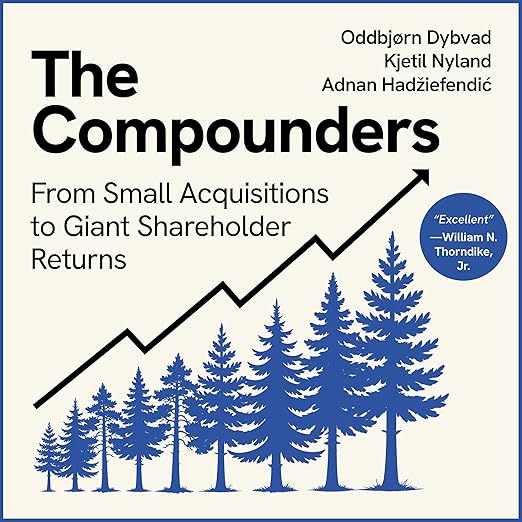
I finished this one during a stretch of travel that had me stuck in a lot of airport lounges, which turned out to be exactly the right context for it. Oddbjorn Dybvad is writing about a category of business I had heard only vaguely referenced before: publicly listed conglomerates that operate with radically decentralized structures, acquire smaller private businesses quietly and consistently, and compound shareholder value over decades without ever making the front pages of the financial press. The Compounders runs nearly nine and a half hours, and by the time I was back home, I had filled two pages of notes.
The Berkshire Hathaway comparison is the obvious entry point, and Dybvad uses it well. The pitch is that there is a cluster of companies operating on similar principles to Buffett and Munger but taking those principles further in specific ways: tighter focus on smaller private acquisition targets, truly decentralized management that leaves founders and family operators in place, and a preference for fragmented markets where scale is still achievable. The book profiles nine of these compounders from around the world, with a notable concentration in the Nordics.
Our Take on The Compounders
The heart of the book is the organizational insight: these firms are not just good capital allocators, they are builders of what Dybvad calls a reinvestment engine. By acquiring businesses that are already profitable, paying modest multiples, and then leaving management largely undisturbed, they create structures that self-compound without the overhead drag of conventional corporate hierarchies. Reviewer New Yorker 330 called this one of the best books on an area of company building that has not been studied nearly enough, and I would agree with that assessment. The author also takes time to explain why the Nordics have produced a disproportionate number of successful compounders, pointing to cultural factors around trust, flat hierarchies, and long-term thinking that are genuinely illuminating rather than generic.
Why Listen to The Compounders
If you have read Will Thorndike’s The Outsiders, which profiled unconventional capital allocators, or have spent time with the serial acquirer literature, this book sits naturally in that conversation but covers ground those titles did not. Dybvad’s nine case studies include firms from several countries and give a sense of how the model translates across different regulatory environments and market structures. The most compelling case studies involve companies that turned down higher acquisition offers from more prominent buyers specifically because they offered a better cultural home for family-owned businesses. There is something quietly radical about that approach, and the book brings it alive through specific examples rather than abstract principle. The accompanying PDF, which Audible notes is available in your library with the audio purchase, presumably contains the financial tables and charts that would be cumbersome to describe verbally, so knowing it exists is useful.
What to Watch For in The Compounders
Reviewer Matej, in a blunt three-star take, argued the book could be reduced to a one-pager: cheaply buy great companies. There is a version of that criticism worth taking seriously. The core mechanism of serial compounders is not conceptually difficult, and if you are an experienced investor, you may find the central thesis familiar within the first hour. What the book earns through its length is depth of case study detail and the historical context around why this model emerged where it did and when. That said, this is emphatically a business nonfiction audiobook rather than an investment how-to. Do not come in expecting stock screener tactics or specific buy lists. The value is in understanding the organizational and cultural architecture that makes these companies tick, not in being handed a portfolio strategy.
Who Should Listen to The Compounders
Investors and business operators who find Berkshire Hathaway’s approach intellectually compelling but want to understand how that model has been adapted and extended by a set of less-famous firms will get the most from this. It is also a strong listen for anyone studying organizational design, particularly the decentralized autonomy question that preoccupies a lot of management thinking right now. The audiobook assumes basic financial literacy, so listeners with no exposure to concepts like return on invested capital or acquisition multiples may need to pause and look things up. But it is not written for specialists, and Dybvad’s prose, as rendered by Josh Innerst, moves at an accessible pace throughout.
Frequently Asked Questions
How does The Compounders compare to The Outsiders by Will Thorndike?
The Outsiders profiles eight individual capital allocators who ran single businesses exceptionally well. The Compounders focuses on a different model: firms that grow through serial acquisition of smaller businesses, often with decentralized management structures. The books complement each other, but Dybvad’s subject matter is more recent and the organizational design angle is distinct.
Does the book explain why Nordic companies dominate the compounder category?
Yes, this is one of the more interesting threads. Dybvad points to cultural factors including long-term orientation, flat organizational hierarchies, high levels of institutional trust, and a business environment that rewards consistent compounding over short-term quarterly performance. It is not a superficial observation and takes up meaningful time in the audiobook.
Is this book useful for someone who wants to invest in compounder stocks?
It is more useful for understanding the category than for selecting specific investments. The book explains what makes these firms durable and why the model works, but it does not provide screeners, current valuations, or specific buy recommendations. Think of it as the intellectual foundation for a research process rather than the research itself.
What does the accompanying PDF add to the audiobook experience?
The PDF referenced in the publisher’s note likely contains the financial tables, charts, and performance comparisons that are difficult to absorb in audio form. If you are engaging seriously with the investment angle, downloading it alongside the audio is worth the extra step.