Quick Take
- Narration: Clay Lomakayu delivers a measured, reverential reading that honors the philosophical weight of the text, though the sheer density of the material makes this a listen best taken in careful segments rather than long stretches.
- Themes: Universal religion, Vedanta philosophy, Indian nationalism and spiritual identity
- Mood: Expansive and contemplative, occasionally demanding
- Verdict: For anyone willing to sit with genuinely difficult ideas about the nature of the self and the unity of all spiritual traditions, this audiobook delivers one of the most consequential voices of 19th-century thought in an accessible format.
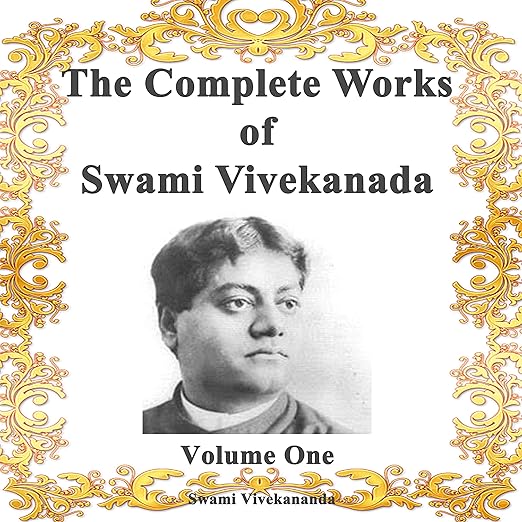
I came to this collection on a Saturday morning when I had blocked off the entire day for reading. I made coffee, sat near the window, and pressed play expecting something austere and distant. Instead, Swami Vivekananda’s voice, channeled through Clay Lomakayu’s narration, met me with a startling warmth. Within the first hour I had stopped thinking of it as a historical document and started thinking of it as a letter written specifically to the moment I was in.
That quality of urgent relevance is what has kept Vivekananda’s writing alive for more than a century. These are not academic texts. They are the words of a man on fire with an idea: that beneath all the world’s religious traditions runs a single current of truth, and that Hinduism, far from being a relic of the past, is uniquely equipped to articulate that truth for the modern world. Whether you agree with that argument or not, the force of its delivery is something else entirely.
Our Take on The Complete Works of Swami Vivekananda
This is, above all, a collection about transformation. Vivekananda believed that every human being carries within them the seed of divinity, and that the purpose of spiritual life is not to acquire something external but to uncover what is already present. That argument surfaces in his lectures, in his letters, in his conversations, and in the formal philosophical texts gathered here. The Sanatana Dharma he describes is not a set of rules but an orientation, a way of understanding the self in relation to the cosmos.
What surprised me most was how contemporary the critique felt. Vivekananda was writing at a moment when colonialism was actively undermining Indian cultural confidence, and his response was not defensiveness but an extraordinary intellectual counteroffensive. He went to the Parliament of the World’s Religions in Chicago in 1893 and essentially told the assembled representatives of Western Christianity that their tradition was one branch of a much older tree. That audacity, rendered in prose that oscillates between scholarly precision and genuine spiritual passion, makes for an unusually energizing listen.
Reviewer Orianna notes that Vivekananda “makes room for all religions, all sects, to live in peace,” and that universalist impulse is visible throughout. He is not arguing against Christianity or Islam; he is arguing that all sincere spiritual paths lead toward the same realization. For listeners coming from any tradition, or from none, that framing is genuinely hospitable.
Why Listen to The Complete Works of Swami Vivekananda
The case for listening rather than reading is partly practical. This is an enormous collection, spanning lectures, essays, poems, and letters across multiple volumes. Having it read aloud by Clay Lomakayu removes the physical and visual overwhelm that the print version can produce, and it allows the rhythm of Vivekananda’s rhetoric to land as it was originally intended, since many of these texts were originally delivered as speeches before they were transcribed.
Lomakayu’s pacing is thoughtful. He does not rush the longer philosophical passages, which is the right call. The sections on Raja Yoga, Jnana Yoga, Bhakti Yoga, and Karma Yoga each require a different kind of attention from the listener, and the narration registers those differences without becoming performative about them. One reviewer described the experience using the Sanskrit mantra for peace three times at the end of their review, which tells you something about the effect these words can have.
The collection is also a remarkable entry point into Vedanta philosophy for Western listeners who may have encountered fragmentary versions of these ideas in popular self-help or mindfulness contexts. Vivekananda is the source. Reading him is like moving from the tributary back to the river.
What to Watch For in The Complete Works of Swami Vivekananda
The collection’s breadth is also its primary challenge. Because it draws together lectures, philosophical treatises, letters, and poetry, the register shifts considerably from section to section. Some passages are immediately accessible; others assume familiarity with Sanskrit terminology and the internal debates of the Advaita Vedanta school. New listeners may find it useful to move non-linearly rather than proceeding from volume one to volume nine in sequence. The sections on practical yoga and the lectures from the Chicago Parliament are excellent starting points.
One reviewer with a three-star rating found the overall experience repetitive and cautioned that the text rewards specific chapters more than comprehensive reading. That is fair. This is reference material as much as it is narrative, and approaching it that way will serve most listeners better than treating it as a cover-to-cover listen. At 18 hours, it is substantial, and spacing sessions out over several weeks rather than consuming it in a single stretch will allow the ideas to settle.
There is also a question of translation and editorial choices. The publisher, Medicine of One, has assembled this collection from a specific set of sources, and listeners who later explore scholarly editions may notice variations in translation and emphasis.
Who Should Listen to The Complete Works of Swami Vivekananda
This collection is ideal for listeners already curious about Vedanta, Hindu philosophy, or the intersection of Eastern and Western spiritual traditions. It rewards listeners who approach it with patience and are comfortable letting a text make demands on them. Readers who appreciated William James’s The Varieties of Religious Experience or Karen Armstrong’s A History of God will find a genuine peer text here. Listeners interested in the intellectual history of the late 19th century, particularly the emergence of global religious dialogue, will find it essential.
Listeners hoping for a gentle introduction to yoga philosophy in the popular contemporary sense may find this a steeper climb than expected. The Vivekananda collected here is a systematic philosopher and a political thinker as much as a spiritual guide, and the collection does not simplify itself for a general audience. That is not a flaw. It is the nature of the work.
Frequently Asked Questions
Is this the complete nine-volume collection or a selected portion?
The audiobook gathers the complete works as compiled by the Ramakrishna Math and runs approximately 18 hours, which covers the major lectures, written works, and letters. It is comprehensive but listeners should note that some scholarly editions include additional correspondence and notes not present here.
Do I need a background in Hinduism or Vedanta to follow the content?
Not necessarily, though some familiarity with terms like Atman, Brahman, Maya, and the four yogas will help. Vivekananda consistently explains his terms for non-specialist audiences, and a brief introductory read on Vedanta before starting will make the philosophical sections significantly more accessible.
How does Clay Lomakayu handle the Sanskrit terminology and philosophical density?
Lomakayu pronounces Sanskrit terms carefully and maintains a steady pace through the more technical philosophical sections. He does not dramatize the text, which is the right approach for material of this register. The narration is clear and dignified without being stiff.
Is this audiobook better approached chronologically or by topic?
By topic, for most listeners. The lectures on Raja Yoga and the talks from the Parliament of the World’s Religions are strong entry points. The poems and letters work well as shorter listening sessions between longer philosophical sections. Proceeding straight through from volume one can feel overwhelming in audio format.