Quick Take
- Narration: Greg Bond reads across fourteen major philosophical works with consistent clarity, a reliable guide through 113 hours of dense classical material.
- Themes: Stoicism and self-mastery, ethics and governance, strategy and human nature
- Mood: Dense and cumulative, best approached as a long-term listening project rather than a single session
- Verdict: An extraordinary value for listeners who want sustained engagement with the Western and Eastern philosophical canon, as long as expectations about depth per text are calibrated appropriately.
I have always been skeptical of omnibus philosophy collections. The temptation is to treat them as a shortcut, a way to claim familiarity with fourteen canonical texts without committing to any of them. And that skepticism is not entirely wrong. But sitting with The Complete Philosophy Collection on long walks over the course of several weeks, I found myself revising that view somewhat. There is something to be said for spending extended time in consecutive proximity with thinkers who speak to each other across centuries.
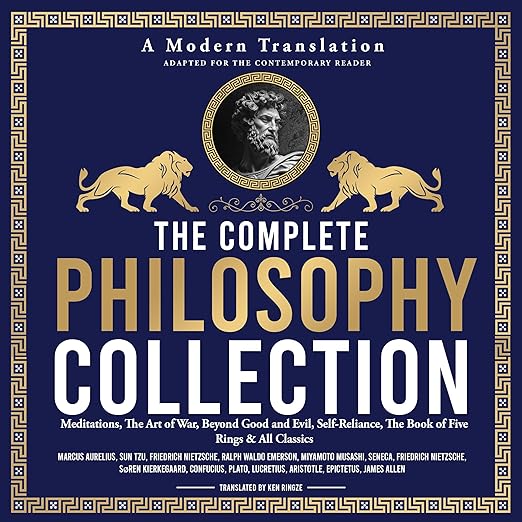
This collection, published by Classic Collections Publishing House and narrated by Greg Bond, gathers fourteen foundational texts running 113 hours and 12 minutes: Marcus Aurelius’s Meditations, Sun Tzu’s The Art of War, Nietzsche’s Beyond Good and Evil and Thus Spoke Zarathustra, Emerson’s Self-Reliance, Musashi’s The Book of Five Rings, Seneca’s Letters from a Stoic, Kierkegaard’s Fear and Trembling, Confucius’s The Analects, Plato’s The Republic, Lucretius’s On the Nature of Things, Aristotle’s Nicomachean Ethics and Politics, Epictetus’s The Enchiridion, and James Allen’s As a Man Thinketh. The range spans Stoic ethics, Confucian governance, Nietzschean self-overcoming, and strategic philosophy in a way that rewards thinking about the conversations happening between them.
Our Take on The Complete Philosophy Collection
What the collection does best is juxtaposition. Moving directly from Marcus Aurelius’s Stoic counsel to Nietzsche’s rejection of the same moral tradition is illuminating in a way that reading them separately with months between, as most people do, is not. The Confucian emphasis on relational ethics sits interestingly against Emerson’s radical individualism. Sun Tzu’s strategic pragmatism rhymes in unexpected ways with Musashi’s approach to discipline through craft. You notice these resonances and tensions more acutely when the texts are continuous rather than isolated.
The tradeoff is depth. No individual text is given the space for extensive commentary or contextual framing beyond brief introductions. This is philosophy in translation and collection form, designed for accessibility rather than scholarly rigor. Listeners who want to go deep into any single text should find a dedicated edition with scholarly apparatus. But for a first sustained encounter with multiple canonical texts, or for revisiting familiar material in a new sequence, the collection format is genuinely useful.
Why Listen to The Complete Philosophy Collection
Greg Bond’s narration holds up across a runtime that would break less disciplined readers. He reads with consistent clarity and appropriate gravity without performing the philosophy in a way that would quickly become exhausting. At 113 hours, the collection demands a narrator who can maintain quality across varied material, from Lucretius’s Latin-derived poetry to Kierkegaard’s theological intensity to Confucian aphorism. Bond navigates these very different registers with enough flexibility to maintain engagement.
The audiobook format suits the Stoics particularly well. Meditations and The Enchiridion were originally personal records and practical guides, not lecture texts, and hearing them read aloud recovers something of their original function as counsel in the moment rather than objects of academic study. The Art of War and The Book of Five Rings also benefit from oral delivery, which foregrounds the aphoristic compression that can feel flat on the page.
What to Watch For in The Complete Philosophy Collection
The collection’s breadth is also its limitation. Texts like The Republic or Nicomachean Ethics are genuinely long, complex philosophical works that reward and require sustained attention in ways that more aphoristic texts do not. Including them in a collection implies that a full Platonic dialogue gets the same treatment as a brief stoic manual, which creates uneven territory for passive listening. Dedicated students of Plato or Aristotle will find the collection format inadequate; curious generalists will find it revelatory.
The attribution of the collection to Sun Tzu on the cover is clearly a cataloguing shortcut for the marketplace rather than accurate authorship attribution; the collection draws from fourteen distinct thinkers, which is worth knowing before you hit play.
Who Should Listen to The Complete Philosophy Collection
Listeners who want a long-form immersion in philosophical thinking across traditions, whether as a first encounter or as a revisit of texts already known, will find 113 hours well spent here. The collection suits long commutes, exercise routines, or any listening context where sustained intellectual engagement over weeks is welcome. Academic philosophers or specialists in any of the included traditions will want single editions with full critical apparatus instead. For general readers who have always meant to read the Stoics or work through Plato but never found the entry point, this collection removes every barrier except time.
Frequently Asked Questions
Is The Complete Philosophy Collection suitable for someone with no philosophy background?
Yes. The texts included range from highly accessible, like The Art of War and The Enchiridion, to more demanding, like The Republic and Nicomachean Ethics. Brief introductions provide context. A complete beginner will find some texts easier than others, but none require prior academic study to follow the core ideas.
How does Greg Bond’s narration hold up across 113 hours of varied philosophical material?
Reviewers describe his delivery as consistently clear and appropriately measured. Maintaining quality across fourteen texts in very different registers is a genuine challenge, and Bond handles the variety without audible lapses. The narration suits the material without competing with it.
Are all fourteen texts presented in full or are they abridged?
The synopsis describes them as the most influential works updated for contemporary listeners, which suggests some editorial compression or adaptation. Listeners seeking unabridged scholarly editions for individual texts should seek dedicated publications rather than relying on this collection for complete texts.
How should I structure listening to 113 hours of philosophy without losing momentum?
Treating it as a long-term project rather than a linear listen works best. The texts are distinct enough that you can return after breaks without losing context. Some listeners pair it with shorter, more narrative audio during the same period. The Stoic texts, Seneca, Epictetus, and Marcus Aurelius, are natural daily-use material that suits the audiobook format particularly well.