Quick Take
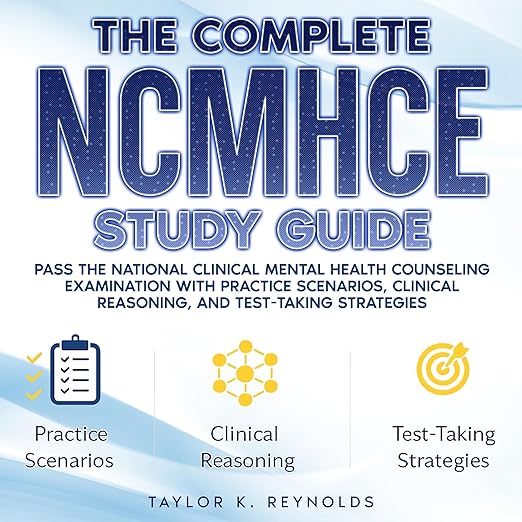
- Narration: Taylor K. Reynolds self-narrates this 11-hour guide, and the author’s clinical background gives the delivery an authority and pacing that purchased narration typically cannot match, Reynolds narrates like someone who has sat for this exam and knows which concepts candidates misread.
- Themes: Clinical reasoning under examination conditions, ethical judgment in mental health practice, structured preparation as professional confidence-building
- Mood: Thoughtful and steady, written to reduce anxiety as much as to transmit content
- Verdict: A well-structured NCMHCE preparation resource that addresses clinical reasoning as a skill rather than a body of facts, the self-narration adds a layer of professional authenticity that genuinely serves this material.
I want to tell you about the moment I understood what makes the NCMHCE genuinely difficult. I was reviewing some clinical scenario examples with a counseling student I know, and she said something I have not forgotten: “The right answer isn’t always the most helpful answer, it’s the most defensible answer given what you know at that moment in the scenario.” That is the entire challenge the NCMHCE presents, and it is also the challenge that Taylor K. Reynolds addresses throughout this guide.
The National Clinical Mental Health Counseling Examination is not a content recall test in the way that most standardized credentials are. It presents clinical scenarios that unfold in stages, and candidates are evaluated on their ability to gather appropriate information, interpret it within an ethical and diagnostic framework, and make clinically defensible decisions. You can memorize every DSM-5 diagnostic criterion and still fail if you cannot translate that knowledge into clinical judgment under test conditions.
The Exam’s Logic as the Guide’s Structure
What I appreciate most about Reynolds’ approach is the explicit commitment to teaching the exam’s logic rather than the exam’s content. The guide describes itself as walking candidates through “the way clinical information is presented, evaluated, and prioritized”, which is a fundamentally different pedagogical goal from reviewing counseling theories and diagnostic criteria in sequence.
This matters enormously for NCMHCE preparation. The scenarios test whether a candidate can identify what is most clinically relevant at each decision point, which requires understanding how the exam weights information and how it evaluates response sequences. Reynolds’ guide structures the content so that these evaluative patterns become visible, which gives candidates a framework for approaching novel scenarios rather than a set of memorized responses.
Self-Narration and the Clinical Authority It Carries
Taylor K. Reynolds narrating their own work on NCMHCE preparation is not a neutral choice. For a guide that asks candidates to trust its clinical reasoning framework, hearing the author deliver that reasoning directly, with the pacing and emphasis that reflects genuine familiarity with the material, carries a credibility that purchased narration cannot replicate. Reynolds reads like someone who has thought carefully about these concepts, not someone rendering text they encountered for the first time in a recording booth.
This is particularly valuable in the sections on ethical judgment and crisis intervention, where the guide asks candidates to internalize professional reasoning patterns rather than procedural rules. The delivery in these sections has the quality of a clinical supervisor explaining decision-making, which is exactly the register that most benefits from authentic professional voice.
Counseling Theories, Human Development, and the Knowledge Foundation
The guide covers the foundational knowledge domains thoroughly: counseling theories with their practical applications, human development across the lifespan, cultural competence as it intersects with clinical practice, and risk assessment and crisis intervention. These sections serve the exam’s scenario-based format by ensuring candidates have the conceptual vocabulary to interpret clinical presentations accurately.
The treatment of cultural competence is worth noting. For an exam that presents diverse clinical scenarios, understanding how cultural context shapes symptom presentation, help-seeking behavior, and treatment preferences is not supplementary knowledge, it is central to clinical reasoning. Reynolds addresses this as integral to the assessment and diagnosis domain rather than as a standalone diversity module.
The Companion PDF and What It Adds
The guide includes a downloadable companion PDF with realistic clinical scenarios, complete solutions, and explanations, available through the Audible library. For an 11-hour guide built around clinical reasoning, this companion is not optional, it is the practice mechanism that converts conceptual understanding into exam-ready judgment. Hearing Reynolds explain how to approach a clinical scenario type is preparation; working through a full scenario with solution review is practice. Both are necessary, and the guide is structured with that distinction in mind.
With 28 ratings at a perfect 5.0 and Reynolds’ self-narration giving the material a distinctive professional character, this is one of the more coherent exam preparation audiobooks in the counseling licensure space.
Frequently Asked Questions
Does this guide address the specific scenario format of the NCMHCE, where questions unfold in stages and candidates are evaluated on sequences of decisions rather than single correct answers?
Yes. The guide explicitly describes itself as teaching candidates how clinical information is presented, evaluated, and prioritized on the exam, which directly addresses the staged scenario format. Reynolds focuses on clinical reasoning as a skill and on understanding how the exam weights decision sequences rather than individual answer choices.
Is the companion PDF mentioned in the description included with the audio purchase, and how do you access it?
The description states that the companion PDF is available in your Audible Library along with the audio when you purchase this title. It contains realistic clinical scenarios with complete solutions and explanations. Candidates should verify access through their Audible library after purchase.
How does the guide handle the DSM-5 diagnostic criteria, does it review them systematically, or does it address diagnosis as part of the clinical reasoning process?
Reynolds frames the guide around clinical reasoning rather than content memorization, which means diagnostic criteria appear as tools within scenario interpretation rather than as a separate review section. Candidates who want systematic DSM-5 review should supplement with a dedicated diagnostic reference; this guide focuses on how to apply diagnostic knowledge under exam conditions.
Is this guide appropriate for candidates taking the NCMHCE for the first time, or is it designed for candidates who have already studied the content and need exam strategy?
The guide describes itself as appropriate for both early preparation and final-approach refinement. The coverage of core counseling domains, ethical judgment, and clinical reasoning makes it suitable as a primary study resource. The exam strategy and test-day anxiety management sections are more relevant for candidates in the final preparation phase.